An online-only course can teach you what a squat should look like. It can’t, by itself, show whether you can coach one safely, notice a movement fault and adapt your instructions in the moment. That’s the difference a personal trainer course with practical workshops should make, but seeing a workshop on the timetable isn’t proof of quality.
It’s reasonable to ask whether hands-on training will prepare you better for working with clients, especially if online study feels flexible but leaves you unsure about your coaching ability. The answer depends on what you practise, how tutors give feedback and how your skills are assessed. This guide compares online-only and blended learning, explains what useful practical workshops should include and gives you questions to ask before choosing a course. Redefining Fitness Ltd’s Level 2 and Level 3 personal training qualifications combine online learning with face-to-face workshops, with subject areas that include kettlebells, indoor cycling, boxing and health-focused modules. The goal isn’t simply to complete course content. It’s to connect what you learn with safe, considered coaching practice.
Key Takeaways
- Look beyond a workshop’s place on the timetable: check whether you’ll actively practise coaching skills, receive feedback and reflect on your progress.
- Use the learning cycle of concept, demonstration, practice, feedback and reflection to judge whether hands-on training can help you build practical competence.
- Compare the flexibility of online learning with opportunities to rehearse skills and interact with tutors, then ask how practical ability is assessed.
- Before choosing a personal trainer course with practical workshops, check the curriculum, practice activities, feedback, assessment and learner support.
- Explore how Redefining Fitness combines online study with face-to-face workshops, and confirm which subjects are included in the qualification you’re considering.
What does a personal trainer course with practical workshops actually teach you?
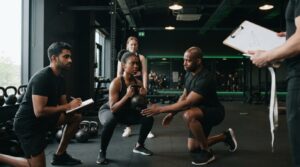
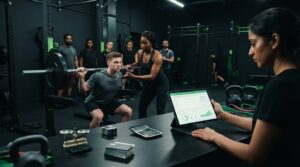
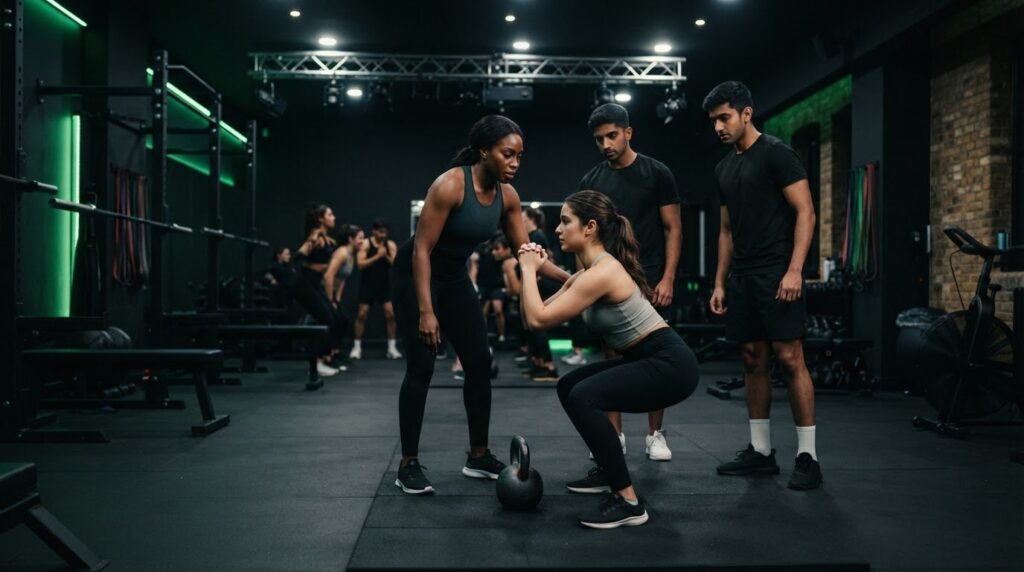
Turning up isn’t the same as learning to coach. A practical workshop should give you supervised time to apply course concepts, practise skills and receive feedback. It should involve more than watching a tutor demonstrate. That active participation is what makes a personal trainer course with practical workshops worth examining closely.
Personal training calls for more than knowledge of exercise theory. A useful workshop lets you rehearse how to demonstrate a movement, explain it clearly, observe what someone is doing and decide how to respond. Practising those decisions, hearing feedback and considering what you’d change next time can help you develop coaching judgement. For a neutral overview of the profession and its responsibilities, see Personal trainer.
What happens during a personal training workshop?
Activities vary by course, but may include tutor demonstrations, paired practice and coaching scenarios. You might take turns explaining an exercise, demonstrating it and observing a partner before offering an appropriate cue. A tutor’s feedback can help you identify when an instruction is unclear or a demonstration needs adjusting.
That feedback matters. If your first explanation doesn’t land, you can practise explaining the same movement in different words rather than assuming everyone learns in the same way. Before enrolling, check the course syllabus. Ask what activities are included, how much time is spent practising and how tutors provide feedback. Don’t rely on the word “workshop” alone.
Which practical skills should learners build?
Look for opportunities to practise demonstrating exercises, observing technique and choosing clear, relevant coaching cues. The aim isn’t to recite a script. It’s to notice what’s happening, communicate a useful next step and check whether your explanation has helped.
Good practice also involves adapting how you communicate. One person may respond to a concise verbal cue; another may need a slower explanation or a demonstration. Rehearsing different approaches can help you respond thoughtfully instead of simply repeating an instruction louder or faster.
Workshops can also give you a setting to practise professional decision-making: pay attention, communicate respectfully and ask a tutor for guidance when you’re unsure how to respond. Attendance alone, however, doesn’t prove competence. A workshop complements study; it doesn’t automatically prepare you to coach independently. Check how practical skills are assessed and what evidence you’ll need to provide. Strong learning connects knowledge with practice, feedback and reflection, so you understand not just what to do, but why.
How practical workshops turn personal training theory into coaching practice
Theory gives you a framework. Practice tests whether you can use it. A well-structured workshop connects the two through a clear learning cycle: learn a concept, watch it demonstrated, practise it, receive feedback, then reflect and try again. That sequence makes a personal trainer course with practical workshops more than a collection of study materials. It gives you a chance to work through coaching decisions with guidance before applying them independently.
For example, after learning a movement principle online, you might watch a tutor demonstrate an exercise, then practise explaining and demonstrating it yourself. A tutor or peer can help you notice whether your instructions are clear and what you could adjust. Reflection matters too: it prompts you to consider what changed after feedback, rather than moving on as soon as the exercise is over.
Feedback turns practice from repetition into progress. Without it, you may repeat the same mistake without realising. With it, you have a specific point to work on next time.
How does tutor feedback improve practical coaching?
Useful feedback identifies a behaviour and suggests a next step. A tutor might point out that your explanation included too many instructions at once, ask you to demonstrate a movement from a clearer angle, or prompt you to observe a particular detail. General praise can encourage you, but it doesn’t tell you what to refine. A pass-or-fail result may record an outcome without showing you how to improve.
Ask how feedback is delivered, whether it covers specific practical skills and whether you’ll get another opportunity to apply it. The chance to adjust, try again and reflect helps you turn advice into a coaching habit.
Where do specialist workshops fit into a qualification?
Specialist subjects can give you further opportunities to apply learning in a particular exercise setting. Redefining Fitness lists workshop areas including kettlebells, indoor cycling, boxing and health-focused modules. This doesn’t mean every subject is included in every qualification. Check the course syllabus to confirm what’s included, how it connects to the qualification and what practical activities you’ll undertake.
Online study and face-to-face workshops can complement each other: use online learning to prepare, then use supervised practice to test how well you can explain and apply ideas. To review the provider’s course and workshop information, explore Redefining Fitness courses and workshop learning.
Practical workshops vs online-only study: which personal trainer course suits you?
Don’t choose a format by its label. Choose a course with the knowledge, practice and assessment you need, in a format you can realistically fit around your life. Online study can offer flexibility and suit independent learners; face-to-face workshops provide scheduled opportunities to practise and get direct input. Neither format is automatically better.
| What to compare | Online-only study | Course with practical workshops |
|---|---|---|
| Practical skill rehearsal | May focus on theory and preparation; check how practical skills are practised and assessed. | Can provide supervised time to rehearse coaching skills and apply feedback. |
| Flexibility | Often lets you organise study around other commitments. | Combines independent learning with sessions you’ll need to plan for and attend. |
| Tutor interaction | Depends on the support and contact the course provides. | May allow direct questions and feedback during practical activities. |
| Scheduling | Check study deadlines, tutor access and assessment arrangements. | Check workshop dates, locations, travel needs and how sessions fit your schedule. |
Use this comparison to investigate the course itself, not to assume every provider delivers the same experience. Focus on the syllabus, how practical ability is assessed and whether tutors give you useful opportunities to develop your skills. Also verify the qualification content and recognition directly with the provider or relevant awarding organisation. Delivery format alone doesn’t establish either.
Is a course with practical workshops better than an online course?
It depends on the course content, tutor input and meaningful assessment. A personal trainer course with practical workshops may suit you if you want coached rehearsal and the chance to ask questions as you practise. But delivery format is separate from qualification content and recognition. Check the exact qualification and verify any recognition claims directly rather than treating “in person” or “online” as proof of quality.
Who benefits most from face-to-face practical sessions?
Beginners may value guided rehearsal, immediate answers and the chance to practise alongside others. You may also prefer experiential or collaborative learning, though no single format suits everyone. If you’re neurodivergent, ask providers what learning support is available and how practical sessions are structured. The right choice supports your learning needs and gives you a clear route to practising and demonstrating skills.
How to assess a personal trainer course with practical workshops before enrolling
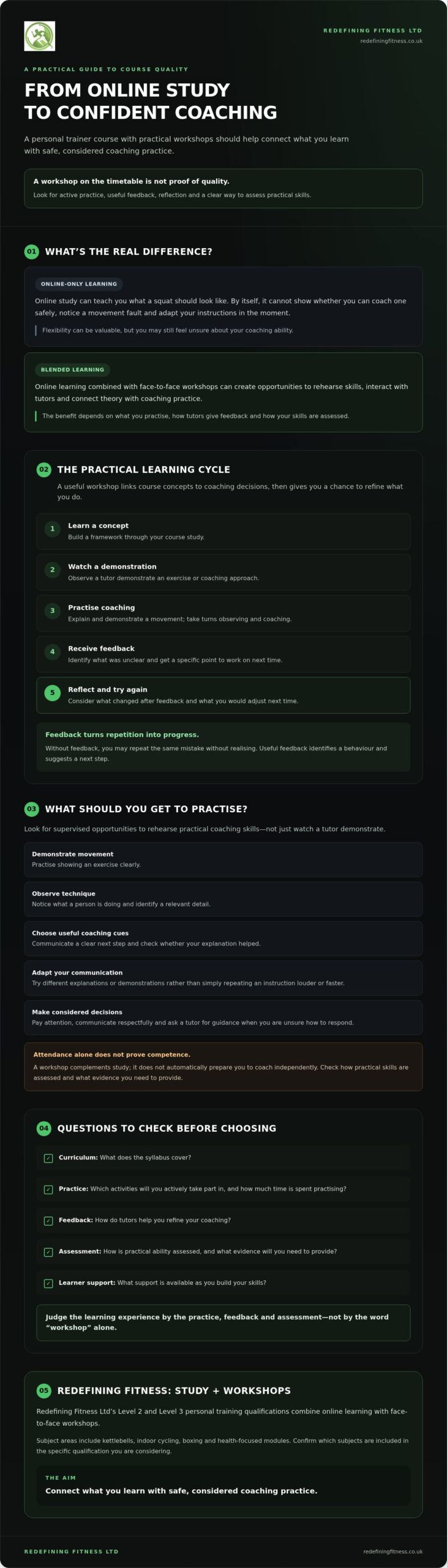
A workshop label tells you very little. Before choosing a personal trainer course with practical workshops, check whether it gives you meaningful chances to practise, receive feedback and demonstrate what you’ve learned. Ask specific questions, then compare the answers with your learning needs and practical commitments.
- Check the curriculum. Find out which coaching and exercise skills the course covers, and how workshops connect with online or classroom study.
- Ask what you’ll practise. How much practical activity is scheduled? Which skills will you rehearse, and will you take an active role rather than mainly watch demonstrations?
- Understand the feedback. Ask who leads each session, how tutors give feedback and whether you’ll have an opportunity to apply it.
- Clarify assessment. Find out how practical skills are assessed and what you’ll need to demonstrate. Don’t assume attendance alone counts as evidence of ability.
- Check support and logistics. Confirm workshop subjects, attendance requirements, schedules, locations, travel commitments and available accessibility or learner support directly with the provider.
A workshop is substantive when you practise relevant skills, receive specific feedback and can show how you’ve applied it. The label alone proves nothing.
What should you ask a course provider about workshops?
Ask who leads the sessions and what learners actually do. How much time is spent practising? What feedback will you receive, and how are practical skills assessed? Can you act on feedback and try again? Request the course-specific schedule and confirm which workshop subjects are included in your qualification. These details may vary, so get clear answers for the course you’re considering.
How can you check whether the course fits your learning needs?
Be realistic about the time you have for study, work and caring responsibilities. Check whether workshop attendance, travel and scheduled sessions are manageable, and consider whether you learn best through independent study, guided practice or a mix. If you’re neurodivergent, ask what support is available, how it works during online study and workshops, and how to access it. Redefining Fitness highlights inclusive teaching and support for neurodivergent learners, but confirm the arrangements for your course.
Its Level 2 and Level 3 personal training qualifications combine online learning with face-to-face practical workshops. To compare the course structure and workshop options, compare Redefining Fitness course and workshop options.
How Redefining Fitness combines personal trainer study with practical workshops
You can judge any course by looking for a clear link between what you study, what you practise and how your skills are assessed. Apply that standard to Redefining Fitness. Its Level 2 and Level 3 personal training qualifications combine online learning with face-to-face practical workshops, bringing independent study together with opportunities for in-person learning.
That blended structure may suit learners who want to study course content online and also value practical workshop time. The format alone can’t tell you how much practice a particular qualification includes or what its assessment involves. Before enrolling, check the current course information and ask how the online material connects to workshop activities and practical assessment.
What does Redefining Fitness offer aspiring personal trainers?
Redefining Fitness offers Level 2 and Level 3 personal training qualifications. In a personal trainer course with practical workshops, the online and face-to-face elements should complement each other: study builds your understanding, while workshops give you a setting to apply what you’ve learned. Confirm the structure for the specific qualification you’re considering, including assessment arrangements and the workshop schedule. Don’t assume the details are identical across both levels.
Ask which workshop activities form part of the course, what skills they address and whether attendance is required. Check dates, locations and any travel commitments directly with the provider. These practical details matter just as much as the course title when deciding whether the study format fits your circumstances.
What support and specialist learning can you explore?
The provider highlights inclusive teaching and support for neurodivergent learners. If this is relevant to you, ask what support is available, how to access it and how it applies to both online learning and face-to-face sessions. Clear answers help you judge whether the learning environment can meet your needs, rather than relying on a broad statement about inclusion.
Redefining Fitness also identifies workshop areas including kettlebells, indoor cycling, boxing and health-focused modules. These examples show the range of subject areas learners may encounter, not a promise that every workshop is included in every qualification. Confirm the subjects available for your chosen course and whether workshop provision varies.
Review the details, then ask direct questions before you choose. Review the Redefining Fitness course options and confirm the qualification structure, practical content, assessment and support that apply to you.
Choose training that turns knowledge into confident coaching
A workshop is valuable when you actively practise, receive useful feedback and understand how your skills are assessed. Online study can offer flexibility, but your choice should depend on the course design, the support you need and whether the practical arrangements fit your life. Check the details, not just the delivery label.
Redefining Fitness offers Level 2 and Level 3 personal training qualifications that combine online learning with face-to-face practical workshops. Its workshop areas include kettlebells, indoor cycling, boxing and health-focused modules, though subjects may vary by qualification. The provider also highlights inclusive teaching and support for neurodivergent learners. Ask which workshops are included and what support and assessment arrangements apply to your chosen course.
If you’re looking for a personal trainer course with practical workshops, take the next step by asking clear questions and setting a high standard. Explore Redefining Fitness personal training courses, review the course details and check that the learning approach suits you. Choose thoughtfully, then build the knowledge and coaching confidence to take your next step.
Frequently Asked Questions
Is a personal trainer course with practical workshops better than an online course?
Neither format is automatically better; the quality of the learning, tutor input and assessment matter most. Online study can suit independent learners and offer flexibility, while workshops provide opportunities to rehearse practical skills and ask questions face to face. If you’re comparing a personal trainer course with practical workshops against online-only study, check how each option teaches and assesses practical ability, not just how the course is delivered.
What do you do in a personal training practical workshop?
You may watch exercise demonstrations, practise coaching with a partner, work through coaching scenarios and receive tutor feedback. Activities can help you rehearse giving clear instructions, demonstrating an exercise and observing how someone performs it. The actual content depends on the course, so check its syllabus rather than relying on the word “workshop”. Ask which skills you’ll practise, how actively learners take part and whether you can use feedback to try again.
Can you become a personal trainer by studying online?
Online learning can be part of personal trainer training, but don’t assume completing online lessons alone demonstrates practical coaching ability. Requirements and assessment arrangements depend on the qualification and provider. Check how you’ll practise and demonstrate relevant skills, whether practical sessions are face to face or delivered another way, and what assessment is required. Confirm the qualification’s recognition directly with the provider before enrolling, especially if you need it for a particular career path.
How much practical training should a personal trainer course include?
There isn’t a single amount that suits every course, so look beyond the total number of workshop hours. Ask what practical activities are scheduled, which skills they cover and whether you’ll have time to practise, receive specific feedback and apply it. Check how practical ability is assessed, too. A shorter session with active coaching and useful feedback may offer more learning than a longer workshop where you mainly observe.
Are practical workshops included in Level 2 and Level 3 personal training courses?
Redefining Fitness describes its Level 2 and Level 3 personal training qualifications as combining online learning with face-to-face practical workshops. However, don’t assume every workshop subject is included in both qualifications. Areas offered by the provider include kettlebells, indoor cycling, boxing and health-focused modules. Ask which sessions apply to your chosen course, and confirm current schedules, attendance arrangements and assessment details with the provider.
What should I ask before booking a personal trainer course with workshops?
Ask what you’ll practise, how much practical activity is scheduled, who leads the sessions and how tutors give feedback. Find out how practical skills are assessed and whether you can act on feedback. Confirm which workshops your course includes, along with dates, locations, attendance requirements and any travel commitments. If you need learning support or accessibility arrangements, ask what’s available and how to access it before you commit.
Do practical workshops make a personal trainer qualification recognised?
No. Workshops can support practical learning, but their presence alone doesn’t establish whether a qualification is recognised. Check the exact qualification title, who awards it and what recognition applies to your intended career or next step. Ask the provider to confirm any awarding body or professional recognition claims, and verify them with the relevant organisation where appropriate. Keep qualification recognition separate from course format: online, blended or face-to-face delivery doesn’t prove recognition by itself.