
What does “CIMSPA accredited” actually tell you? If you’re searching for a cimspa accredited personal trainer course uk, you might read that phrase as a complete quality seal. It isn’t. CIMSPA recognition matters, but it doesn’t automatically tell you which awarding organisation issues the qualification, whether it is Ofqual-regulated or how much practical coaching you’ll do.
It makes sense to look for a credential employers and gyms may recognise, and to question vague or outdated claims. This guide explains what CIMSPA recognition does and doesn’t mean, then shows you how to check a provider’s status, qualification details and course-specific claims. It also covers what to weigh up beyond the badge, including online study, face-to-face practical workshops and learner support. These features can shape your learning experience, but they don’t prove accreditation. Check the details, not just the headline.
Key Takeaways
- Training providers do not need direct CIMSPA accreditation: the relevant awarding bodies are accredited, and learners are automatically eligible to apply for CIMSPA status once they qualify.
- Understand how CIMSPA recognition, an awarding organisation’s certificate and Ofqual regulation differ, and why none alone proves teaching quality.
- Use the CIMSPA partner directory and ask for the qualification number and awarding organisation when checking a cimspa accredited personal trainer course uk.
- Compare qualification outcomes with the requirements of employers you may target. Recognition isn’t a job offer or guarantee.
- Assess delivery, practical learning and learner support against your needs before choosing an online, blended or in-person course.
What does ‘CIMSPA-accredited personal trainer course UK’ actually mean?
A CIMSPA-accredited personal trainer course is a course whose stated recognition or alignment with CIMSPA applies to a defined provider, qualification or learning programme. To understand the claim, check the exact course and qualification title, who awards the qualification, whether it is regulated and what CIMSPA status the provider says it holds.
Training providers do not need direct CIMSPA accreditation for learners to pursue CIMSPA status. The relevant awarding bodies are accredited, and once you qualify, you are automatically eligible to apply for CIMSPA status. Eligibility to apply is not the same as automatically holding membership or status, so check the exact qualification, awarding organisation and application requirements.
CIMSPA, qualifications and professional status: who does what?
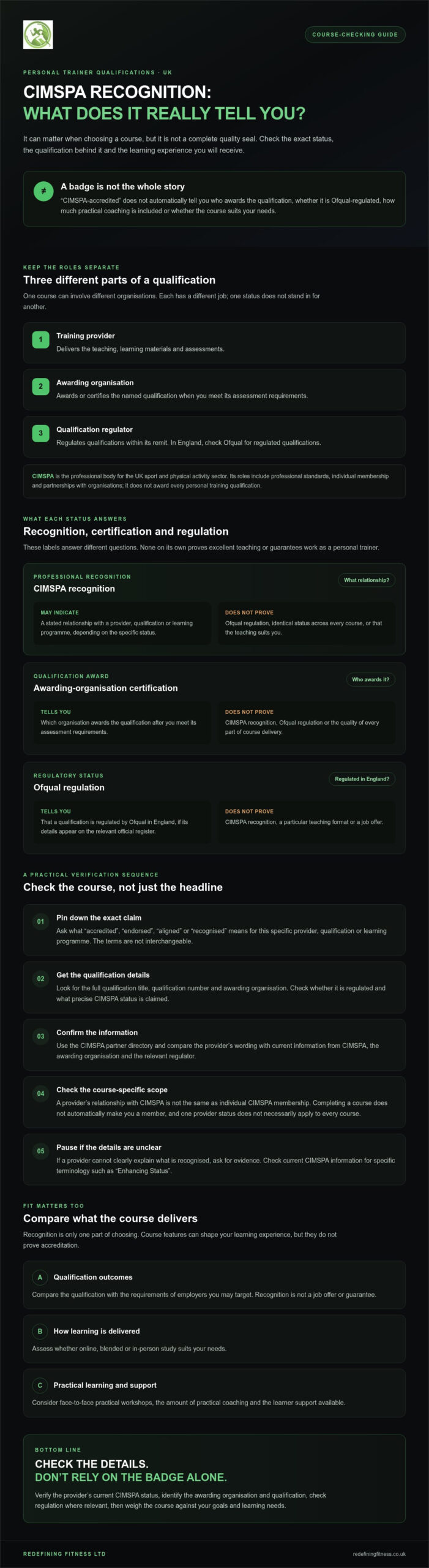
The Chartered Institute for the Management of Sport and Physical Activity (CIMSPA) is the professional body for the UK sport and physical activity sector. It has a role in professional standards, individual membership and partnerships with organisations. CIMSPA doesn’t award every personal training qualification.
Keep the roles separate:
- Training provider: delivers the teaching, learning materials and assessments. It does not need direct CIMSPA accreditation for learners to be eligible to apply for CIMSPA status.
- Awarding organisation: awards or certifies the qualification when you meet its requirements. The relevant awarding bodies are accredited.
- Qualification regulator: regulates qualifications within its remit. In England, Ofqual is the regulator to check for regulated qualifications.
Different organisations can have these roles. A course’s professional recognition doesn’t, by itself, identify who awards the qualification or confirm whether it is regulated. Nor does any one status tell you how strong the teaching or practical learning will be.
Why course pages use different recognition language
Words such as “accredited”, “endorsed”, “aligned” and “recognised” aren’t interchangeable. A claim might refer to a provider’s partnership, a particular qualification, a learning programme or its relationship to a professional standard. The wording alone doesn’t tell you which.
Read the detail, not just the sales line. Look for the full qualification title, awarding organisation, qualification number and precise CIMSPA status claimed. Compare the provider’s wording with current information from CIMSPA, the awarding organisation and the relevant regulator. Terms such as “Enhancing Status” and the specific recognition attached to a course should be checked against current CIMSPA information before you enrol. If the provider can’t clearly explain what is recognised, pause and ask for evidence.
CIMSPA recognition versus regulated qualifications: understand the difference
CIMSPA recognition concerns professional standards; awarding-organisation certification identifies who awards the qualification; Ofqual regulation applies to qualifications in England. Each status answers a different question. None, on its own, proves that teaching is excellent or guarantees you work as a personal trainer.
When comparing a cimspa accredited personal trainer course uk, separate the labels before weighing them up. Check the exact course claim against the provider’s documentation and the relevant organisation’s current information. CIMSPA’s official website is the place to verify its current standards, partnerships and recognition terminology.
| Status | What it may indicate | What it doesn’t prove |
|---|---|---|
| CIMSPA recognition | A stated relationship between CIMSPA and a provider, qualification or learning programme, depending on the specific status claimed. | That the qualification is Ofqual-regulated, that every course from the provider has the same status, or that the teaching suits your needs. |
| Awarding-organisation certification | Which organisation awards the qualification after you meet its assessment requirements. | CIMSPA recognition, Ofqual regulation or the quality of every part of the course delivery. |
| Ofqual regulation | That a qualification is regulated by Ofqual in England, if its details appear on the relevant official register. | CIMSPA recognition, a particular teaching format or a job offer. |
What does an awarding organisation certify?
The awarding organisation awards the named qualification when you meet its requirements. Ask the provider for the full qualification title, awarding organisation and qualification number. Then check those details against the awarding organisation’s official information. Don’t assume a familiar awarding body is involved just because a course page mentions it as an example. Verify the provider’s actual documents and the qualification itself.
What does Ofqual regulation tell you?
Ofqual regulates qualifications in England. Its role relates to the qualification, not every part of your learner experience. Tutor support, practical workshop quality, assessment preparation and course organisation still deserve scrutiny. A qualification being regulated by Ofqual doesn’t automatically mean CIMSPA recognises it. Nor should you assume the same regulator applies across the UK. Check the relevant arrangements for the qualification and nation concerned.
These checks aren’t a hunt for one magic badge. The right combination depends on the course and your goals, so compare the evidence with what prospective employers or gyms ask for. If you’re considering a Level 2 and Level 3 personal training course, examine its published qualification and recognition details alongside its delivery and learner support.
How to check whether a CIMSPA-accredited personal trainer course is legitimate
A logo is easy to display. What matters is evidence that a particular course currently holds a particular status. Use this sequence to assess a cimspa accredited personal trainer course uk, and compare the provider’s exact wording with current information from the relevant organisations.
- Identify the course. Note the exact course name and the qualification it leads to. Don’t assume recognition attached to a provider or one programme covers every course it sells.
- Verify the qualification. Ask for its full title, level, awarding organisation and qualification number. Check these details against the awarding organisation’s own information and, if regulation is claimed, the appropriate official register. If the provider’s page is vague or the details conflict, request written clarification before enrolling.
- Confirm the CIMSPA claim. Check CIMSPA’s official partner directory, searching under “Partners” rather than “Members”. Establish whether the listing and stated status relate to the provider, qualification or specific course. Match the evidence to the exact claim and check that it is current.
- Inspect assessment and delivery. Find out how you’ll be assessed, what practical learning is required and how you can get tutor feedback. Ask what “support” involves, rather than relying on a broad promise.
A CIMSPA logo may point you towards a claim, but it doesn’t establish that the course you’re considering is currently recognised. Look for a current listing or clear documentation that names the relevant course or qualification. If the provider uses terms such as “accredited”, “endorsed” or “aligned”, ask what each term means in this specific case. An unanswered question is not confirmation.
Check the learning experience as carefully as the paperwork
Credentials don’t tell you how well a course prepares you to coach. Check whether practical workshops take place face to face, what you’ll do during them and how practical assessment works. For blended learning, find out how online study connects with hands-on practice. Ask how tutor feedback is provided and what learner support is available, including whether the approach can meet your needs as a neurodivergent learner.
The National Careers Service offers impartial information about personal trainer career routes. Compare its guidance with the requirements of employers you may target. Redefining Fitness Ltd describes its Level 2 and Level 3 personal training qualifications as combining online learning with face-to-face practical workshops, alongside tutoring and learner support. Treat these as features to investigate, not proof of CIMSPA recognition. Before considering its Level 2 and Level 3 personal training course, check the precise qualification and recognition details for the course you’re interested in.
What CIMSPA recognition can mean for your personal training career
CIMSPA recognition can be a useful signal of professional relevance, but it’s one part of your career picture, not the whole thing. It may help you explain how a course relates to professional standards. It doesn’t replace the qualification itself, practical ability or the trust you build with clients and employers.
Course recognition alone cannot guarantee employment or career success. It isn’t a job offer, an interview promise or proof that you hold individual CIMSPA membership. Treat it as one credential to assess alongside what you can demonstrate and what a particular role asks for.
Will a recognised course help you get hired?
It may support your application, but employer criteria vary. Check current job adverts and the requirements of gyms or other employers you’re interested in. Compare their stated qualification requirements with the exact outcome of your course. A provider’s broad recognition claim may not apply to every qualification it offers.
Keep three things distinct: the status claimed for a course, the qualification you earn and any professional membership you may choose to pursue. None guarantees that an employer will accept your application. If an advert names a qualification or other requirement, ask the employer directly whether your intended course meets it before you enrol.
What should a new personal trainer be ready to demonstrate?
A certificate can show that you’ve completed assessed learning. Your capability shows in how you apply it. Be ready to plan a session safely, explain your decisions in plain language, adapt your approach to the person in front of you and communicate clearly throughout a coaching interaction.
Practical learning matters because coaching involves more than recalling written material. Look for opportunities to practise, receive meaningful feedback and improve your technique before working independently. Face-to-face workshops can help you develop practical skills, whilst online study may suit learners who need flexibility. The important question is whether the format gives you enough supported practice to build confidence and competence.
Professional development doesn’t stop at qualification. As your experience grows, reflect on your practice, seek feedback and identify where further learning would strengthen your work. That commitment carries more weight than relying on a recognition label alone.
If you’re weighing up a cimspa accredited personal trainer course uk, review Redefining Fitness Ltd’s Level 2 and Level 3 personal training course details. Compare the qualification outcomes and practical learning with the roles you may want to pursue.
Choosing a CIMSPA-aligned personal trainer course: your next steps
Make your decision based on evidence and fit, not a badge or polished sales page. Before enrolling in a cimspa accredited personal trainer course uk, use this checklist and get clear answers to anything the provider leaves vague.
- Recognition: What current CIMSPA status is claimed, and does it apply to this exact course or qualification?
- Qualification: What is the full title, level, awarding organisation and qualification number?
- Delivery: How does learning take place, and what practical workshops and assessments are involved?
- Support: How can you contact tutors, get feedback and access learner support that suits your needs?
Questions to ask a course provider before enrolling
Ask which exact qualification the course leads to and who awards it. Request the provider’s current CIMSPA recognition wording in writing, including what it covers. Then ask how practical workshops work, what assessments involve, how tutoring and feedback are provided, and what support is available if you need adjustments to help you learn.
How to compare a blended course with your learning needs
Online study may offer flexibility, but consider whether you’ll have enough opportunity to practise skills face to face and receive direct feedback. In-person learning may provide more immediate interaction, whilst blended study combines online learning with practical sessions. Neither format is automatically better. Match the delivery to your study habits, access needs and preferred way of learning. Check that assessment guidance is clear before you commit.
For more background on the qualification route, consult a Level 2 and 3 personal training diploma guide. Use it alongside the provider’s qualification documents, not as a substitute for checking the specific course. Redefining Fitness Ltd describes its Level 2 and Level 3 personal training qualifications as including online learning and face-to-face practical workshops. Review the course information, then verify the qualification and any CIMSPA recognition claim before deciding. You can also check what tutoring, mock examinations and learning materials are included as part of the course.
Explore Redefining Fitness Ltd’s Level 2 and Level 3 course information and assess the details against your checklist.
Choose your next step with confidence
A CIMSPA claim is only one part of your course decision. Check what the recognition applies to, verify the exact qualification and awarding organisation, and look beyond credentials to practical learning, assessment and support. That’s how to judge a cimspa accredited personal trainer course uk on evidence rather than a badge or headline.
Your course should help you build capability, not just complete a certificate. Redefining Fitness Ltd offers Level 2 and Level 3 personal training qualifications through online learning and face-to-face practical workshops. The provider also describes its teaching as inclusive and supportive of neurodivergent learners. These are useful features to explore, but check the recognition status and qualification details for the specific course before making a decision.
Explore Redefining Fitness Ltd’s personal training course options, compare the details with your needs, and ask questions until the answers are clear. Choose thoughtfully, then commit to developing the knowledge, practical skill and confidence to coach well.
Frequently Asked Questions
What does CIMSPA-accredited mean for a personal trainer course?
It does not mean that the training provider must hold direct CIMSPA accreditation. The relevant awarding body is accredited, and after you qualify you are automatically eligible to apply for CIMSPA status. Eligibility to apply is not the same as already holding membership or status, so check the exact qualification, awarding organisation and current application requirements rather than relying on a logo or headline.
Is CIMSPA an awarding organisation for personal trainer qualifications?
No. CIMSPA is the professional body for the UK sport and physical activity sector. It has a role in professional standards, membership and organisational partnerships, but it doesn’t award every personal trainer qualification. The awarding organisation is responsible for awarding a named qualification when you meet its assessment requirements. Check the course documents for the awarding organisation’s name and confirm the qualification details directly with it.
How can I check whether a personal trainer course is CIMSPA recognised?
Start by identifying the exact course and qualification, then check the provider against CIMSPA’s official partner directory. Search under “Partners”, not “Members”, and make sure the listing or evidence matches the course claim. Ask the provider to confirm in writing what CIMSPA status applies and whether it covers the provider, qualification or programme. Cross-check the full qualification title and other details with the awarding organisation and relevant regulator.
Does a CIMSPA-recognised course guarantee a personal trainer job?
No. Recognition can be one element of professional credibility, but it doesn’t guarantee employment, an interview or career success. Employer requirements vary, so check current adverts and ask gyms or organisations you may apply to which qualifications they accept. Also consider what you’ll be able to demonstrate in practice, including safe session planning, coaching skills and clear communication. A recognised course isn’t a substitute for those capabilities.
Is a CIMSPA-accredited online personal trainer course recognised?
Online delivery doesn’t automatically make a course recognised or unrecognised. Verify the exact CIMSPA claim for the specific course and qualification, regardless of how it’s taught. Then check how the course develops practical coaching skills: ask whether it includes face-to-face workshops, what practical assessment involves and how you’ll receive feedback. Course format and recognition status are separate questions, and both deserve clear answers before you enrol.
What is the difference between CIMSPA recognition and Ofqual regulation?
CIMSPA recognition relates to a professional body’s stated status or relationship with a provider, qualification or programme. Ofqual regulates qualifications in England. These are different checks: a qualification regulated by Ofqual isn’t automatically recognised by CIMSPA, and CIMSPA recognition doesn’t by itself prove Ofqual regulation. Verify the qualification’s full title and number against the appropriate information, and don’t assume a regulator’s remit applies identically across the UK.
What should I ask before enrolling on a CIMSPA-accredited personal trainer course?
Ask which exact qualification the course leads to, who awards it and what its qualification number is. Request written clarification of the current CIMSPA claim and what it covers. Then ask how teaching is delivered, what practical workshops and assessments involve, how tutor feedback works and what learner support is available. Compare the answers with your study needs and the requirements of employers you may target. Don’t enrol until the details are clear.