

Why Online Personal Trainers Fail & How to Succeed Online coaching isn’t the problem. Building a career around workout templates, limited practical experience and the hope that clients will simply appear is. The answer to why many online personal trainers fail is often less about exercise knowledge and more about turning it into trusted coaching, consistent client relationships and a sustainable business.
Online personal training can work well for people who feel confident exercising independently and mainly need a programme. But a screen doesn’t replace sound judgement, clear communication or the ability to adapt your coaching as a client’s needs change. Treating it as if it does is where standards slip.
This article explains why online personal trainers struggle and what can give a career stronger foundations: practical coaching, realistic growth expectations, continued education, mentorship and a sustainable plan. No overnight-success fantasy, just the skills and decisions that help you build a coaching practice with substance, serve clients well and keep developing professionally.
Table of Contents
1. Practical coaching skills and real-client practice
Online coaching can expose weak practice quickly. A polished programme cannot replace assessment, clear communication and adjustments based on what a client actually does. Start with a specific group, such as beginners returning to exercise, rather than promising results to everyone. A clear focus helps you explain who you coach, what problem you address and what your service involves.
For UK trainers, separate competence, insurance and data protection: work within your training, choose insurance that covers your online coaching and activities, and handle client records in line with UK data-protection requirements. A regulated Level 3 Personal Trainer qualification is valid regardless of its delivery method, but that fact alone does not determine your insurance cover or how you should manage client information.
To reduce the risk of business failure, practise coaching with real people, seek feedback and refine your assessment and follow-up process. Track client progress and retention to see where your service helps and where it needs work. A qualification provides knowledge; repetition builds judgement.
Before writing a plan, assess the person in front of you. Record reliable baseline measures, ask about injury history, available equipment, mobility and recovery, then use movement screens to identify limitations. A client training at home with resistance bands, for example, needs a different progression from someone with gym equipment. Reassess using the same measures to judge progress, rather than guessing from appearance or enthusiasm.
Don’t accept every enquiry. A client who expects rehabilitation beyond your competence, refuses to share relevant information or needs close form correction may not suit remote coaching. Explain the limits of your service honestly and agree on an approach that fits their needs. Online training can suit someone confident in the gym who mainly wants programming; it is a poor fit when remote feedback cannot address their practical needs.
Market the solution, not a list of exercises. Name the intended client, their challenge and your coaching process. “Strength training for beginners with limited home equipment” gives a clearer picture than “personal training for everyone”. In every conversation, respond promptly, listen carefully, explain the next step and follow through. Professionalism is not a logo; it is consistent behaviour.
Make progress visible. Agree on a relevant goal, record attendance and training performance, and review the plan when recovery or circumstances change. Ask for feedback during check-ins, not only when a client is considering leaving. Generic programmes are easy to confuse with a basic app; attentive assessment and thoughtful adjustments make your coaching more useful and specific, and can help retain the right clients.
2. Setting realistic expectations for business growth
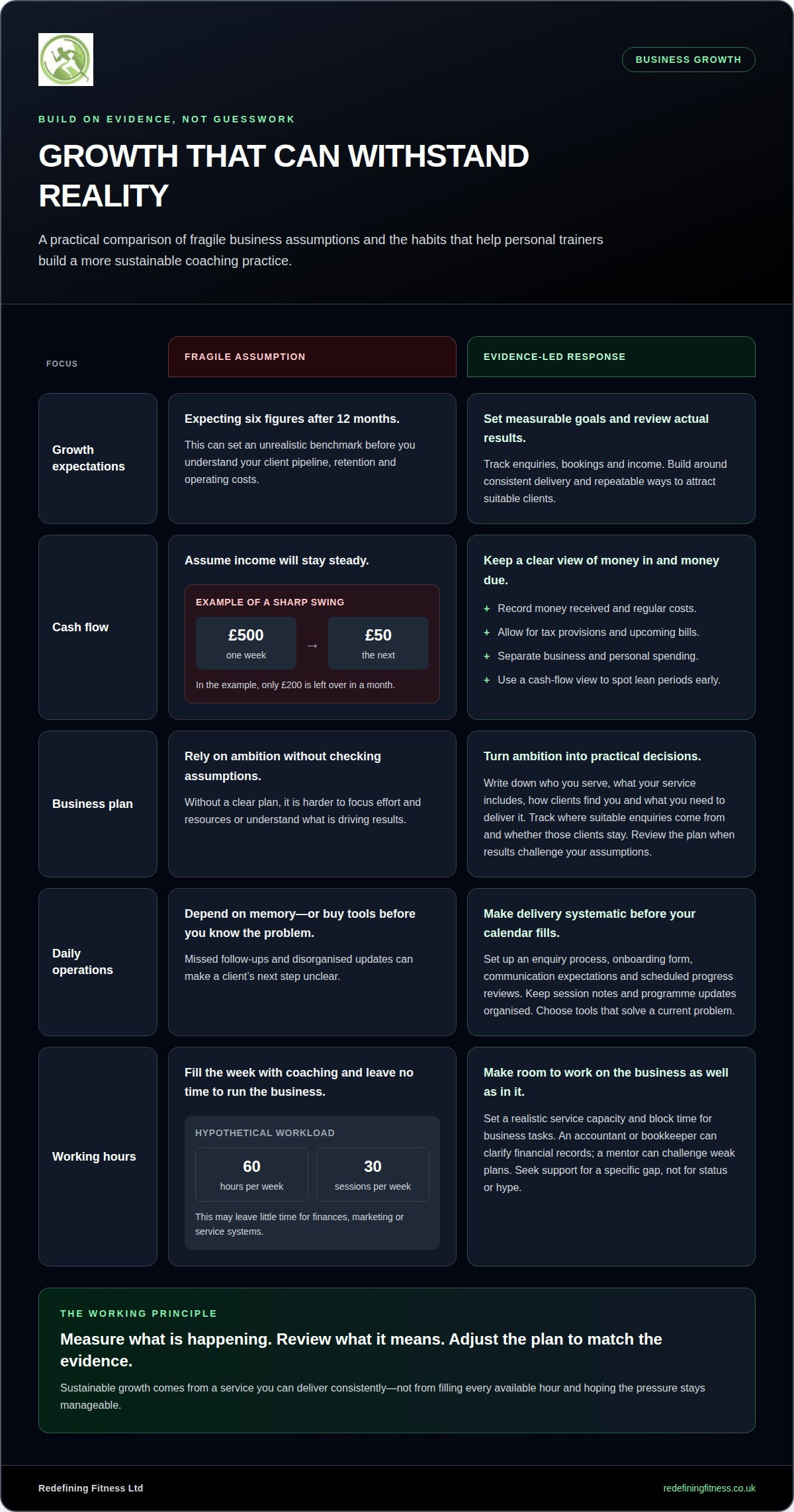
Build a business around evidence, not launch-day fantasies. Expecting six figures after 12 months after starting the business sets an unrealistic benchmark, especially before you understand your client pipeline, retention and operating costs. Growth depends on consistent delivery and repeatable ways to attract suitable clients. Set goals you can measure, then review them against actual enquiries, bookings and income.
Cash flow can swing sharply, even when your coaching is strong. One example gives £500 one week and £50 the next, with only £200 left over in a month. Treat those figures as a warning about fluctuating income, not a forecast. Record money received, regular costs, tax provisions and upcoming bills. Separate business and personal spending, then use a cash-flow view to spot lean periods before they become urgent.
A business plan turns ambition into decisions. According to the UK Government, it explains an organisation’s mission, objectives and strategies, helping focus effort and resources. Write down who you serve, what your service includes, how clients find you and what you need to deliver it. If referrals bring suitable enquiries, for example, track where they come from and whether those clients stay. Review your plan when real results challenge your assumptions.
Make delivery systematic before your calendar fills. Set up a clear enquiry process, an onboarding form, agreed communication expectations and scheduled progress reviews. Keep session notes and programme updates organised so a client’s next step doesn’t depend on memory. A calendar, secure record-keeping system and simple income tracker can reduce missed follow-ups. Choose tools that solve a current problem; buying software before you understand your workflow is not an investment in growth.
Think like an owner, not only a coach. A hypothetical trainer working 60 hours per week and delivering 30 sessions per week may leave little time to review finances, improve marketing or strengthen service systems. Block time to work on the business as well as in it. An accountant or bookkeeper can help clarify financial records, while a mentor can challenge weak plans. Invest in support that addresses a specific gap, not status or hype.
Knowledge earns its keep when you apply it to sound decisions. Set a realistic service capacity, monitor enquiries and client retention, and adjust your plan when the numbers reveal a problem. Sustainable growth comes from a service you can deliver consistently, not from filling every available hour and hoping the pressure stays manageable.
3. Continuing education and certifications
A certificate starts your professional development; it doesn’t finish it. Thousands of people pursue personal trainer certification every year, so a qualification alone won’t distinguish your coaching. Build on your foundation with focused study, practical reflection and learning that addresses real client needs. If a client asks about training around a health condition, recognise the limits of your knowledge and develop your understanding before shaping your advice.
Online study can teach theory-based subjects effectively, including anatomy, physiology, training principles and nutrition fundamentals. Use that knowledge to explain why a programme suits a client, rather than handing over generic sessions without context. Understanding what RPE is in training and how to use it effectively, for example, helps you adjust effort to a client’s readiness instead of relying only on fixed weights or repetitions. Theory matters, but it must lead to better decisions in practice.
Course length alone tells you little about learning quality. Some online personal trainer certification programmes promise certification in as little as four weeks; other comprehensive diplomas span several months. Neither timeline proves that a learner can coach confidently. Examine what the course teaches, how assessments test understanding, and whether learning includes opportunities to apply concepts. A rapid certificate cannot replace deliberate practice and useful feedback.
In the UK, a regulated Level 3 Personal Trainer qualification is valid regardless of its delivery method. Employers and clients may still recognise qualifications differently, so consider recognition alongside course content and assessment. CIMSPA-aligned qualifications awarded by Active IQ or YMCA Awards are widely recognised in the UK and internationally. Treat those names as useful context, not a substitute for checking how a course develops your actual coaching capability.
Keep learning specific. If your clients struggle with exercise consistency, study behaviour change and practise setting realistic actions. If your programming lacks variety, revisit training principles and consider how different movements can serve the same goal. After each learning activity, write down one change you’ll apply, one client situation it could help and one question that remains. This turns education into consistent improvement, not another certificate collecting dust.
Choose continuing education by identifying a gap first. Compare it with the course syllabus, assessment approach and support available during study. A module on anatomy may strengthen your explanations; a practical workshop may sharpen your exercise coaching. Build a learning plan that matches your clients and intended area of work. Your credibility grows when education improves the decisions clients experience, not when your profile merely lists more credentials.
4. Practical experience and mentorship
Passing a personal trainer course assessment doesn’t automatically prepare you for a gym floor. Assessment shows you can meet a defined standard; live coaching tests how you respond when plans meet real people. A client might misunderstand an instruction, lose confidence or struggle with an exercise. You need to notice, explain, adapt and learn from the moment. Theory matters, but practical judgement grows through repeated coaching and honest feedback.
Plan hands-on experience before your first independent coaching role. Practise explaining exercises, observing movement and adapting instructions with appropriate supervision. After each session, record what worked, what confused the client and what you’ll change next time. For example, if someone can’t follow a written cue, demonstrate the movement or use simpler language. These small challenges reveal gaps that a workbook cannot expose.
Mentorship gives those experiences direction. Choose a mentor whose coaching standards and professional conduct you respect, rather than copying whoever appears busiest. Ask them to observe a session, then request feedback on one skill, such as cueing or session structure. A focused conversation about a specific moment is more useful than vague praise. Apply the advice, then review the same skill in your next session.
Choose role models with care. A colleague’s popularity or social following doesn’t prove their methods suit your clients or goals. Look for someone who explains decisions, treats clients respectfully and keeps developing their practice. Notice how an experienced coach handles a client who arrives tired: do they adapt thoughtfully or push through the original plan? Study the reasoning, not just the visible routine.
Real-world experience also teaches you how the work feels across a normal week. One trainer worked at a gym for nine months before moving on; another account describes completing more than 10,000 one-to-one sessions to date. These examples show different stages of practice, not a required timetable or target. Your own progress depends on repeated opportunities to coach, reflect and handle unfamiliar situations responsibly.
Build a simple learning loop: coach, reflect, seek feedback, then practise again. Keep notes on recurring challenges, such as unclear explanations or missed opportunities to adapt. Take those patterns to a mentor instead of waiting until you feel overwhelmed. If you struggle to explain a movement, rehearse two clear cues and test them in your next supervised session. Competence comes from deliberate repetition, not pretending every answer comes easily.
5. Sustainable career development
A sustainable fitness career needs more than a full diary. One fitness-industry author believed 80% of personal trainers leave within their first two years. Treat that figure as a warning about work pressures, not a personal forecast. Client numbers can rise and fall, so build routines that support your energy, finances and professional development. For guidance on self-employment, use GOV.UK’s self-employment guidance and Acas workplace resources.
Plan for uneven demand. Trainers may move between a packed schedule and periods spent finding clients. Keep professional relationships active during busy spells, rather than rebuilding your network only when bookings dip. A former client might refer someone with similar goals; a trusted colleague might share a suitable opportunity. Follow up thoughtfully and make your work easy to describe. CIMSPA and the National Careers Service offer relevant professional and career information.
Use evidence to guide your next move. Track enquiries, conversion, referrals and client retention, then review the pattern regularly. If enquiries arrive but few people book, revisit how you explain your service. If clients leave early, examine their experience and communication. For business planning, UK Government guidance explains how a plan can help identify problems, set goals and measure progress. Keep financial records using HMRC’s self-employed expenses guidance and its record-keeping guidance.
Protect time for learning, even when paid work competes for attention. One author recommends spending at least 30 minutes each day on personal development, ideally 60 minutes. Use that time deliberately: review a client challenge, study a relevant topic or practise a coaching skill. A written learning log can connect each activity to a change in your work. For guidance on workplace wellbeing, explore Health and Safety Executive stress advice and Mind’s workplace resources.
Broaden income carefully, within your expertise. A trainer might combine individual coaching with group sessions or a relevant specialist service, rather than relying on one format. Each addition needs a clear audience and a delivery process you can sustain. Don’t add offers simply because another trainer promotes them. For practical business support, see the Federation of Small Businesses and the Information Commissioner’s Office SME hub.
Make the reality of self-employment part of your plan. Set working boundaries, reserve time for administration and schedule periods for rest. Review your goals and business measures together, then adjust when the evidence changes. Sustainable success comes from adapting without abandoning your standards. If you’re ready to build your foundation in fitness, explore personal trainer career training and ask yourself: are you the fitness industry’s next best secret?
Redefining Fitness: Level 2 & 3 Personal Training Course
Redefining Fitness Ltd offers a Level 2 & 3 Personal Training Course for people building the knowledge and practical foundations for a fitness career. Delivered online and in person, the courses combine blended learning with face-to-face workshops, helping you connect study with coaching practice. If you’re serious about developing beyond generic programmes, structured education can strengthen your understanding and prepare you to keep learning through real-world experience. Further specialist study includes kettlebells, circuits and indoor cycling, giving you ways to broaden your fitness knowledge. Inclusive teaching also supports neurodivergent learners. A qualification is a starting point, not a substitute for practice, reflection or professional development. Ready to take your next step? Contact Redefining Fitness Ltd to discuss your training.
Build the Career You Want to Stand Behind
Understanding why many online personal trainers fail matters only if it changes what you do next. Don’t wait until confidence arrives fully formed or every part of your business feels certain. Choose a practical step: seek feedback on your coaching, strengthen a skill or define the clients you’re equipped to serve. Then act on what you learn.
Professional standards aren’t a finish line. They’re the choices you make repeatedly, especially when growth feels slower than you hoped. Build a career that respects your clients, your limits and your ambition. That’s how you become more than another name in a crowded feed.
Are you the fitness industry’s next best secret? Take the next step and contact Redefining Fitness to discuss your goals. Keep learning, keep sharpening your craft, and give your ambition something solid to stand on.
Frequently Asked Questions
Final Thoughts: Is Online Personal Training Worth It?
Online personal training can suit clients who feel confident exercising independently and need structured programming. It may be less suitable for someone who needs frequent hands-on guidance or close movement correction. For trainers, the opportunity depends on delivering more than downloadable workouts. Consider whether you can communicate clearly, adapt support remotely and help clients stay engaged. The format works best when the coaching fits the person.
What Are the Most Common Reasons Online Personal Training Businesses Fail?
Reasons why many online personal trainers fail include difficulty attracting and retaining clients, generic programmes and the expectation that demand will grow without deliberate business development. Weak communication can erode trust before clients see meaningful progress. A client who receives a plan but no useful response to questions, for example, may disengage. A clear service, consistent follow-up and attention to client feedback help address these avoidable weaknesses.
How Do Online Personal Trainers Find Clients and Retain Them?
Make your offer easy to understand: identify who it helps and the problem it addresses. Share useful information where your intended clients spend time, then invite conversations rather than pushing an immediate sale. Retention grows through dependable communication, progress reviews and coaching shaped around each client. Ask what is getting in the way of training, for example, then agree on a practical adjustment together.
What Pricing and Revenue Models Work for Online Personal Trainers?
Common pricing structures include charging for individual sessions, offering a package of sessions or setting a recurring fee for ongoing coaching. Choose a model that matches the work delivered, the support included and the time required outside sessions. Packages can clarify commitment and help clients understand what they receive. Track income alongside time spent on programming and communication, so a busy diary doesn’t disguise an unsustainable workload.
What Skills and Qualifications Do Online Personal Trainers Need in the UK?
Online trainers need sound exercise knowledge, communication skills, assessment judgement and the ability to adapt programmes responsibly. In the UK, a regulated Level 3 Personal Trainer qualification is valid regardless of its delivery method. Employers and clients may consider whether a qualification is recognised, alongside your practical readiness. For example, explaining an exercise clearly on video requires different communication choices from demonstrating it beside a client in person.
What is the success and failure rate of personal training businesses in the UK?
Most personal trainers go out of business within their first one to two years.
How competitive is the UK online personal training market?
Thousands of people pursue personal trainer certification every year, and trainers are advised to define a specific market position rather than try to serve everyone. The material does not give a direct measure of competition in the UK online market.
How do online personal trainers compare with in-person trainers for client results and retention?
Online coaching can work well for clients confident training independently who mainly need programming, but remote feedback may not address form, injuries or changing recovery as effectively. Attentive assessment, check-ins and programme adjustments can support progress and retention; no direct comparison of results or retention rates is provided.
Are you the fitness industry’s next best secret? Explore the personal training course prospectus and take a considered next step towards your career in fitness.

Training to Failure & Muscle Growth: Complete PT Guide
Training to Failure & Muscle Growth: Complete PT Guide Training to failure isn’t a requirement for muscle growth. The real question, what…

What Is RPE in Training? How to Use It Effectively
What Is RPE in Training? How to Use It Effectively Effort isn’t a feeling to ignore; it’s information you can use. To understand what RPE is in…
