

Training to Failure & Muscle Growth: Complete PT Guide Training to failure isn’t a requirement for muscle growth. The real question, what training to failure means and whether it’s necessary for building muscle, has a clear answer: you can make progress without pushing every set until you can’t complete another repetition with proper form.
That doesn’t make effort optional. Challenging sets matter, but confusing productive training with grinding out repetitions at any cost can leave you more fatigued and less in control. Technical failure is the point where your form breaks down; muscular failure is when you can’t complete another repetition with sound technique.
Here, you’ll learn how these limits differ, what it means to stop short of failure, and how close you may need to train to support muscle growth. You’ll also see when failure training may fit, why recovery and exercise choice matter, and why the hardest possible set isn’t automatically the smartest. Train with intent, not ego.
Table of Contents
What Is Training to Failure?
Training to failure means continuing a set until you can’t complete another repetition. The key distinction is whether your form remains sound or breaks down first.
Defining Training to Failure
Training to failure is performing repetitions until you cannot complete another repetition of an exercise. This matters because effort alone doesn’t tell you whether the movement is still controlled. A set of 8 to 15 repetitions with a challenging weight can approach failure, but the count isn’t the definition. Your ability to complete the next repetition, and how you do it, sets the limit.
Muscular and Momentary Failure
Muscular failure is the point at which your muscles can no longer complete another repetition. Momentary muscular failure describes that temporary inability during a set. A failed attempt doesn’t mean you’ve permanently lost the ability to move the weight. Technical failure is different: it happens when you can continue only by losing proper form, so the set should stop there.
For example, on a push-up, technical failure might mean your hips sag or your body stops moving as one unit. If you maintain that position but cannot press your chest back up, you’ve reached muscular failure. On the RPE scale, maximum effort is described as 10/10. Don’t confuse that rating with permission to force a repetition through poor technique.
Beginners should prioritise proper form and stop before failure. Pre-failure means ending the set just before failure, guided by how your muscles and joints feel. Tempo failure occurs when you can no longer maintain the cadence of earlier repetitions. These stopping points help you end a set before control disappears.
Which exercises are safest to take to failure? For beginners, bodyweight movements such as push-ups and machine exercises are safer options because a missed repetition is less likely to leave you pinned beneath a heavy load. A heavy squat without a spotter can be dangerous. Don’t push past form failure, which can expose your joints and muscles to injury.
How often should you train to failure in a workout programme? Reserve it for the last set of the last one to three exercises in a workout, rather than taking every set to the limit. There’s little useful training to do after reaching failure, so placing it near the end helps preserve your earlier work. Let your technique, exercise choice and ability to recover guide how often you use it.
Injury, Fatigue, and Recovery Risks
Failure training has a cost: each all-out set adds fatigue that can affect later work and recovery. A 2019 review in Strength and Conditioning Journal found near-failure training may be as effective, with fewer risks. That matters when your aim is consistent progress, not one dramatic final repetition. Training to failure may also raise the potential for overtraining and overuse injuries, particularly when hard sets accumulate without enough recovery.
Technique is the boundary you don’t cross. A repetition forced through a shortened range or with a shifted body position is not a useful badge of effort. Training past form failure can cause joint and muscle injury, so end the set when control goes. If a press turns into a back arch or a squat becomes an uncontrolled drop, stop instead of forcing another repetition. A clean final repetition beats a risky failed lift.
Beginners can approach failure safely by prioritising sound technique and stopping before their form breaks down. If technique remains solid, they may occasionally reach the limit on an exercise where a missed repetition won’t create danger. Push-ups and machine exercises are practical options because they reduce the risk of being trapped beneath a failed lift. A heavy squat without a spotter is different: don’t take that lift to failure alone.
Recovery matters, too. If you’re run down, frequently ill or sleeping poorly, avoid failure training rather than treating exhaustion as proof of commitment. Before a major event, leave failure work out during the couple of days when soreness or fatigue could interfere. If you return to hard sets after a break, warm up properly first. These choices help protect the quality of the work that follows.
Keep failure work selective. Reserve it for the last set of the last one to three exercises, where reaching the limit won’t compromise the rest of your session. A rest-pause method can extend a set after initial failure, but it also adds work and fatigue; it isn’t a shortcut around recovery. If your next session suffers, use failure less often or stop further from it. Consistent training depends on performing your next session well, not merely surviving this one.
Apply the same judgement across your programme: choose a stable exercise, keep repetitions controlled and stop when your form changes. That gives beginners a clear standard and reminds experienced lifters to distinguish effort from recklessness. Near-failure work can provide a strong stimulus without requiring a failed repetition every time. Base your decision on technique, exercise risk, sleep, soreness and what your next session requires.
Repetition maximum (RM)
A repetition maximum (RM) is the heaviest weight you can lift for a specified number of repetitions. The number describes the repetition target, not a universal measure of strength. For example, your 10RM is the weight you can lift for 10 repetitions but cannot lift for an 11th. Read it precisely: a 10RM load is not simply a weight you happen to use for a set of 10.
A 1RM is the maximum weight you can fully lift at least once. It’s often used to describe maximal strength, while a 10RM gives a different view of what you can lift repeatedly. For hypertrophy, a 10RM weight is described as more useful than a 1RM. That distinction matters: a single maximal lift and a challenging set of repeated lifts are not interchangeable measures.
To determine a true RM, you must lift to failure. If you complete 10 repetitions and could still perform an 11th, that load is not your 10RM. If you can’t complete the 10th repetition, it also doesn’t meet the definition. The limit is specific: 10 completed repetitions, followed by inability to complete one more. This makes the test demanding, so don’t confuse a routine working set with a verified maximum.
RM figures can help describe a load, but they don’t tell the whole story of a session. A 10RM identifies a weight tied to 10 repetitions; it doesn’t tell you whether every set needs to reach that limit. Nor does a 1RM reveal how many controlled repetitions you can perform at a lighter load. Keep the exercise and repetition target clear when interpreting either figure.
Does training to failure work differently with light and heavy weights? Failure may matter more for muscle gains with lighter weights than with heavier loads, but that doesn’t mean every light-weight set must end in failure. What matters in practice is how close the set comes to the point where you can’t complete another repetition, while maintaining meaningful effort and controlled movement.
Imagine two sets: one uses a lighter load and ends with several possible repetitions remaining; the other uses a heavier load and comes close to its repetition limit. The weight alone doesn’t show how demanding either set was. The RM concept makes the target clearer, but reaching a true maximum requires failure and demands more than ordinary training. Use RM language for a tested limit, not to turn every set into a test.
Because finding your repetition maximum requires lifting to true failure, treat an RM as a specific test result, not a label for an ordinary set.
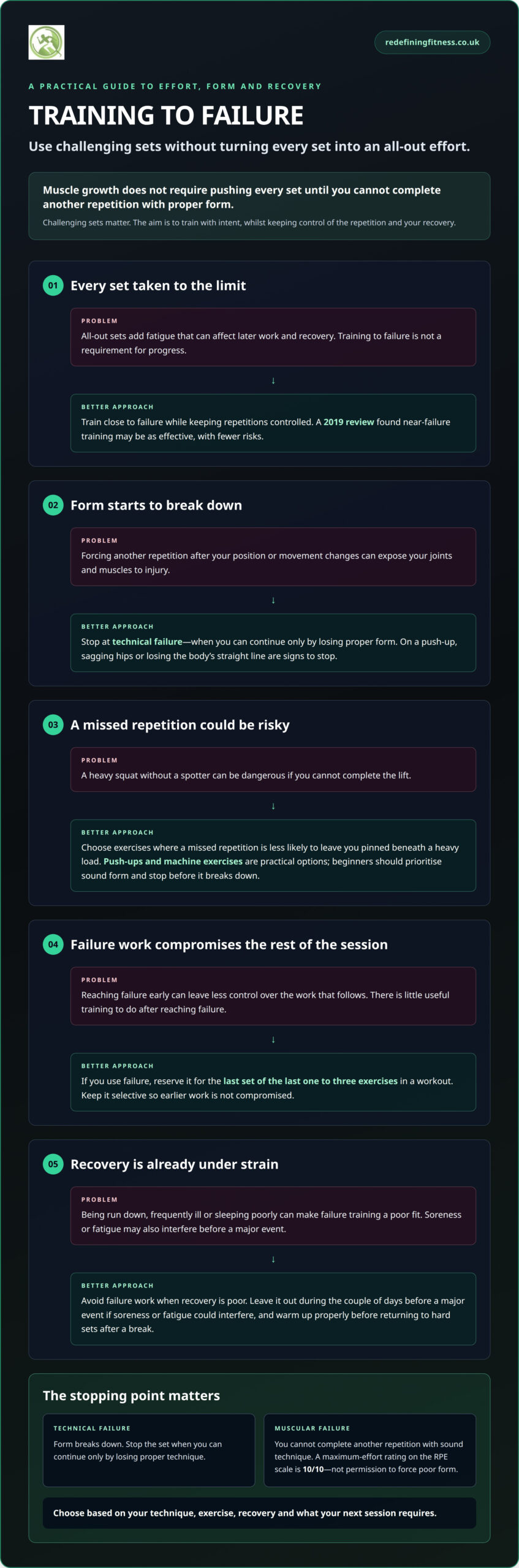
Technical failure versus muscular failure
Technical failure occurs when you can’t complete another repetition with proper form. Muscular failure is when your muscles can’t complete another repetition despite your effort to maintain that form. The distinction matters because a set can reach its safe stopping point before the muscle is completely unable to move. Calling every difficult repetition muscular failure blurs that line.
Consider a squat. If your final repetition becomes shallow or your torso position changes to force the weight up, your technique has failed. Stop there. Moving the weight by changing the movement doesn’t make that repetition a sound continuation of the set. Technical failure gives you a clear standard: the next repetition should meet the same movement quality as the previous ones.
Now compare that with a machine chest press. You lower and press the handles through the same controlled range, but eventually can’t complete the pressing phase. If you can’t finish another repetition without changing your form, your muscles have reached their limit for that set. A failed attempt isn’t an invitation to twist, bounce or shorten the movement to claim one more repetition.
Use the exercise to decide what failure means in practice. A controlled machine movement gives you a stable setting to assess whether each repetition follows its intended path. A barbell lift requires you to manage the load and your body position together. In both cases, the standard is the same: if the next repetition requires a clear change in technique, end the set.
This distinction also makes training records more useful. Instead of writing only “failure” beside a set, note whether you stopped because your form changed or because you could no longer complete the repetition. For example, record a press as ending when the final repetition stalled, or a squat as ending when your depth or torso position shifted. Those descriptions show what limited the set, rather than making effort sound like a single, simple measure.
Don’t chase muscular failure by sacrificing the movement. Respect technical failure, the point when your form begins to break down; muscular failure describes your muscles’ inability to complete another proper repetition. Keep the same range and execution from the first repetition to the last. If the final attempt requires altered form, the set is already over.
Training to failure can mean stopping when you can’t complete another repetition with proper form, a point called technical failure. This definition makes the stopping point about the quality of the repetition, not simply how demanding the set feels. You may complete a difficult repetition cleanly, while an attempted extra repetition may fall short once you can’t maintain proper form. Keeping that distinction clear gives “failure” a specific meaning in a set. It also prevents the term from suggesting every set must continue until no movement is possible. The relevant endpoint here is the inability to complete another repetition properly.
Whether training to failure is necessary for muscle growth
No. Two systematic reviews found no benefit to reaching failure for muscle hypertrophy, and a 2021 review reported no notable difference in strength or size improvements. The useful target is a demanding, controlled set, not failure for its own sake.
Failure and Muscle Growth
Training to failure isn’t necessary for muscle growth because challenging sets can stimulate growth without a failed repetition. Training to failure is not always necessary for muscle growth, as challenging sets may stimulate growth without reaching failure. A 2021 review in the Journal of Sport and Health Science also reported no notable difference in muscle strength or size improvements between failure and non-failure training.
That doesn’t make every comfortable set productive. The set still needs enough effort to challenge the working muscles. A possible muscle-growth sweet spot is 0-5 repetitions from failure, so stopping short can still mean training hard. The practical distinction is between ending a set with meaningful effort and ending it because another repetition is impossible.
Failure may matter more with lighter weights than heavier loads, but it still isn’t a compulsory finish. A lighter-load set that ends far from fatigue, for example, may offer less challenge than one taken close to its limit. Judge the set by effort and control, not by whether you reach a dramatic final repetition.
Reps in Reserve for Growth
Reps in reserve means the number of additional repetitions you believe you could complete before failure. For muscle growth, a useful target is to finish within 0-5 repetitions of failure. This gives you room to keep technique steady while bringing the set close enough to its limit.
How many reps in reserve should you leave for muscle growth? Aim to stop no more than 3-5 repetitions short of failure. A fatigue-focused set may end with two or three repetitions still possible, rather than requiring a failed attempt. Treat that estimate as a guide to effort, not a reason to sacrifice control.
Strength goals offer another reason not to chase failure on every set. A systematic review found some evidence that training without reaching failure may be superior for strength. Research comparing failure and non-failure training also found no consistent pattern linking failure work to testosterone. Neither point makes failure useless; both challenge the assumption that harder always means better.
Use failure selectively, particularly near the end of a workout, because there’s little training you can do afterwards. If you can complete two or three more controlled repetitions, the set can still support growth. Keep effort high and movement consistent, with repetitions in reserve rather than turning every set into a test.
Redefining Fitness: Level 2 & 3 Personal Training Course
Redefining Fitness Ltd offers Level 2 and Level 3 personal trainer qualifications for people ready to turn sound training principles into professional practice. The courses are delivered online and in person, combining blended learning with face-to-face workshops. If you want to coach effort responsibly, distinguish technical limits from muscular fatigue, and build your understanding beyond slogans such as “train to failure”, structured study is a practical next step.
Specialist workshops cover areas including kettlebells, circuits and indoor cycling, with inclusive teaching and support for neurodivergent learners. Choose this route if you’re developing the knowledge and practical capability to work as a personal trainer, rather than seeking a personal training session. Are you ready to build your expertise? Contact Redefining Fitness Ltd to discuss the Level 2 & 3 Personal Training Course.
Put Your Coaching Knowledge Into Practice
Good coaching means making sound decisions, adapting your approach to the person in front of you and explaining why a training choice fits. Building that judgement takes more than memorising exercise cues. It takes a commitment to keep learning and apply your knowledge with care.
Are you the fitness industry’s next best secret? Explore the prospectus and contact Redefining Fitness Ltd to take your next step towards a career in fitness.
Frequently Asked Questions
Who Is Lifting to Failure Right For?
Training to failure suits people who can maintain consistent technique and choose exercises where a missed repetition is manageable. It can help you judge how close a set is to its limit, but it isn’t a test for every session. If you’re new to resistance training, stop before your form changes and build movement control first. Once your technique is dependable, you can occasionally approach the limit on a suitable exercise.
What Does Training to Failure Mean in Resistance Training?
It means continuing a resistance exercise until you can’t complete another repetition as intended. During a shoulder press, for example, the set ends if you can no longer press the weight through its usual range without changing your posture. A repetition forced through a shortened movement isn’t equivalent to a controlled one. The aim is to recognise the set’s limit, not distort the exercise to get one more repetition.
Is Training to Failure Necessary for Muscle Growth?
No. You can build muscle without making every set end in a failed repetition. Two systematic reviews found no benefit to reaching failure for hypertrophy, and a 2021 review reported no notable difference in strength or size improvements. Focus instead on making your sets challenging and repeatable. In a London training routine, that means choosing an effort level you can recover from and sustain across your programme.
How Does Training to Failure Compare with Stopping Short of Failure for Hypertrophy?
Both approaches can support hypertrophy, and reaching failure isn’t required for a productive set. A possible muscle-growth sweet spot is within 0-5 repetitions of failure, while stopping 3-5 repetitions short is also advised. These ranges describe proximity to the limit, not a guarantee of results. For example, a controlled set that ends with a few good repetitions remaining may be more useful than a failed attempt that disrupts your next exercise.
What Are the Risks and Drawbacks of Training to Failure?
Failure training can add fatigue and increase the potential for overtraining and overuse injuries. It can also make later exercises harder to perform well. A failed heavy squat without a spotter may be dangerous, so exercise choice matters. Avoid pushing beyond sound technique, and be cautious when you’re run down or sleeping poorly. Near-failure training may offer a productive alternative with fewer risks, according to a 2019 review.

Training to Failure & Muscle Growth: Complete PT Guide
Training to Failure & Muscle Growth: Complete PT Guide Training to failure isn’t a requirement for muscle growth. The real question, what…

What Is RPE in Training? How to Use It Effectively
What Is RPE in Training? How to Use It Effectively Effort isn’t a feeling to ignore; it’s information you can use. To understand what RPE is in…
