
What Is RPE in Training? How to Use It Effectively Effort isn’t a feeling to ignore; it’s information you can use. To understand what RPE is in training and how you should use it, start with the strength-training scale: it runs from 1 to 10, with 1 representing very easy effort and 10 the hardest possible effort. Pair it with reps in reserve, and you have a practical way to judge how close a set comes to failure.
You know that the same weight can feel manageable one day and punishing the next. Forcing every session to match a fixed plan isn’t always the most disciplined choice; it can make your training less responsive. RPE lets you adjust effort to how you feel that day, rather than forcing your body to obey the plan.
Here, you’ll learn how RPE relates to reps in reserve, how to adjust weights and repetitions based on effort, and how to manage training load without turning every set into a test of willpower. We’ll also explain the different RPE scales, so you can assess your effort accurately and use it with purpose.
Table of Contents
The Borg and modified RPE scales
RPE describes how hard you feel you’re working. Unlike heart rate or power, it isn’t an objective measurement. Several RPE scales are in use, so identify which scale your programme follows before interpreting a rating.
The 1-to-10 RPE Scale
The strength-training RPE scale rates a set from 1 to 10, from very easy effort to the hardest possible effort. It matters because a number gives you a practical way to communicate how demanding a set felt, even when the weight alone doesn’t tell the whole story. On the GAA scale, 1 means very light effort and 10 means maximum exertion.
Don’t confuse a strength-training 1-to-10 scale with every scale that uses similar numbers. The modified Borg RPE scale runs from 0 to 10, with 0 representing rest and 10 maximum effort. The original Borg scale instead uses 6 to 20 points. The number only helps if you know which scale is being used.
RPE and Reps in Reserve
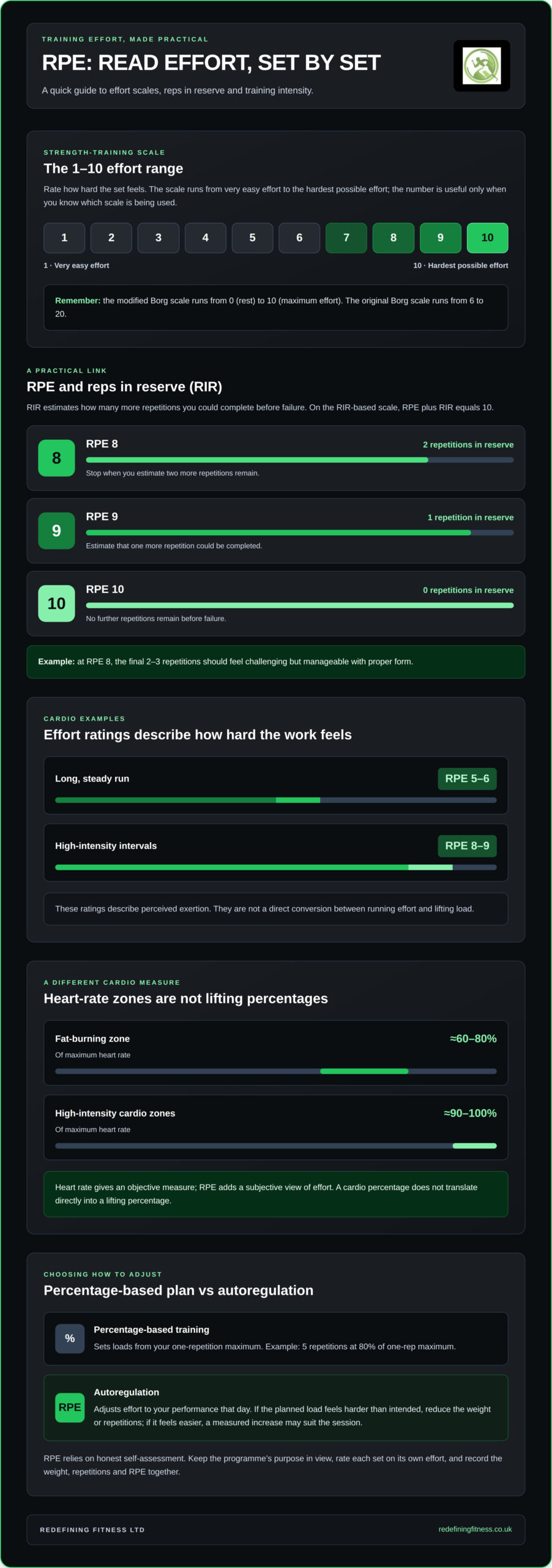
Reps in reserve, or RIR, estimates how many more repetitions you could complete before reaching failure; on the RIR-based scale, RPE plus RIR equals 10. This link matters because it turns a subjective rating into a clearer estimate of how close your set came to its limit. At RPE 8, you estimate two repetitions remain; at RPE 9, one remains; at RPE 10, none remain.
Use that relationship to choose a weight for the planned workout: select a load that lets you complete the set at its target RPE, then adjust the weight if the effort is too high or low. For an RPE 8 set, stop when you estimate two repetitions remain, with the final 2-3 repetitions challenging but manageable with proper form.
Building Accurate RPE Ratings
Accurate RPE means rating your actual effort, not matching someone else’s number or the one you hoped to achieve. This matters especially for beginners: a rating guides training only when it reflects the set you performed. Start by noticing what a challenging but controlled repetition feels like, then honestly assess how many more repetitions you could do.
For example, after a set rated RPE 8, ask whether you could have completed two more repetitions with proper form. If you believe only one remained, the effort was closer to RPE 9; if you could have managed three, it was closer to RPE 7. Record the weight, repetitions and rating together. Comparing those details across similar sets helps make your estimates more consistent.
Expect your judgement to sharpen with practice, not bravado. A set’s RPE can change with the load, repetitions and how hard the work feels that day, so rate each set on its own effort. Keep the scale consistent: a 7 on the 1-to-10 strength scale is not a rating from the original Borg 6-to-20 scale. That distinction keeps your training notes useful.
Autoregulation compared with percentage-based training
Percentage-based plans prescribe loads based on your one-repetition maximum, while autoregulation adjusts effort to your performance that day. RPE can guide those adjustments, but it won’t make every session feel the same.
RPE in Strength Training and Cardio
RPE rates perceived effort in both lifting and cardio, helping you judge intensity across different activities. In strength training, it can guide the load you choose for a set; in cardio, it describes how hard the work feels. That distinction matters: 70% of maximum heart rate isn’t equivalent to lifting 70% of your one-rep maximum with maximum effort.
For example, a long, steady run can be rated RPE 5-6, while high-intensity intervals can be rated RPE 8-9. Those ratings describe perceived exertion, not a direct conversion between running effort and lifting load. Use the activity’s target and the session’s purpose to interpret the number, rather than treating every RPE score as interchangeable.
Limitations of RPE
RPE is a judgement of effort, not an objective measurement such as heart rate or power output. It can help you adjust a session, but it relies on honest self-assessment. Your rating may be inaccurate if you underestimate your effort, compare yourself with someone else, or mistake discomfort for the effort needed to continue.
Percentage-based training offers a different reference: five repetitions at 80% of one-rep maximum sets the load from a maximum-strength estimate. Yet a fixed percentage doesn’t respond to how difficult that load feels on the day. RPE can respond, but it doesn’t remove judgement from training. Treat both methods as tools with different strengths.
With autoregulation, you adjust the planned work to match your actual performance. If a prescribed load feels harder than intended, reduce the weight or repetitions. If it feels easier, a measured increase may suit the session. The aim isn’t to chase a higher rating or improvise without a plan. Use perceived effort to keep the work aligned with the session’s purpose.
Heart-rate zones can also describe cardio intensity, but they measure a different signal from RPE. Cardio in the fat-burning zone is described as approximately 60-80% of maximum heart rate, while high-intensity cardio zones are approximately 90-100%. These percentages don’t translate directly into lifting percentages. RPE adds a subjective view of effort, while heart rate gives an objective measure.
That difference matters when a plan meets real life. A percentage-based session starts with a calculated load; an RPE-based adjustment accounts for how demanding the work feels. Neither method tells the whole story alone. Use the prescribed structure as your framework, then interpret the effort honestly. Developing that judgement is part of learning to coach and programme effectively, including through personal training education.
Progressing by adding weight or reps
Progression doesn’t mean adding weight every time a set feels easy. Use the planned repetitions and RPE together to judge whether the load still provides the intended challenge. If you complete the work at the target effort with sound technique, you have a basis for progressing. If the same load suddenly feels much harder, forcing an increase ignores useful feedback.
There are two straightforward ways to progress: do more repetitions with the same weight, or lift more weight for the planned repetitions. RPE helps you judge when either change is appropriate. Keep the training goal steady and change one variable at a time. That makes it easier to assess whether the new workload suits you. Changing the weight and repetitions together makes comparison harder.
Consider a squat programme beginning with 225 lbs for three sets of five at RPE 8. That is a reference point, not a demand to increase the load automatically next session. Record how each set felt and whether the repetitions stayed controlled. If the sets match the intended effort, the programme can progress by adding repetitions or weight according to its plan, while retaining the target effort.
The same logic applies to a dumbbell press example that starts with 70-pound dumbbells for three sets at RPE 8. The starting load gives you a measurable baseline. If the prescribed work feels harder than RPE 8, reducing the load can bring the session back towards its target. If it feels easier, you can progress according to the programme rather than guessing or making a dramatic jump.
Don’t assume one easy set means every set can handle more. Effort may rise as the workout goes on, so assess each working set and keep your technique consistent. Sensible progression maintains the intended challenge; it doesn’t turn the final repetitions into a scramble. If your form changes as you add repetitions, you’ve changed the quality of the set, not just its quantity.
Keep a simple record of each exercise, load, repetitions and RPE. This lets you compare similar work: the same movement, a similar number of repetitions and a clear effort rating. If the target effort remains manageable, you can consider progressing. If it rises beyond the plan, hold the load steady or adjust it. The aim is steady development, not heavier numbers at the expense of repeatable training.
RPE makes progression responsive, but it still needs structure. Your programme sets the goal; your rating helps you assess how well the session met it. Increase the weight or repetitions when the prescribed effort supports that choice, and make changes gradually enough to assess their effect. That way, each workout informs the next instead of becoming another fresh test.
RPE ratings and reps in reserve
Use RPE in line with your training goal, not as a score to chase. Reps in reserve provide a practical estimate of how many repetitions you could have completed before failure.
Interpreting RPE Ratings Through Reps in Reserve
On the RIR-based scale, RPE and reps in reserve add up to 10. RPE 8 means about two repetitions remain; RPE 9 means one, and RPE 10 means none. This relationship matters because it gives you a consistent way to judge effort across different loads and repetition ranges. For example, a set of five and a set of ten can both reach RPE 8.
Use the estimate to interpret the set, not to claim perfect precision. If your target is RPE 8, finish when you judge that two good repetitions remain. If your form would break down before those repetitions, the set is already harder than the number suggests. Keep the rating tied to the repetitions you could complete with proper form.
Choosing RPE for Strength or Muscle Growth
For muscle growth, aim for RPE 7-9 on most working sets, leaving one to three repetitions in reserve. For strength, use top sets around RPE 8-9.5 and back-off sets around RPE 7-8. These targets matter because they make effort fit the purpose of each set, rather than treating every lift as an all-out attempt.
At RPE 8, the final 2-3 repetitions should feel challenging but manageable with proper form. The National Center for Biotechnology Information review says proximity to failure is essential for an optimal muscle-hypertrophy stimulus, regardless of repetition range. That doesn’t mean every set must reach failure; it means the set needs sufficient effort to create a meaningful stimulus.
Think in terms of the whole session. A strength workout might use a demanding top set, followed by lighter back-off sets that still require focused work. A muscle-growth session can use RPE 7-9 across its working sets, with the exact effort shaped by the exercise and repetitions. Keep your technique consistent, because a heavier load that changes the movement isn’t a clean measure of progress.
Reserve RPE 10 for all-out maximum attempts and use it sparingly. A zero-repetition reserve means you can’t complete another repetition, so repeating that effort across every set can make the session harder to manage. If a set reaches RPE 10 unexpectedly, record it honestly. That information shows the prescribed load overshot the intended effort and helps guide your next training decision.
Ratings only help when they reflect your actual effort. Don’t label a set RPE 8 because the programme says so if you had no repetitions left, or because you want the session to look tougher. Match the rating to the repetitions you could still perform, then use the target for the next set. Consistent effort judgements make RPE useful for both strength work and muscle growth.
Managing training load
RPE makes training load responsive: you adjust the work when the planned effort doesn’t match the session. Aim for RPE 7-9 on main lifts, but read that target alongside your performance. One unexpectedly hard set calls for attention; a pattern of hard sessions calls for a broader change. The key is to respond to the evidence, not force every workout to meet an unchanged plan.
Training phase changes the useful target. During a high-volume phase, aim for RPE 7-8 to keep the work challenging without pushing every set towards a maximal effort. During a strength phase, target RPE 8-9 with heavier weights. Those ranges give you a framework for matching effort to purpose. They aren’t interchangeable instructions: the phase determines whether you prioritise manageable volume or heavier strength work.
Treat each set as feedback. If a main lift feels much harder than its planned RPE, reduce the weight or repetitions rather than grinding through the original prescription. For example, if the first working set already feels excessively challenging, repeating the same load and repetitions may add to the strain. A measured adjustment keeps the session aligned with its goal and helps you assess later sets.
Don’t overreact to one difficult day. Effort varies between sessions, so interpret a rating in context: compare similar lifts and look for a repeated pattern. Persistently high RPE across sessions may suggest you need more recovery, such as a rest day or a lighter workout. A repeated pattern matters more than one tough set because it may indicate that your workload is outpacing your recovery.
Adjust the smallest useful part of the plan. If repetitions are the issue, reduce them; if the load is too demanding, lower the weight. Keep the session’s purpose intact while making that change. A moderate-intensity, high-volume phase still calls for RPE 7-8, and a strength phase still targets RPE 8-9. Changing the dose is not abandoning the plan; it is managing load deliberately.
Record the lift, working load, repetitions and RPE after each session. That simple record helps distinguish an isolated difficult workout from several sessions trending harder. Use the pattern to decide whether to maintain the plan, reduce the work or allow more recovery. If you’re developing the judgement to programme and manage effort for others, explore professional fitness education.
Redefining Fitness: Level 2 & 3 Personal Training Course
Redefining Fitness offers Level 2 and Level 3 personal trainer qualifications, delivered online and in person. If learning to programme training and interpret effort has sparked an interest in coaching, these qualifications are a natural next step towards building your knowledge and practical competence as a personal trainer.
RPE is one tool in a coach’s wider judgement. A rating helps only when it fits the exercise, training goal and person doing the work. Developing that perspective takes more than memorising a scale. It means learning to apply exercise principles thoughtfully and explain them clearly, whether you’re coaching strength exercises or sessions such as circuits.
If you’re ready to explore personal training qualifications, contact Redefining Fitness to discuss the Level 2 and Level 3 courses.
Put your coaching ambition into action
Understanding what RPE in training means and how to use it is a starting point. The next step is learning to apply that judgement with purpose, adapt your approach to different people and build sessions around clear goals. Strong coaching means understanding effort ratings in context, not assigning everyone the same number.
Redefining Fitness offers a Level 2 & 3 Personal Training Course, with further learning in areas including kettlebells and circuits. If you’re ready to deepen your coaching knowledge, take a closer look at how professional training could support your ambitions.
Are you the fitness industry’s next best secret? Explore the prospectus with Redefining Fitness Ltd and consider your next step. Keep learning, question your approach and bring that intent to every person you coach.
Frequently Asked Questions
What Is RPE, and How Does It Work?
RPE is a rating of how demanding exercise feels to you, helping you adjust effort during a session. To understand what RPE is in training and how you should use it, treat the rating as feedback rather than a performance score. It reflects your perception, not an objective output. The National Center for Biotechnology Information offers access to exercise research, whilst the NHS provides wider health and activity information.
Autoregulated Training: Who Should Use the RPE Scale?
RPE can help beginners learning to pace sets and experienced lifters adapting demanding sessions. It’s useful when a fixed percentage doesn’t reflect how today’s work feels. Beginners can record ratings alongside exercises, then compare similar sessions to build self-assessment skills. For broader context on participation and coaching, explore resources from Sport England and UK Coaching.
What Does RPE Mean in Strength Training?
In strength training, RPE describes how difficult a working set feels, rather than judging success only by the weight on the bar. Two people lifting the same load may experience different effort. A coach can use the rating to discuss whether the exercise matched its intended challenge. Professional development resources from CIMSPA can also help coaches build their wider understanding of exercise practice.
How Does the RPE Scale From 1 to 10 Work?
On the strength-training scale, 1 represents very easy effort and 10 the hardest possible effort. Use the number to describe a set, not to rank yourself against another lifter. The scale helps you distinguish a warm-up from demanding work and communicate that difference clearly. For additional UK health and activity information, NHS inform provides general guidance for people planning physical activity.
What Is the Difference Between RPE and Reps in Reserve (RIR)?
RPE rates set difficulty, while reps in reserve estimates how many further repetitions you could complete before failure. On the RIR-based scale, RPE 7 corresponds to three repetitions in reserve. Estimate the extra repetitions you could perform with sound form, rather than relying only on how uncomfortable the final repetition felt. The British Heart Foundation offers broader information about activity and heart health.
How Can RPE Guide Progressive Overload and Workout Adjustments?
Use RPE to judge whether a planned increase still matches the session’s intended effort. If a set feels harder than expected, adjust the next set instead of forcing the original demand; if it feels easier, follow your programme rather than making an impulsive jump. Keeping a record helps you identify patterns. The Open University’s OpenLearn also provides learning resources for developing knowledge independently.
How Does RPE Compare With Percentage-Based Training?
Percentage-based training sets the load from a one-repetition maximum, while RPE describes how hard the work feels during the session. Percentages offer a planned starting load; effort ratings help you assess how that load feels on the day. These approaches can work together without being interchangeable. For wider UK sport and activity context, consult UK Sport and the GOV.UK information service.

Training to Failure & Muscle Growth: Complete PT Guide
Training to Failure & Muscle Growth: Complete PT Guide Training to failure isn’t a requirement for muscle growth. The real question, what…
What Is RPE in Training? How to Use It Effectively
What Is RPE in Training? How to Use It Effectively Effort isn’t a feeling to ignore; it’s information you can use. To understand what RPE is in…
