
Growth isn’t the same as opening more sites. The fastest-growing gyms in the UK in 2026 need to be judged against several measures, including membership, club numbers and market value. The clearest picture from the latest figures is that private-sector gym membership grew faster than membership at public facilities, while the UK fitness industry also expanded overall.
That distinction matters. A booming market doesn’t mean every operator is growing at the same pace, and a large estate doesn’t automatically make a brand the fastest-growing. This article separates wider UK fitness-industry growth from private operators’ performance, then examines what the leading operator data can tell you. You’ll get a sharper view of which growth measures matter, how private gyms compare with public facilities, and where momentum sits. No lazy league-table assumptions. Just a grounded look at trends shaping UK gyms in 2026.
Table of Contents
UK Membership Growth Compared with the Fitness Industry
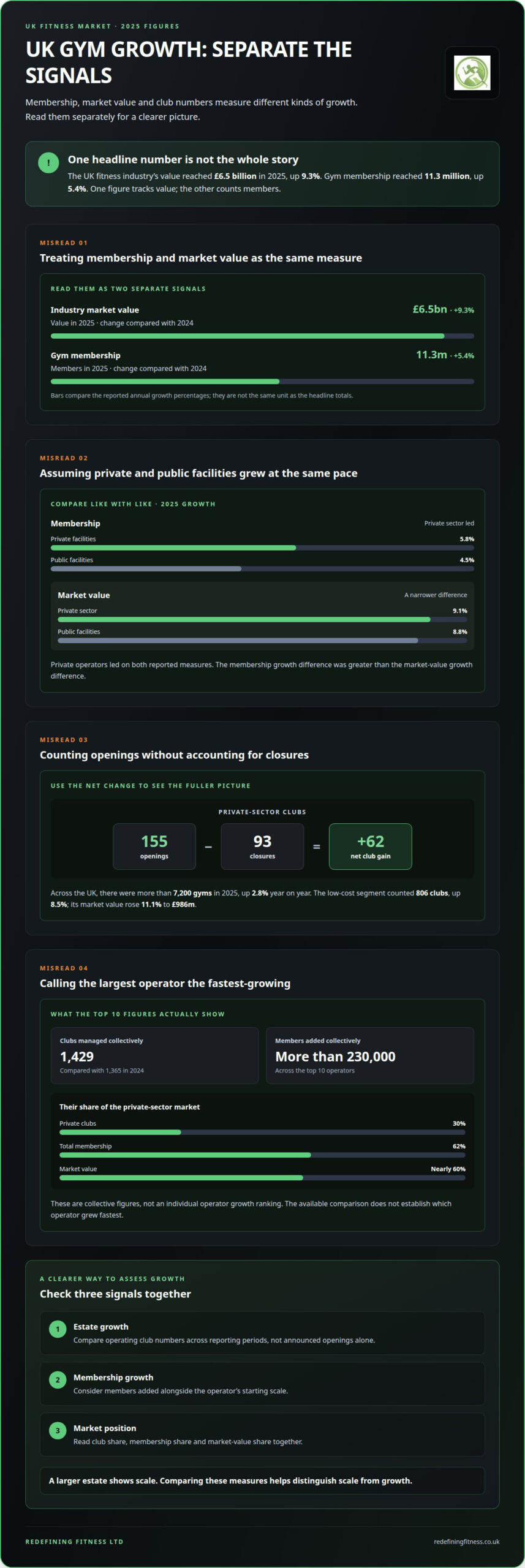
Start with the scale, then separate membership growth from industry growth. The UK fitness industry reached a market value of £6.5 billion in 2025, up 9.3% compared with 2024. Gym membership reached 11.3 million in 2025, an increase of 5.4% on the previous year. These figures measure different things: one tracks industry value, the other counts members. Treating them as interchangeable produces a weak reading of the market.
The longer view shows how far participation has expanded. UK gym membership rose by 150%, from around 4.8 million in 2013 to approximately 12 million in 2024, according to the UK Government. These reported figures provide a longer-term perspective, while the 2025 estimate uses a different reported membership total. The useful signal is sustained demand across a decade, followed by further reported growth in 2025. For operators, retaining members and converting interest into regular attendance matter alongside opening facilities. Local context can sharpen that work: population data from the Office for National Statistics can inform where demand may develop, while Sport England’s participation resources offer a broader view of activity.
Membership also grew at different speeds across facility types. Private-sector gym membership in the UK grew by 5.8% in 2025, compared with 4.5% at public facilities. Private-sector market value rose by 9.1%, while public facilities recorded 8.8% growth. Private operators therefore led on both measures, although the gap in market value growth was narrower than the membership difference. That distinction matters when judging success: member numbers show participation, while market value reflects a separate measure of the sector’s scale. For operators considering workforce capability, CIMSPA’s professional resources and ukactive’s sector information provide relevant industry context.
Supply expanded too, but not at the same pace as demand. The UK had more than 7,200 gyms in 2025, a 2.8% year-on-year increase. Private-sector clubs recorded a net gain of 62 units, with 155 openings and 93 closures. Openings alone exaggerate expansion; closures change the final picture. The low-cost segment counted 806 clubs, up 8.5% from the previous year, and its market value rose by 11.1% to £986 million. Those figures show particularly strong momentum in value-led facilities. Planning decisions also sit within wider local priorities, including those reflected in Local Government Association guidance and Department for Culture, Media and Sport policy.
Market size gives the growth figures a wider frame. The UK fitness industry’s £6.5 billion value in 2025 captures more than membership totals, while the national penetration rate reached 16.8%. The Mintel report covers a forecast of the UK private health and fitness clubs sector through 2031. That forecast horizon helps frame long-term planning, but it is not a specific prediction of each operator’s results. A national market can expand while individual clubs face different local demand, competition and retention pressures. Health-related planning can draw on public resources such as the NHS information service, alongside local authority health and wellbeing priorities.
Fitness increasingly competes on experience, not just equipment. In the UK, 61% of Gen Z gym and leisure centre users say these facilities are their main way of socialising. Group workouts can create repeated contact, shared goals and relationships that make attendance feel connected to community. That does not mean every member wants the same format. A timetable combining individual training, group sessions and welcoming shared spaces gives people different ways to build a routine. Local outdoor activity can add another option, with parks and public spaces relevant to planning by organisations such as Parks for London.
Digital and outdoor experiences widen those choices. A 2021 survey found that 98% of UK fitness and leisure operators think digital will play an increasing role in the future, according to the UK Government. Digital tools can support workout planning and communication between visits, while park-based circuits or outdoor walking groups offer a change of setting. Neither replaces well-run facilities for every member. The practical opportunity is to connect in-person sessions with useful digital support and outdoor options, then build partnerships around local needs. Public health evidence and physical activity guidance from the Office for Health Improvement and Disparities can inform that wider perspective.
Leading Private Gym Operators
Scale matters, but it isn’t the same as speed. The top 10 UK private-sector gym operators collectively managed 1,429 clubs, compared with 1,365 in 2024. Together, they added more than 230,000 members. Those figures show a concentrated group expanding its reach and customer base, but they don’t create an individual growth ranking. The available comparison is collective, so naming one operator as the fastest-growing would claim more than the figures establish.
The top 10 represented 30% of private clubs, 62% of total membership and nearly 60% of market value. Read those shares together. Their proportion of membership is more than twice their proportion of clubs, indicating that the leading operators account for a substantial share of private-sector participation. Their share of market value is also close to their share of membership. Club counts alone, then, miss the concentration of members and value among the largest businesses. The fastest-growing gyms in the UK in 2026 can’t be identified by estate size alone.
Mintel defines the health and fitness clubs examined in its report as privately owned and operated on a commercial, for-profit basis. That definition draws a useful boundary around this comparison. It separates commercial private operators from public facilities, which serve a different organisational model. It also keeps the focus on clubs rather than every business connected to exercise. Use that distinction before comparing an operator’s locations, membership or expansion plans.
For anyone assessing growth, separate three signals:
- Estate growth: compare the number of operating clubs across reporting periods, not just announced openings.
- Membership growth: look at added members alongside the operator’s starting scale.
- Market position: consider club share, membership share and value share together.
These checks prevent a large global brand from looking like the fastest mover simply because it already operates at scale. A smaller operator can expand quickly from a lower base, while a large chain can add members across many locations without leading on percentage growth. The top 10 figures show collective progress, not the pace of every individual company. Anyone asking which gyms are the fastest-growing in the UK in 2026 should keep that distinction front and centre.
Gym operators can grow in several ways: by opening facilities, taking over existing sites, or increasing capacity and activity at established locations. Each route affects reported club numbers differently. An acquisition can add a location to a company’s estate without creating a new facility for the market. Membership figures offer another measure, showing whether a business is attracting people rather than simply changing ownership or adding premises.
Operational execution is central to sustainable growth. When assessing expansion, consider local demand, site capacity, the exercise offer and the member experience. A well-known brand may attract attention, but repeat attendance also depends on whether facilities support practical routines. Group workouts, accessible programming and clear ways to track progress can help clubs serve different goals. Partnerships with local organisations can also broaden how people discover exercise.
So, who leads? The clearest evidence identifies the top 10 as a group: their combined estate grew from 1,365 clubs in 2024 to 1,429, and they added more than 230,000 members. It does not establish a precise order amongst individual operators. The strongest reading is disciplined, not speculative: assess estate change, member gains and market share separately. For professionals building the skills that support inclusive participation, fitness workforce development is one practical part of the wider sector.
Different expansion strategies impact reported estate growth differently, while member demand remains relevant to the commercial picture. In the UK, 97% of gym operators rely on memberships as their main source of revenue. An opening or takeover therefore does not, on its own, show whether an operator is attracting or retaining members; estate changes and membership performance are distinct signals.
Participation and stated interest offer context for the potential audience, but do not establish which operator is growing fastest. In the UK, 29% of women aged 16-34 had visited a private fitness club in the past year, while 47% of men aged 16-34 had done so. In the UK, 39% of women aged 16-34 expressed interest in attending a private fitness club. These are audience measures, not company growth rates. One club operated by the quoted Snap Fitness franchisee in Ireland opened in early 2022, a single site event that cannot by itself provide a comparative measure of operator growth.
Redefining Fitness
Redefining Fitness Ltd helps aspiring fitness professionals build the skills needed to contribute to a changing UK gym sector. Its Level 2 & 3 Personal Training Course is delivered online and in person, with face-to-face workshops covering specialisms such as kettlebells, circuits and indoor cycling. That practical breadth connects directly to the varied classes and training experiences operators use to serve different members.
Turn to Redefining Fitness Ltd if you want to prepare for work in fitness or strengthen your knowledge across these areas. Blended learning, inclusive teaching and support for neurodivergent learners create a learning environment shaped around different needs and ways of engaging. The industry’s growth is only part of the story; capable, thoughtful professionals help turn facilities and programmes into meaningful experiences for members.
Contact Redefining Fitness Ltd to discuss your next step in fitness training.
Build Your Place in the Next Wave
The fastest-growing gyms in the UK in 2026 are part of a bigger shift: fitness is changing through the people who shape its culture, coaching and everyday experiences. The next opportunity isn’t simply to follow expansion. It’s to bring judgement, care and practical skill to the communities those facilities serve.
If you’re considering a career in fitness, focus on the contribution you want to make. Effective professionals keep learning, adapt to different needs and help people feel capable of taking part. That work matters in established clubs and in the new experiences the sector continues to create.
Are you the fitness industry’s next best secret? Take the next step and explore the prospectus and contact Redefining Fitness Ltd to discuss your direction. Your ambition deserves a clear path forward, and the industry needs people ready to raise its standards.
Frequently Asked Questions
Which UK Gym Chains Are Growing Fastest in 2026 by New Locations and Memberships?
The figures presented here don’t rank individual chains by 2026 openings or membership gains. They show the top 10 private-sector operators’ combined estate and member growth, not each company’s results. To identify a leader, compare each chain’s new operating locations and membership change over the same period. Also distinguish absolute gains from percentage growth: a large chain may add more members, while a smaller operator grows faster proportionally.
What Are the Latest 2026 Figures for UK Gym Membership and Fitness Club Growth?
The latest comparable figures here cover 2025: UK gym membership reached 11.3 million, while the number of gyms exceeded 7,200. Private-sector clubs recorded a net gain of 62 sites that year. These are national and sector-level measures, not a complete 2026 count. For a useful comparison, keep membership totals, club numbers and market value separate; each measures a different part of industry growth.
Which Gym Brands Opened the Most New UK Sites in 2025 and 2026?
No individual brand can be identified as the biggest opener from the figures covered here. Across the UK private sector, 155 clubs opened and 93 closed in 2025, producing a net gain of 62. That total doesn’t show how openings were distributed between operators. A reliable 2026 comparison likewise needs brand-level site announcements or published estate figures, rather than an industry-wide total or a chain’s existing size.
How Fast Are PureGym, The Gym Group, JD Gyms and Other Major UK Chains Expanding?
The figures here don’t provide separate expansion rates for PureGym, The Gym Group, JD Gyms or other named chains. They measure the top 10 private operators collectively, so they can’t support a precise brand-by-brand ranking. For a fair comparison, examine each operator’s net change in active sites and membership across the same reporting period. Keep acquisitions distinct from new openings, since they affect an operator’s estate differently.
Which Independent and Boutique Fitness Gym Brands Are Growing Fastest in the UK?
National totals alone cannot identify the fastest-growing independent or boutique gym brand because they do not break growth down by operator or business format. To assess a smaller brand, compare its site count and membership over consistent periods, distinguishing new openings from relocations and acquisitions. A fuller class schedule or a strong local following may suggest momentum, but neither establishes a national growth ranking.
What Are the Fastest-Growing Gym Formats in the UK, Such as Budget Gyms, 24-Hour Clubs and Boutique Studios?
Low-cost gyms show particularly strong momentum: the segment had 806 clubs, up 8.5% year on year, and its market value rose 11.1%. The material gives no comparable growth figures for 24-hour clubs or boutique studios.
What Are the Typical Monthly Membership Prices and Joining Fees at Rapidly Expanding UK Gyms?
No joining-fee figures are provided.
What Risks and Challenges Could Slow UK Gym Expansion in 2026?
Local demand, competition, member retention, site capacity and the member experience can all affect expansion. Closures also reduce net estate growth, so openings alone do not show the full picture.