

How to Use NLP with Personal Training Clients: a workout plan can set out the movements, but it can’t do the thinking for your client. Learning how to use NLP with personal training clients starts with exploring the beliefs behind their choices, then using questions to clarify values, shape meaningful goals and build focus. The aim is to help clients find approaches that fit their motivations, not hand them another script to follow.
Knowing what to do doesn’t always make it easy to do. A client may want to train consistently but feel stuck when work, confidence or old habits get in the way. NLP offers coaching tools to open that conversation and help clients notice their thoughts, choices and state of mind.
Here, you’ll learn how to explore the positive intention behind unhelpful behaviours, shape goals that matter to the person pursuing them, and use mindfulness and attention training to support focus. You’ll also see how to apply these ideas thoughtfully, adapting your questions and coaching to the individual instead of relying on quick fixes.
Table of Contents
- 1. Exploring the origins and positive intentions of unhelpful behaviours
- 2. How Can Personal Training Clients Benefit From NLP?
- 3. Using values to make future goals more compelling
- 4. Coaching and personal development
- 5. Mindfulness, attention training and state management
- Redefining Fitness: Level 2 & 3 Personal Training Course
1. Exploring the origins and positive intentions of unhelpful behaviours
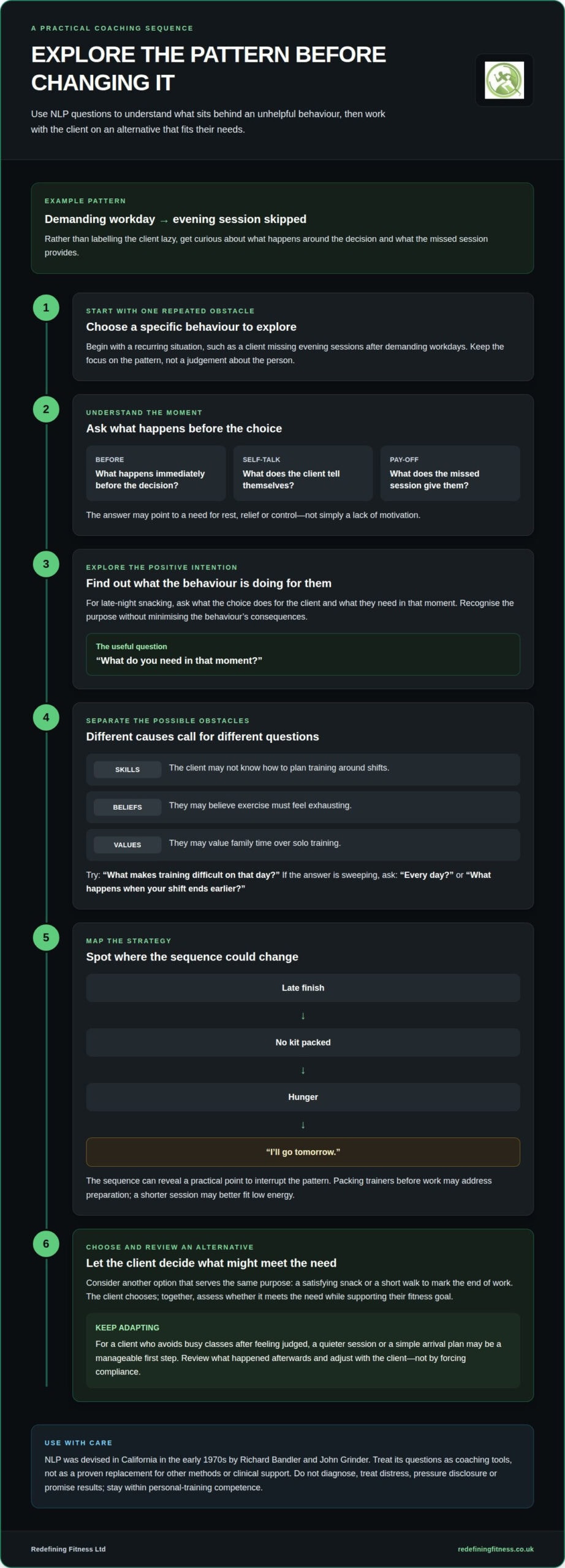
Stop labelling a client lazy before you understand the pattern. NLP, devised in California in the early 1970s by Richard Bandler and John Grinder, offers questions for examining how language, thought and behaviour connect. In practice, begin with one repeated obstacle: a client skips evening sessions after demanding workdays. Ask what happens immediately before the decision, what they tell themselves, and what the missed session gives them. Their answer might reveal a need for rest, relief or control, not a lack of motivation.
What evidence supports NLP techniques for fitness behaviour change compared with motivational interviewing or CBT? A responsible trainer shouldn’t claim NLP is more effective than either approach without sound comparative evidence. Treat NLP questions as coaching tools, not as a proven replacement for other methods or clinical support.
Explore the behaviour’s positive intention without minimising its consequences. If a client snacks late at night to unwind, ask what that choice does for them and what they need in that moment. Then consider another option that serves the same purpose, such as preparing a satisfying snack or taking a short walk to mark the end of work. The client chooses the alternative; you can help them assess whether it meets the need while supporting their fitness goal.
Separate the behaviour from the skills, beliefs and values around it. A client may miss a session because they haven’t learned to plan around shifts, believe exercise must feel exhausting, or value family time over solo training. These are different obstacles. Ask, “What makes training difficult on that day?” Then clarify: “Every day?” or “What happens when your shift ends earlier?” These questions challenge sweeping claims without attacking the person.
Explore the strategy, not just the intention. Map what happens before a missed workout: a late finish, no kit packed, hunger, then the thought, “I’ll go tomorrow.” That sequence shows where a practical change might interrupt the pattern. Packing trainers before work could solve a preparation problem; a shorter session might address low energy. Don’t prescribe the same fix for both.
Learned patterns often began as useful responses in a particular setting. A client who avoids group exercise after feeling judged may now see every busy class as a threat. Ask when the reaction appears, what the client expects and what they notice in that moment. Build an alternative through a manageable first step, such as choosing a quieter session or agreeing a simple arrival plan. Review what happened afterwards and adjust the approach with the client rather than forcing compliance.
2. How Can Personal Training Clients Benefit From NLP?
A goal that sounds impressive can still feel meaningless to the person expected to pursue it. Use the Well-Formed Outcome technique to turn a broad wish into a specific, positive target, then explore what might obstruct it. For example, “I want to lose 5 kg and improve my relationship with food” gives you two connected outcomes to discuss, rather than a single number that ignores daily experience.
Shape the goal with questions. Ask what the client wants, how they’ll recognise progress, what resources they already have and what could get in the way. Someone hoping to attend a weekly class might identify shift patterns as a barrier and choose a shorter home session as an alternative. Keep the goal in the client’s own words, and agree how you’ll review it together.
The mental side matters. “I must never miss a session” creates an all-or-nothing standard; “I’ll plan one movement session after work” gives the client a clear action. Ask why the goal matters, then connect the answer to a value such as independence, energy or time with family. A target becomes meaningful when it supports something the client genuinely cares about.
Do UK personal trainers need qualifications or consent to use NLP techniques? Treat NLP as a coaching method, work within your personal-training competence, and explain an exercise before inviting the client to try it. Make their agreement part of the conversation rather than assuming they want to use every technique.
Which NLP techniques can support motivation and adherence? Use a Well-Formed Outcome conversation to clarify the target and barriers, then try intention-setting with simple self-talk. A client might say, “I’m putting my kit by the door and walking for ten minutes after work.”
What are the risks and ethical boundaries? NLP mustn’t turn a fitness coach into a psychologist or mental-health professional. Avoid diagnosing, treating distress, pressuring disclosure or promising results. Keep the work focused on training choices and agreed goals.
How should trainers adapt for anxiety, trauma or neurodivergence? Ask what communication and session structure feel manageable, offer choices and pause if an exercise causes discomfort. Use clear, literal instructions and predictable steps, such as explaining each movement before a new circuit.
What language patterns work in practice? Ask, “What would make a short session possible today?” rather than “Why didn’t you train?” Try, “What would progress look like this week?” These questions invite specific answers without shaming the client. Well-formed goals and intention-setting can help, but the wording should fit the person, not a script.
3. Using values to make future goals more compelling
A target can be clear and still fail to motivate someone. Ask, “What’s important to you about exercising?” Then listen for the value behind the answer. A client who says, “I want to keep up with my grandchildren,” may care most about independence, shared time or feeling capable. Don’t decide what their words mean for them. Ask them to explain what those words mean in their life.
Clarify motivation before shaping the next step. If a client values confidence, ask what might help them feel more confident in a session. They might choose to practise a movement before joining a busy class. If they value connection, exercising with a friend may suit them better than training alone. The client’s values keep the exercise relevant by guiding its setting and approach.
Values can also reveal a mismatch. Someone may say they want to get fitter yet repeatedly choose plans that leave no room for family commitments. Don’t call that a lack of commitment. Ask which parts of the plan support their priorities and which create friction. Then reshape the routine around a value they’ve named, such as family time, by choosing an activity they can share with a relative.
The Logical Levels Alignment exercise explores motivation across six levels. Use it to help a client connect a specific exercise habit with its wider meaning, rather than treating the habit as an isolated task. Invite them to consider how the goal fits their circumstances, capabilities and the person they want to become. Keep the discussion grounded in their answers, not labels imposed by the trainer.
Try a focused sequence: ask what matters about the goal, what success would look like in daily life, and what action would express that value this week. A client who values independence might choose a regular strength session because carrying shopping matters to them. The immediate action has a practical purpose, while the broader motivation gives it personal meaning. Review the choice together and ask whether it still feels relevant.
Watch for limiting language. “I’m just not someone who exercises” turns past experience into a fixed identity. Ask, “What would make exercise feel more like something you can do?” That question opens space for a different response without arguing with the client. This is the discipline behind neuro-linguistic programming: use language to explore perspective, then let the client decide which change fits their values. Meaningful success is personal, not a trainer’s template.
4. Coaching and personal development
NLP techniques only become useful when coaching starts with the person, not the script. Coaching informally began in the 1970s, and its practical foundation remains clear: listen carefully, ask purposeful questions and agree what the client wants to achieve. The UK Government notes that effective questioning and active listening can help identify needs, guide conversations and build trust. Put that into practice by asking, “What would make this session useful for you?” Then give the client space to answer.
During a consultation, use a simple sequence: agree on the client’s focus, explore what they’ve tried, identify beliefs or obstacles, and choose one action together. At the next check-in, ask what happened and what they learned. A client who planned morning exercise but struggled to get up might prefer an evening session. That isn’t failure; it’s useful information for adjusting the coaching.
The NLP Meta Model describes 12 language patterns linked with deletions, distortions and generalisations. You can use its questioning approach to gently examine statements such as, “I always lose motivation.” Ask, “What happens on the days you do keep going?” The aim isn’t to catch the client out. It’s to widen their view of their own choices, beliefs and capabilities.
Practice helps you distinguish reciting a technique from coaching a real person. Try a short consultation with a colleague: one person plays a client who feels uncomfortable in a busy class, while the other explores what would make participation easier. Afterwards, discuss which question opened the conversation, where the coach interrupted, and whether the agreed next step reflected the client’s values.
Try perceptual positions as a reflective exercise. Invite a client to consider a challenging training interaction from their own perspective, another person’s perspective and a detached observer’s viewpoint. Keep it grounded: the client might reconsider how they interpreted a classmate’s comment, then decide what response feels useful next time. Don’t present an imagined viewpoint as proof of what another person thinks.
Learning how to use NLP with personal training clients means following a clear process during a consultation: agree on the focus, listen to the client’s account, ask open questions, explore their language and settle on a practical action they choose. During movement, use clear coaching cues and observe the client’s response. Ask whether the instruction helped instead of assuming you know their internal state.
That discipline matters. Pacing and leading means acknowledging an aspect of the client’s current state before inviting a manageable shift, such as moving from “I feel uncertain” to trying a familiar exercise. Use observation to guide a question, not to diagnose. To use NLP with personal training clients responsibly, focus on client-led goals and professional boundaries. Good coaching helps clients develop awareness and act on their own values; it doesn’t use linguistic programming to override them.
5. Mindfulness, attention training and state management
Attention can be practised in the moment; it isn’t simply something a client either has or lacks. Before a squat set, invite them to notice their feet, breathing and the next movement. This brief check-in gives the session a clear focus. It doesn’t promise to remove discomfort; it helps the client notice what’s happening and choose their next action deliberately.
Make mindfulness practical. Ask the client to name a sensation, such as pressure through their heels, and a cue, such as “push the floor away”. Then let them complete the movement and describe what they noticed. This connects attention to an observable exercise task without asking them to empty their mind or practise formal meditation.
State management starts with noticing, not controlling. A client arriving distracted might describe racing thoughts before a circuit. Acknowledge what they say, ask what would help them focus on the first exercise, and offer a choice of simpler starting movements. This respects their experience while keeping the conversation grounded in the session. Don’t assume you can read someone’s internal state from their posture or facial expression.
Use the client’s own language to identify a pattern. “I always lose focus halfway through” can prompt a useful question: “What do you notice just before your attention shifts?” They might mention fatigue, uncertainty about the next movement or noise in the room. Adjust the relevant factor, then check whether the change helps. This is linguistic awareness in practice, not mind-reading.
Imagery training can help clients mentally rehearse a familiar movement. Ask them to picture setting up for a controlled lunge, noticing their balance and completing the movement with steady breathing. Keep the scene specific to an exercise they know, then compare the imagined cues with their actual movement. If visualisation feels uncomfortable or distracting, return to direct coaching cues.
Build an attention routine clients can use throughout their fitness journey: notice what’s pulling focus, choose a useful cue, perform the next action, then reflect on what changed. Before a cycling interval, for example, a client might notice tension, relax their grip and focus on a steady pedal stroke. Review the pattern after the effort, not during a demanding movement.
Mindfulness and NLP are coaching tools, not substitutes for mental-health care. Keep the work tied to exercise, avoid pushing clients to disclose personal experiences, and adapt your language to their preferences. If you’re developing your coaching practice, explore personal training qualifications and look for learning that builds practical, inclusive skills. Ask how any accredited programme connects communication, observation and safe exercise coaching.
Redefining Fitness: Level 2 & 3 Personal Training Course
Redefining Fitness offers Level 2 and Level 3 personal trainer qualifications for people ready to build their coaching foundations. If you want to turn ideas about communication, motivation and client-centred practice into professional skills, this is a practical next step. The courses combine blended learning with face-to-face workshops, with options including kettlebells, circuits and indoor cycling.
Strong coaching means more than delivering exercises. It means listening, asking useful questions and adapting your approach to the person in front of you. Explore how these foundations could shape your development as a trainer. Are you the fitness industry’s next best secret? Contact Redefining Fitness or visit redefiningfitness.co.uk to take your next step.
Make Your Next Coaching Conversation Count
Put these ideas into practice with intention. In your next conversation, choose a question that helps a client describe what they want from training, then listen without rushing to fix their answer. That pause can reveal what matters to them and what support feels useful. Keep your coaching within professional boundaries, and let the client choose the actions they’re ready to take.
Learning how to use NLP with personal training clients isn’t about mastering a clever script. It’s about developing the judgement to ask better questions, notice when your approach isn’t working and adapt respectfully. That skill grows through study, reflection and honest practice, not shortcuts.
Ready to take your next step in fitness? Are you the fitness industry’s next best secret? Explore the Redefining Fitness Ltd prospectus and consider where your professional development could lead. Bring curiosity, practise with purpose and keep raising your standard.
Frequently Asked Questions
How Does Neuro-linguistic Programming Work?
NLP uses communication exercises to help people notice how they describe situations and respond to them. A trainer might ask a client to explain what makes a particular exercise feel difficult, then explore a practical adjustment. Keep that conversation within coaching, not psychological assessment. Professional guidance from the British Psychological Society and UK Coaching can help trainers think carefully about their professional role.
How Can Personal Training Clients Benefit From NLP?
Clients may find it useful for exploring what makes a training choice feel manageable, then selecting an action that fits their circumstances. For instance, someone returning after a long break could choose a familiar movement before trying a new class. Keep progress grounded in the client’s own experience. Resources from CIMSPA and Sport England offer wider context on professional practice and participation in sport and physical activity.
How Does NLP Work?
In a coaching conversation, NLP can involve noticing a client’s wording, asking what they mean and exploring possible responses. If someone says, “I can’t do this movement,” ask which part feels challenging and whether a simpler variation would help. That keeps the discussion connected to exercise. If a client raises a health concern beyond your role, use appropriate professional boundaries and consider general guidance from the NHS or NICE.
What Is NLP?
NLP, short for neuro-linguistic programming, is a collection of communication and personal-development techniques. In fitness coaching, a trainer might use reflective questions to help a client describe what they want from a session. It isn’t a personal-training qualification or a replacement for mental-health care. For general information about wellbeing and support, readers can consult Mind and the British Association for Counselling and Psychotherapy.
How can a personal trainer use NLP goal-setting and visualisation with clients?
Ask the client to choose an exercise goal, then invite them to picture a realistic moment connected with it, such as entering a swimming pool or beginning a familiar circuit. Ask what they noticed and whether the imagined scene changed their plan. Keep visualisation optional and practical. If the client wants broader wellbeing support, GOV.UK provides access to public-service information, while the Chartered Society of Physiotherapy offers information relevant to physiotherapy.
How can trainers use active listening, rapport-building and questioning without manipulating clients?
Be clear about why you’re asking a question, reflect the client’s words accurately, and leave them free to disagree or decline. For example, ask, “Would you like to explore that, or focus on today’s session?” Don’t use rapport to secure compliance or imply certainty about what someone thinks. A respectful coaching relationship makes choices explicit and keeps the client in control of personal information and agreed actions.
Are you the fitness industry’s next best secret? Explore the Redefining Fitness Ltd prospectus and consider your next step in fitness education.
What evidence supports NLP techniques for fitness behaviour change compared with motivational interviewing or CBT?
There’s no sound comparative evidence presented here that NLP is more effective than motivational interviewing or CBT. Treat NLP questions as coaching tools, not as a proven replacement for other methods or clinical support.

Nutrition Hacks for Personal Trainers: Drive Client Results
Nutrition Hacks for Personal Trainers: Drive Client Results Nutrition advice can help clients make progress, but a trainer’s role has clear…

Your First 90 Days as a New Personal Trainer: Success Plan
Your First 90 Days as a New Personal Trainer: Success Plan Your first 90 days as a new personal trainer should be about building confidence through…
