
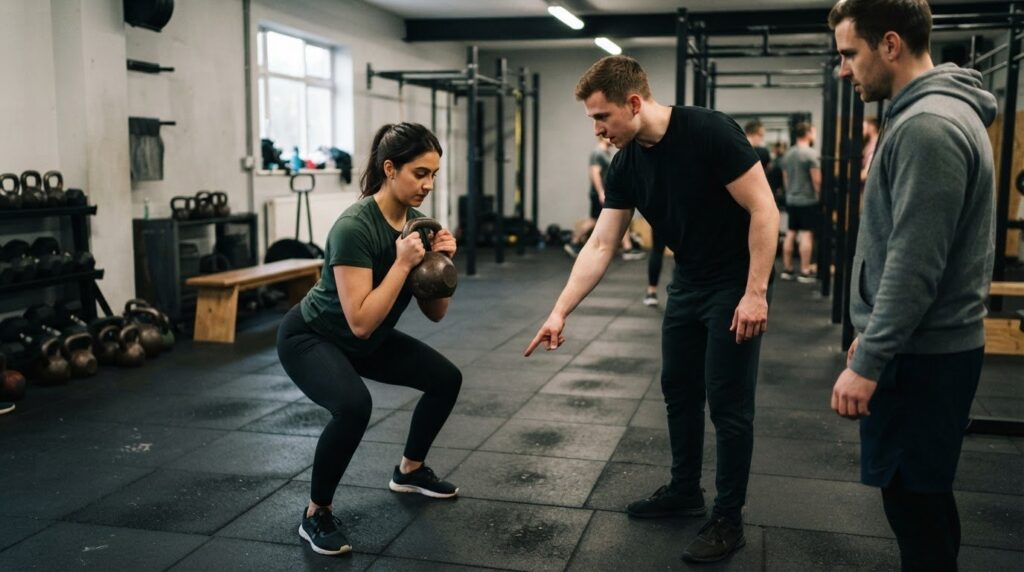
How to Use External Cues in Personal Training Stop coaching every body part when the task needs a clear result. To use external cues in your personal training sessions, direct attention towards what the movement should achieve or affect, rather than asking the client to focus only on how their body moves. A squat cue such as “push the floor away” gives the client an outcome to act on, while “tighten your thighs” directs attention internally.
You already know that a cue can change the quality of a repetition. The more important question is whether that learning lasts beyond the moment you give the instruction. External focus can support motor-skill retention and transfer, helping clients perform a movement more independently instead of relying on a running commentary from their coach.
Here, you’ll see how external and internal cues differ, when each can help with strength and skill learning, and how to choose words that make sense to the person in front of you. You’ll also learn why the real test isn’t whether a client performs well while you’re cueing, but whether the skill holds when the cue falls away.
Table of Contents
Internal versus external attentional focus
Internal cues direct attention towards the body and movement process; external cues point towards an outcome beyond the body. The distinction matters because the same exercise can feel and look different depending on what the client focuses on.
Contrasting internal and external cues
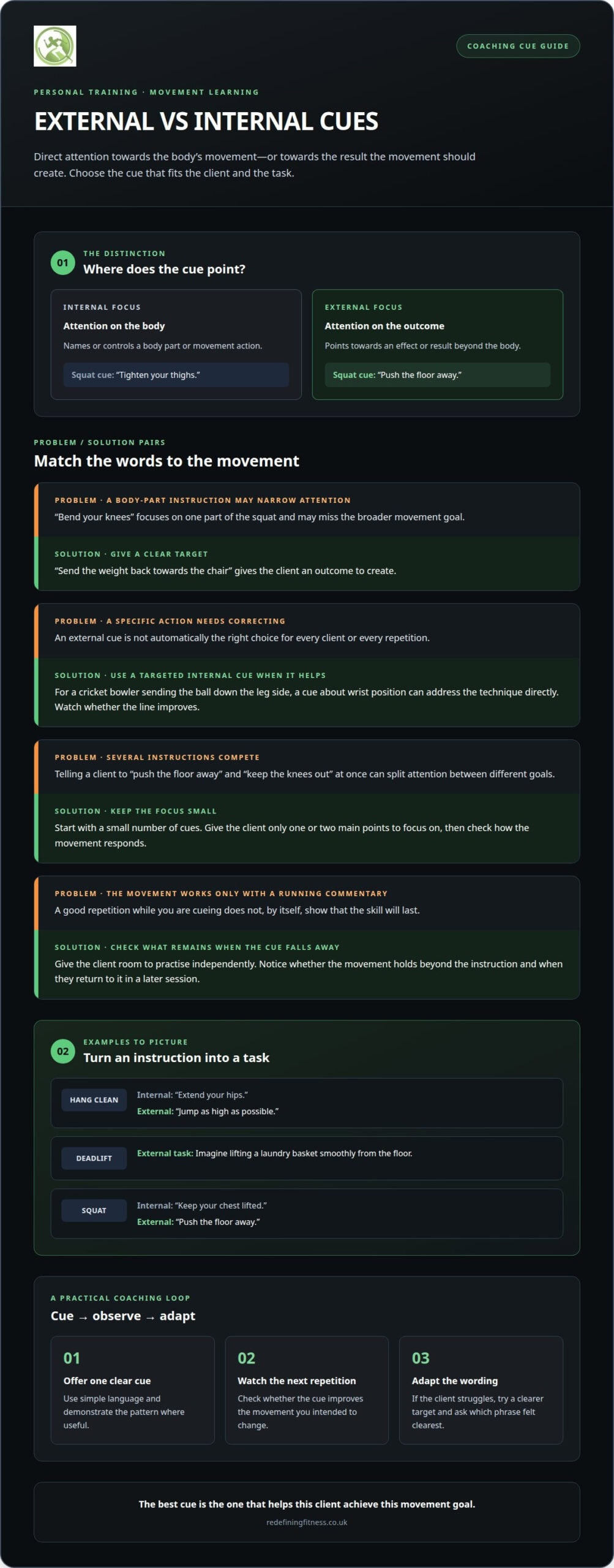
An internal cue asks a client to notice or control a body part, such as keeping the chest lifted during a squat. An external cue directs attention towards the movement’s effect, such as pushing the floor away. One centres attention on the body; the other gives the client an outcome to create.
That difference can shape how a motor skill develops. A study on internal versus external attentional focus appeared in Journal of Motor Behavior, volume 30, issue 2, pages 169–79. Internal focus may help beginning exercisers and can support muscular recruitment and activation, with possible benefits for muscle development depending on the population. Don’t assume one focus suits every client.
Internal cues can narrow attention to one body part, interrupt automatic movement patterns and overlook how the rest of the body contributes. For a client learning a squat, “bend your knees” may help with a specific correction; “send the weight back towards the chair” gives a broader movement goal. Choose the cue based on the problem you observe.
Cue examples in sport
In sport, an internal cue names a body action, while an external cue describes an effect or target. For a hang clean, “extend your hips” is internal; “jump as high as possible” is external. The first directs attention to the hip action, while the second encourages a whole-body movement towards a clear result.
Consider a cricket bowler who repeatedly sends the ball down the leg side. A coach may use an internal cue about wrist position to address the technique directly. In a squat, “push through your heels” is also an internal cue. These examples show why labelling cues matters: the words should address the movement you observe, not become a script repeated without thought.
External focus often supports motor learning and performance, but a targeted internal cue can still help when a specific action needs correction. Watch what changes after each instruction. If the cricket bowler’s line improves with a wrist cue, that response offers practical evidence about which focus helps the athlete.
Common mistakes with external cues
Common mistakes include giving several competing instructions, choosing an outcome that doesn’t match the task, and treating external cues as a rule for every client. For example, telling a client to “push the floor away” and “keep the knees out” at once may split attention between different goals. Use the cue that best addresses the movement you see.
Another mistake is assuming a body-focused instruction has no place in coaching. If a specific technique issue needs attention, a concise internal cue, such as wrist position for the cricket bowler, may help. The better standard isn’t “external every time”; it’s selecting a cue, observing the next repetition and changing your approach if the movement doesn’t respond.
Don’t mistake more words for better coaching. If the squat still shifts away from the intended pattern after “push through your heels”, simplify the instruction or choose a clearer target. Then assess the movement again. The client’s response, not your attachment to a favourite phrase, should determine whether that cue stays.
Want to Learn More About Cueing?
A useful cue doesn’t add noise; it gives the client a movement outcome to act on. The test is whether the instruction helps them perform the exercise with more control and less conscious effort.
How External Cues Guide Movement
An exercise cue is a word or phrase that prompts a movement pattern or directs attention towards a particular part of an exercise. An external cue points to the movement’s effect or outcome, such as asking a client to lift a laundry basket during a deadlift.
That image gives the client a practical task instead of a list of body-part instructions. For UK coaches, use clear, simple language, demonstrate the pattern where useful and avoid jargon. Then assess what happens: effective movement means accuracy, consistency and reliability in reaching the intended goal.
Reducing Thought During Movement Learning
External cues can reduce the conscious thought a client uses to organise a new movement pattern. Instead of mentally managing each joint during a deadlift, the client can focus on lifting the imagined basket smoothly from the floor.
This matters because attention spent decoding instructions is attention taken away from performing the exercise. Beginners may need a simple, relatable image; experienced lifters may respond better to a precise outcome linked to their goal. For a client with an injury history, keep the cue focused on the agreed movement task and observe their response rather than assuming one phrase suits everyone.
Introducing and Adapting Cues
Start a new exercise with a small number of cues that support the desired movement, then give the client only one or two main points to focus on. For a deadlift, demonstrate the pattern and ask the client to lift the laundry basket, rather than delivering a running commentary.
How do you introduce and adapt external cues during a training session? Offer a short cue, watch the next repetition, and change the wording if the client struggles. Ask which phrase felt clearest. This practical approach also answers what UK fitness qualifications and coaching guidance say: communicate simply, demonstrate where useful, and adapt your instruction to the person.
Allowing Time to Learn Movement Patterns
Give clients room to learn before treating every error as a cueing failure. A new exercise may look untidy at first, then improve naturally when the client returns to it in a later session. Correct only what needs attention; constant interruption can stop them feeling the movement for themselves.
How can external cues help beginners, experienced lifters and clients with injuries? Match the cue to the person’s experience, movement goal and response, then judge progress across individual sessions rather than waiting two to three months. A cue is working when the client performs the task more accurately and consistently, and can identify which instruction helped. Use that evidence to keep, refine or replace the cue.
Building this judgement takes practice. Explore personal training education to develop your coaching knowledge alongside your practical skills.
External cue examples for strength exercises
Choose a cue for the movement you want, not a phrase you like repeating. An effective external cue gives the client a clear target, then lets you judge the result through their movement and feedback.
Choosing cues for individual clients
Choose an external cue that matches the client’s task, experience and response to coaching. A useful phrase makes the intended movement easier to understand instead of adding another instruction to decode.
For example, a client who loses balance during a squat might respond to a bench as a target, while another may need a simple visual demonstration. Ask what the client noticed, then compare the next repetition with the previous one. Their feedback helps you decide whether the cue improved position and control. Keep the phrase that changes the movement; replace the one that doesn’t.
Dumbbell row cue examples
For a dumbbell row, direct attention towards where the weight should travel. “Pull the dumbbell towards your back pocket” gives the client a visible destination, rather than asking them to think through several shoulder and arm actions.
You could also ask them to guide the dumbbell towards a point beside the lower ribs. These are different targets, so watch the client’s position and the path of the weight. If “back pocket” makes the client twist, choose a steadier target and reassess. In strength coaching, a cue’s value comes from the movement it produces, not how clever it sounds.
Hip hinge cue examples
A hip-hinge cue should help the client move their hips back while keeping the task understandable. Asking them to touch their buttocks to a wall behind them gives a concrete target and can make the hinge easier to picture.
Stand the client close enough to reach the wall with a controlled hip movement. If they bend their knees excessively or turn the action into a squat, adjust their starting position and demonstrate the target again. The wall provides immediate feedback: the client can feel whether their hips travel back to meet it. This makes the cue useful beyond sports drills, including when teaching strength exercises.
Squat cue examples
For a squat, use a box or bench as a target: “lower until you lightly touch the seat.” The client now has a clear destination, which can help organise depth and tempo without a string of body-part instructions.
Match the target to the movement you want. A high bench creates a different range of motion from a low one, so choose a position the client can reach with control. Watch whether they touch lightly or drop onto the seat, then use that feedback to adjust the target or cue. In coaching, that observation matters more than forcing the same squat cue on every client.
Auditory, kinaesthetic and visual cueing
The cue’s wording matters, but so does how the client receives it. A spoken instruction, a demonstration and a felt movement can all support an external focus, provided each directs attention towards the same task.
Auditory cues use clear spoken words to guide the next movement. During a deadlift, “lift the basket smoothly” gives the client an image and a movement outcome. Keep the instruction plain; technical jargon can make clients spend more attention decoding your words than performing the exercise. Give the cue before the repetition, then allow the client space to act on it.
Visual cueing makes the task visible. Demonstrate a squat, or point to a box the client should touch lightly. The demonstration shows the movement pattern; the box gives an external target. These are related but distinct teaching tools. Use the visual example to make the task clear, then watch whether the client can reproduce the intended movement without copying every detail mechanically.
Kinaesthetic cueing draws attention to what the client feels during movement. For example, ask them to notice whether both feet stay grounded during a squat, or whether the dumbbell travels towards the intended point during a row. This can help clients recognise when a repetition feels different. They may then adjust their next attempt without needing a fresh instruction for every movement.
Combine modalities when one channel alone isn’t getting through. For a new exercise, give a short spoken cue, demonstrate the pattern, then ask the client what they felt. In an online group class, a coach can use verbal cues the first time through a workout and visual or kinaesthetic prompts the next time. Keep the focus on one shared outcome, not three competing tasks.
Separate the cue’s sensory method from its focus. “Push the floor away” is auditory when spoken, but its external focus remains the effect of the movement. A mirror or demonstration changes the information the client receives, not necessarily the target of their attention. This distinction helps you build a connection between a simple phrase and the movement outcome it represents.
Use feedback to choose the next instruction. If a client hears “reach the ceiling” during an overhead press but still struggles, demonstrate the press and ask what they notice during the movement. If the next repetition improves, keep that combination; if not, simplify the spoken cue or change the visual target. Teaching isn’t a performance of clever phrases. It’s selecting the method that helps this client move with greater control.
External cues for motor-skill learning
A movement that improves while you’re prompting it isn’t automatically a skill the client has mastered. Motor learning means the movement pattern can hold beyond the immediate coaching moment, so judge external cues by what happens when your instruction disappears.
External focus can support retention and transfer: a client may retain a learned movement and apply it in a different setting. In strength and conditioning, technique practised with a coach should remain useful when attention shifts to the lift itself. A cue such as “drive the platform away” can organise a push, but test the skill when the prompt is removed.
Separate practice performance from learning. A client might produce a cleaner repetition after hearing a cue, yet still rely on that prompt. After practising with cues, test the skill without them. For a hip hinge, remove “send your hips back” and observe whether the client reaches the intended pattern. That uncued attempt offers stronger evidence of retention than coached practice alone.
How to use external cues in your personal training sessions depends partly on cue frequency. External cues can be effective periodically or on every repetition or swing. If a new lifter loses the target between repetitions, repeat a short prompt. If a more practised client maintains the pattern independently, leave space before offering feedback. The goal is to develop skill, not dependence on your voice.
Refine technique when the movement calls for it. Keep instructions simple during an athlete’s first week with an exercise; from week 2 onwards, add cues when they help refine the pattern. Early errors don’t automatically prove the cue failed. The movement may improve when the athlete returns the following week, even without correction. Observe that change before adding instructions.
Transfer is the sharper test. If a client learns a deadlift with a target, see whether the hinge pattern carries over when they lift an unfamiliar object. The setting has changed, but the movement goal remains recognisable. If the pattern breaks down, restore a clear target, then vary or remove the prompt and reassess.
Using external cues well in your personal training sessions ultimately comes down to evidence: does the movement hold when the cue changes or disappears? Combine purposeful prompting with uncued attempts, and assess the skill itself, not how often you delivered instructions.
Redefining Fitness: Level 2 & 3 Personal Training Course
Redefining Fitness offers Level 2 and Level 3 personal training qualifications, delivered online and in person. If you want to move beyond memorising cue phrases, use your training to build the judgement behind them: observe a movement, choose a clear instruction, and assess whether the client can repeat the skill without constant prompting.
The course combines blended learning with face-to-face workshops, including specialist subjects such as kettlebells, circuits and indoor cycling. That gives aspiring trainers a route to develop practical coaching knowledge alongside their qualification. Are you the fitness industry’s next best secret? If you’re ready to develop your coaching skills, contact Redefining Fitness or visit redefiningfitness.co.uk.
Put Your Coaching Into Practice
Knowing how to use external cues in your personal training sessions is only the start. Turn that understanding into deliberate coaching: choose an instruction for a clear reason, watch the client’s response and keep developing your judgement through practice.
Don’t aim to sound impressive. Aim to help people move with greater independence. Stay curious about how each client responds, refine your communication and treat every session as an opportunity to strengthen your craft. Consistent, thoughtful coaching is built one decision at a time.
Are you the fitness industry’s next best secret? Explore the prospectus and take your next step towards a career in personal training. Bring your ambition, keep raising your standards, and make your coaching count.
Frequently Asked Questions
What are external cues in personal training?
External cues direct a client’s attention towards an effect or target outside their body. In a walking lunge, for example, ask them to step towards a floor marker rather than think through each leg movement. The marker gives the client a concrete aim. You can then observe whether they reach it with control and adjust its position if the target doesn’t suit their current movement.
How do external cues differ from internal cues in exercise coaching?
External cues focus on what the movement does; internal cues focus on the client’s body or movement process. For a standing calf raise, “press the floor away” gives an external focus, while “tighten your calves” directs attention internally. The first gives a movement outcome; the second names a body area. In practice, choose based on the coaching problem and whether the client responds clearly to the instruction.
What are examples of external cues for common strength exercises?
For a bench press, try “push the bar towards the ceiling”, giving the lifter a clear direction of travel. During a kettlebell swing, “send the bell towards the wall in front of you” can focus attention on its path. Keep the target relevant to the movement and watch the next repetition. If the client changes position in an unwanted way, use a simpler cue or choose a different target.
Do external cues improve exercise performance compared with internal cues?
External cues often support motor learning and performance, but they aren’t automatically the best choice for every person or task. A client may move more effectively when attention stays on an outcome, while a focused internal instruction can help address a specific technique issue. Compare the client’s movement after each cue, including whether they can perform without ongoing prompts. Their response matters more than applying one cueing style as a universal rule.

Nutrition Hacks for Personal Trainers: Drive Client Results
Nutrition Hacks for Personal Trainers: Drive Client Results Nutrition advice can help clients make progress, but a trainer’s role has clear…

Your First 90 Days as a New Personal Trainer: Success Plan
Your First 90 Days as a New Personal Trainer: Success Plan Your first 90 days as a new personal trainer should be about building confidence through…
