

8 Ways to Stand Out as a Personal Trainer in the UK means tailoring programmes to each client, applying sound training principles, continuing to learn through professional development, building specialist coaching expertise, communicating with clarity, tracking progress, understanding your local audience and earning a strong reputation. None depends on a flashy trend or a louder social media presence. They depend on the quality of your coaching.
You already know clients want more than a list of exercises. They want a trainer who listens, adapts and can explain why a programme fits their goals. That standard takes work, but it’s what separates capable professionals from coaches who simply repeat what’s popular. Resources on physical activity and wellbeing and handling personal information can also support thoughtful practice.
Read on to learn how to make programming more personal, put sound principles ahead of passing fads, develop expertise and build trust in your community. You’ll come away with practical ways to sharpen your craft and make your value clear to the people you’re best placed to help. For local insight, explore Office for National Statistics data and Sport England resources, and keep promotional claims responsible by consulting the CAP Code.
Table of Contents
- 1. Balancing optimal programming with client preferences
- 2. Applying training principles rather than relying on trends
- 3. Continued learning and specialist qualifications
- 4. Building a local reputation and referral network
- 5. How can personal trainers choose a profitable niche and target audience?
- Redefining Fitness: Level 2 & 3 Personal Training Course
1. Balancing optimal programming with client preferences
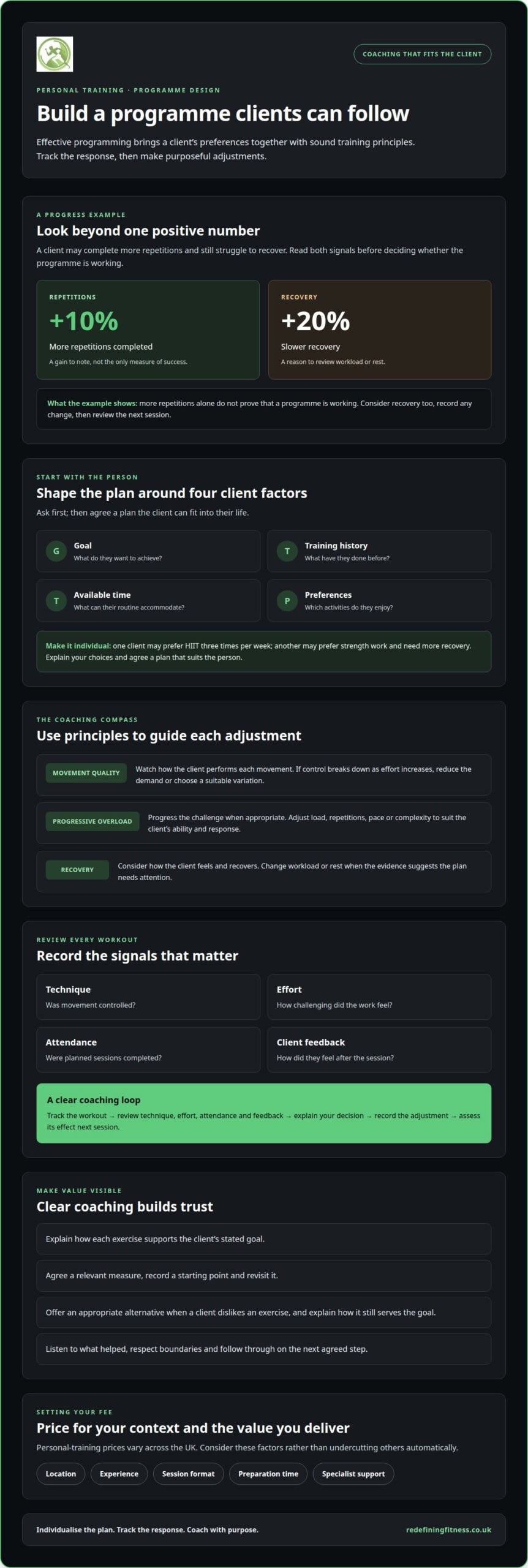
The 8 ways to stand out as a personal trainer start with a programme clients can actually follow. Begin by asking about their goal, previous training, available time and preferred activities. HIIT three times per week may suit one client, whilst another may prefer strength work and need more recovery. Ask what they enjoy, explain your choices and agree on a plan that fits their routine. A technically impressive programme is useless if it ignores the person expected to complete it.
Use movement quality, progressive overload and recovery to guide your decisions. Track each workout, then review technique, effort, attendance and how the client feels after sessions. If a client adds repetitions but struggles to recover, don’t treat that gain alone as proof the programme is working. Adjust the workload or rest, record the change and review the next session. This gives every adjustment a clear reason instead of relying on guesswork.
Coach clients with different fitness levels, ages and goals before narrowing your focus. A beginner learning a squat may need a demonstration and one cue at a time. An experienced client might respond better to a specific performance target. Both need clear instruction, but not identical coaching. Supportive coaching means listening, respecting boundaries and correcting technique without making someone feel exposed or incapable.
Motivation needs evidence. Agree on a relevant measure, such as controlled movement or completing planned sessions, then record a starting point and revisit it. If a client enjoys circuits but dislikes one exercise, offer an appropriate alternative and explain how it serves their goal. Among the 8 ways to stand out as a personal trainer, individualising the method shows clients that their preferences shape the programme without erasing its purpose.
Across the UK, personal-training prices vary rather than following one typical rate. Set a competitive fee by weighing your location, experience, session format, preparation time and specialist support against the value you deliver, rather than undercutting others automatically.
Referrals grow from an experience people can describe. Agree communication preferences, arrive prepared and give specific feedback. For example, after a client completes a circuit with stronger control, connect that progress to the goal you set together. Ask what helped them most, listen to the answer and follow through on the next agreed step. Consistent, respectful communication gives clients a genuine reason to recommend your coaching to someone they know.
Keep tracking workout data and evaluating progress; for example, a client might gain 10% more repetitions but slow recovery by 20%, prompting programme changes.
2. Applying training principles rather than relying on trends
The 8 ways to stand out as a personal trainer begin with a simple discipline: choose training methods for a reason. Before adopting a popular challenge, identify what it develops, such as strength, fitness or movement skill. Then select exercises that serve that goal. A client seeking stronger legs needs suitable lower-body movements, not a random sequence copied from social media. Explain the purpose behind your choices.
Use a consistent decision process: match the method to the client’s goal, check they can perform each movement with control, then adjust the challenge. Change the load, repetitions, pace or complexity as needed. If technique breaks down, reduce the demand rather than pushing through for a dramatic finish. That’s professional judgement, not a lack of ambition.
Keep evidence and context together. A method that suits one person may not suit another’s experience, preferences or recovery. Research in physical therapy has recognised for decades that general strength training can be as effective as, or more effective than, specific physiotherapy exercises for rehabilitation. That doesn’t mean every strength exercise is suitable for every client. Thoughtful exercise selection still matters.
Don’t mistake novelty for progress. A client who follows demanding online workouts may need structure, not another complicated circuit. Record the exercise, workload, technique and response in a training log. Review those details before changing the programme. If progress stalls, consider whether the goal, exercise choice, effort or recovery needs attention. Make one purposeful adjustment, then assess its effect. That’s how the 8 ways to stand out as a personal trainer become visible in everyday coaching.
In the UK, treat insurance, health screening, data protection and advertising as separate responsibilities. Match your insurance arrangements to your working setting, use screening to inform exercise choices, protect personal information and keep promotional claims accurate and supportable.
Make each session review useful. Before a client leaves, ask what felt manageable and what felt challenging. Compare their feedback with your notes, then explain one decision for the next session. If their movement became less controlled as effort increased, for example, plan a variation that supports better practice. Clear reasoning beats calling every new method revolutionary, and gives clients another reason to value your coaching.
That reasoning also helps clients understand the value of coaching. A structured, evidence-based exercise plan with a personal trainer can produce greater fitness gains than exercising alone. More than 6 million people work out with personal trainers, so clear explanations and individual attention can help distinguish considered coaching from a one-size-fits-all session. Keep the plan practical: connect each exercise to the client’s stated aim, explain how its challenge will progress, and agree how recovery will shape the next session.
Movement efficiency, progressive overload, and recovery are principles personal trainers can use to adapt coaching to individual clients. Apply them as decision tools, not slogans: notice whether a movement is performed efficiently, progress the demand when the client is ready, and account for recovery before adding more work. The author says he has delivered more than 400 presentations. That experience reinforces the value of communicating decisions clearly, while the client’s response should still guide each adjustment. When clients understand why a plan changes, they can take a more active part in following it and reporting what is working.
3. Continued learning and specialist qualifications
A qualification starts your development; it doesn’t finish it. Fitness knowledge, coaching methods and client needs keep evolving, so make regular learning part of your professional routine. Choose a topic relevant to the people you coach, study credible material, then compare what you learn with your practice. If clients struggle with exercise technique, for example, revisit movement coaching and practise giving clearer cues. Record what you learn and how it changes your sessions.
In the UK, the qualifications named in this field include a Level 2 Certificate in Fitness Instructing and a Level 3 Diploma in Fitness Instructing. Treat each as a foundation for your professional development, not proof that you can coach every population or method. Map your current knowledge against the work you want to do. Identify gaps, then choose further learning that deepens competence in a relevant area rather than collecting certificates without a purpose.
Specialist expertise is useful when it solves a real coaching problem. A trainer interested in kettlebells, for instance, should learn to select and teach suitable movements, adapt technique cues and progress clients sensibly. Someone drawn to health-focused coaching should build knowledge that supports safe, inclusive exercise practice. In both cases, be precise about what your training covers and coach within that scope.
Reduce injury risks with a repeatable process: discuss relevant exercise history, observe how a client moves, choose an appropriate starting point and adjust the session if pain or concerning symptoms arise. Work within your qualifications by coaching exercise, not diagnosing conditions or claiming to treat them. If a client’s needs fall outside your competence, pause that element of training and direct them to an appropriately qualified health professional.
Make continued learning practical. After a session, note one coaching decision that worked and one that could improve. If a client repeatedly loses balance during a movement, for example, consider whether your demonstration, cue or exercise choice needs changing. Study that specific issue, practise a suitable progression and review the result in a later session. This cycle turns education into sharper coaching rather than another certificate sitting unused.
Choose learning with a clear purpose. Before enrolling, write down the client group or coaching challenge you want to address, the skill you need to build and how you’ll apply it. A focused plan helps distinguish meaningful development from trend-chasing. Your reputation grows when clients see your knowledge shaping thoughtful decisions, your boundaries staying clear and your practice continuing to improve.
4. Building a local reputation and referral network
A local reputation grows through repeated, useful contact, not a polished slogan alone. Start by defining the people you serve and the problem you help them tackle. For example, you might focus your message on helping beginners feel confident using strength exercises. Keep that focus consistent across conversations, community events and your online profile. A clear promise helps local people understand who you coach and why your approach suits them.
Build relationships where your intended clients already spend time. Introduce yourself to nearby community groups, sports clubs and wellbeing businesses, then find a practical way to contribute. You could offer a short movement session at a community event or share general exercise guidance with a local group. Make it useful for attendees, not a disguised sales pitch. Follow up personally and suggest a relevant next conversation.
Referrals need a strong experience behind them. Agree on each client’s goals, communication preferences and next steps, then deliver what you agreed. After a client completes a planned block of sessions, for example, review their progress together and ask what felt most valuable. If they choose to recommend you, make it easy to describe your work by explaining your coaching focus in one clear sentence. Never pressure someone to refer friends.
Your online presence should make the same promise as your in-person coaching. Use a consistent name, photograph and description across your website and social profiles. Show what a session involves with specific examples, such as adapting a movement for a beginner. Share useful coaching insights instead of generic motivational quotes. A prospective client should quickly understand who you support, your approach and how to take the next step.
Keep your professional brand grounded in evidence of your work. With permission, share a client’s account of their experience, but don’t imply that one person’s result is guaranteed for everyone. You could also explain how you structure an initial conversation or adapt a session to a client’s confidence. These details demonstrate care and judgement more convincingly than claims such as “best trainer in town”.
Make local networking a habit with a simple follow-up system. After meeting someone at a community event, note where you met and what you discussed, then send a relevant message. If a nearby sports club asks about supporting new members, suggest a practical idea that matches your expertise. Track which conversations lead to meaningful relationships and invest your time where you can contribute consistently. That’s how visibility becomes trust and trust strengthens your local reputation.
5. How can personal trainers choose a profitable niche and target audience?
A profitable niche starts with a real audience and a problem you can competently address. Don’t choose one just because it sounds impressive on social media. List the clients you enjoy coaching, the needs they bring and the skills you can offer. Then look for overlap. Helping beginners build strength, for example, gives you a clearer focus than promising to help everyone achieve every fitness goal.
Use client needs to shape your decision. 50 percent of personal training clients have special medical needs such as obesity, arthritis and diabetes. About half of personal training clients are over 45 and identify as beginning and intermediate exercisers. These groups need thoughtful, appropriate coaching, not sweeping promises. Consider whether your knowledge and qualifications match the support they need before presenting them as your target audience.
Assess local demand through direct conversations and existing relationships. Ask community groups what exercise support their members seek, listen to prospective clients’ goals and notice which enquiries recur. A niche helping London beginners build strength may make sense if people regularly ask for support getting started. Separate curiosity from demand: a popular post doesn’t prove people want to pay for ongoing coaching.
Next, consider whether you can deliver the niche sustainably. Think about the time needed to prepare sessions, the setting and equipment involved, and whether clients may need ongoing support. A niche built around a specific coaching method may require additional expertise and suitable facilities. A focus on beginners might depend instead on clear instruction, confidence-building and adaptable session planning. Shape your offer around what you can deliver consistently.
Test your positioning with a plain-language description. Name the audience, their goal and your approach, such as “I help new exercisers build confidence with structured strength training.” Use that sentence in conversations and online profiles. If people still misunderstand who you coach, sharpen the wording. If enquiries consistently concern a different need, review the evidence before changing direction.
Finally, judge the niche by more than its potential income. Track which enquiries lead to suitable clients, which sessions you can deliver well and what clients value enough to continue. Review those patterns regularly, then refine your audience or service where the evidence points. A strong niche connects genuine demand with your competence and a clear, repeatable coaching offer. Profitability depends on that fit, not a catchy label.
Redefining Fitness: Level 2 & 3 Personal Training Course
Redefining Fitness offers a Level 2 & 3 Personal Training Course for people ready to build their coaching foundations and develop professional expertise. Delivered online and in person, the course combines blended learning with face-to-face workshops. It can help you turn the principles in this guide into practical knowledge for your next steps as a trainer.
To deepen your focus, explore specialist learning in kettlebells, circuits or indoor cycling. Choose the area that aligns with the clients you want to support, then build your skills with purpose. Strong coaching starts with solid foundations and grows through deliberate practice.
If you’re ready to develop your fitness career, visit Redefining Fitness to explore the course.
Choose Your Next Move and Build On It
Your next step isn’t to overhaul your entire coaching practice. Choose one decision you can improve this week, then put it into action. You might sharpen how you explain your coaching approach, identify a skill to develop or plan a conversation with a local organisation. Make the action specific, set aside time in your working week and review what you learn.
The 8 ways to stand out as a personal trainer work best as a standard you keep raising, not a checklist you complete once. Stay curious about your craft, be honest about what you can offer and keep building the confidence to serve the people who need your expertise. Your next chapter starts with a deliberate choice, followed by consistent effort.
Are you the fitness industry’s next best secret? Contact Redefining Fitness Ltd today to ask about the prospectus and take your next step with purpose.
Frequently Asked Questions
What are the most effective ways for a personal trainer to stand out in the UK?
Stand out by making your coaching approach specific, consistent and easy to understand. A London trainer, for example, could explain clearly how they help nervous beginners feel comfortable with strength training. Back that message with thoughtful session planning, clear professional boundaries and examples of how you adapt your coaching. Clients notice the difference between a memorable promise and a consistently considered experience.
How can a personal trainer attract clients through social media and local marketing?
Choose a platform you can maintain, then share useful, recognisable content rather than posting just to be visible. A short demonstration could explain how to set up for a basic movement, while a London-focused post might highlight your involvement in a local wellbeing event. Make your profile clear about who you support, what you help them work towards and how they can make an initial enquiry.
How can personal trainers show client results ethically using testimonials and progress tracking?
Ask permission before sharing a testimonial or identifiable client story, and let the client approve the final wording. For progress tracking, agree on a relevant measure together, such as improved control during an exercise or completing a planned session. Present the context accurately and avoid suggesting another person will achieve the same result. A client’s private progress record doesn’t automatically belong in your marketing.
What steps can a newly qualified UK personal trainer take to find their first clients?
Start with a clear description of the people you’re equipped to coach, then tell your existing community what kind of support you provide. Practise explaining your approach in plain language, and prepare a sample session plan that demonstrates your decision-making. In London, introduce yourself to relevant community groups or local clubs and offer a useful conversation, not a hard sell. Build trust through professional follow-through and honest communication.

Nutrition Hacks for Personal Trainers: Drive Client Results
Nutrition Hacks for Personal Trainers: Drive Client Results Nutrition advice can help clients make progress, but a trainer’s role has clear…

Your First 90 Days as a New Personal Trainer: Success Plan
Your First 90 Days as a New Personal Trainer: Success Plan Your first 90 days as a new personal trainer should be about building confidence through…
