

Motivational Interviewing for PT Clients: Practical Guide. Pressure doesn’t create lasting motivation; it can create resistance. Learning how to use motivational interviewing with personal training clients starts with working alongside them, listening without judgement and helping them uncover their own reasons for change. It makes room for mixed feelings instead of treating them as a lack of commitment.
A training plan is more likely to work when clients understand why they want to follow it. The challenge is helping them explore that reason without taking over, lecturing or treating a setback as failure. This guide explains how empathy, open questions and reflective listening can support conversations about behaviour change.
You’ll learn when this approach can help, how to respond when a client feels unsure and why their autonomy matters. The focus is thoughtful coaching, not pressure.
Table of Contents
What is Motivational Interviewing?
Motivational interviewing is a collaborative way to help clients explore their own reasons for behaviour change. It treats mixed feelings as useful information, not as proof that someone lacks commitment.
Clinical psychologists William R. Miller and Stephen Rollnick developed the approach in the early 1980s, drawing on experience treating alcoholism. Their book Motivational Interviewing: Helping People to Change is in its 3rd edition. The method can stand alone or complement other approaches, including fitness coaching. Its focus is the conversation: you help a client voice what matters to them, rather than supplying motivation on their behalf.
Ambivalence About Habitual Behaviours
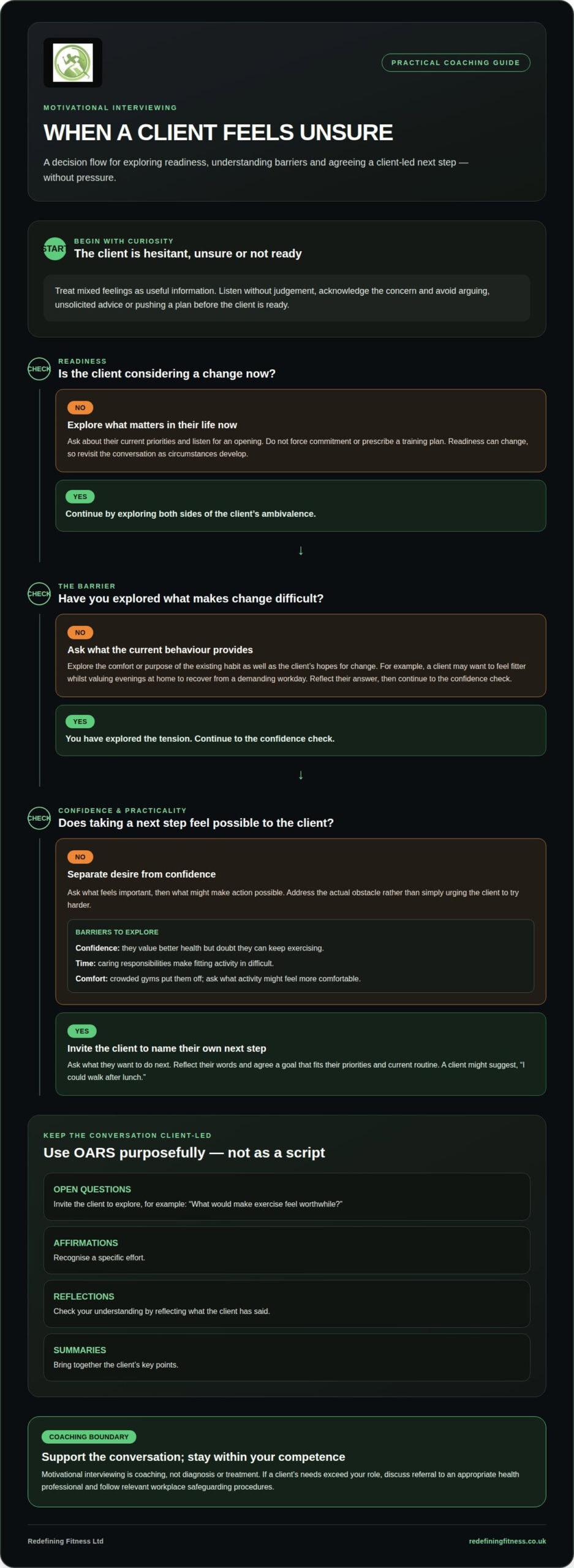
Ambivalence is the pull between wanting a change and valuing the comfort or purpose of a current habit. A client may want to feel fitter yet rely on evenings at home to recover from a demanding workday. That tension matters because a plan based only on the stated goal can overlook what the current behaviour provides. Explore both sides before discussing strategies. The client’s own explanation may reveal a more workable starting point.
During an initial consultation or goal-setting session, ask what the client hopes will change, then explore what makes change difficult. Reflect their answers and agree on a goal that fits their priorities and current routine.
Normalising Resistance and Ambivalence
Ambivalence is a normal response when a person weighs the costs and benefits of changing a familiar behaviour. A client who says, “I want to exercise, but I hate crowded gyms,” is sharing a barrier to understand, not inviting an argument. Acknowledge the concern without judgement, then ask what kind of activity might feel more comfortable. This encourages discussion rather than defensiveness.
Common mistakes include treating hesitation as laziness, giving unsolicited advice and pushing a plan before the client is ready. Avoid telling clients they are wrong. Reflect their concern and invite them to consider their options.
Confidence, Readiness and Motivation Barriers
Confidence, readiness and practical barriers all shape how ambivalence appears. Someone may value better health but doubt their ability to keep exercising, or have little time because of caring responsibilities. Separate desire from confidence: ask what feels important, then what might make action possible. This helps you choose strategies that address the actual obstacle instead of simply urging the client to try harder.
Personal trainers in the UK can develop motivational interviewing through dedicated practitioner training or continuing professional development. It is a communication skill, not a substitute for a personal training qualification. Use it to strengthen conversations about goals, confidence and readiness.
Motivational interviewing and behaviour change
Motivational interviewing supports behaviour change by drawing out the client’s own reasons for action. In personal training, that means building a programme around what the client values, rather than simply prescribing exercise.
Stages of Change and Pre-contemplation
Stages of change describe how a person’s readiness to act can shift over time, from not considering change to taking action and maintaining new behaviour. A client in pre-contemplation may not see a reason to become more physically active. Pushing a training plan can intensify resistance. Ask what matters in their life now, then listen for an opening instead of forcing commitment. Readiness can change, so revisit the conversation as circumstances develop.
Client-led Arguments for Change
Client-led arguments for change are the reasons a person gives in favour of their own next step. Ask, “What might become easier if you moved more?” and give the client room to answer. If they mention having more energy to play with their children, reflect that value rather than replacing it with a weight-loss target. Their words can make a goal personally meaningful and help them decide what action feels realistic.
Supporting Lasting Behaviour Change
Lasting behaviour change connects exercise with routines and values the client can sustain. In an exercise referral setting, a trainer can explore what activity feels manageable and what might disrupt attendance, then shape support around those answers. Motivational interviewing has also been studied in health contexts: according to The cited study’s publisher (not identified in the research facts), a 12-month study found benefits for people at high risk of cardiovascular disease, with greater improvement in BMI and cholesterol levels. According to The cited study’s publisher (not identified in the research facts), a study of 185 kids found motivational interviewing useful for improving eating behaviour, physical activity and weight loss. These findings do not promise the same result for every client.
Change Talk and Trainer Boundaries
Change talk signals a client’s reasons, desire or readiness to change. Listen for it alongside sustain talk, which favours keeping things as they are. Ask what the client wants to do next, reflect their answer and let them shape the plan. For example, “I could walk after lunch” is a client-led possibility, not a cue to impose a schedule.
Stay within your competence: motivational interviewing is coaching, not diagnosis or treatment. If a client’s needs exceed your role, discuss referral to an appropriate health professional and follow relevant workplace safeguarding procedures.
Empathy and client-centred communication
Empathy helps you understand a client’s perspective without assuming you share it. In a training session, listen closely before choosing your next coaching technique. How to use motivational interviewing with personal training clients starts with that attentive listening, not a ready-made script.
OARS Core Communication Skills
OARS describes four communication skills: open questions, affirmations, reflections and summaries. Use them purposefully, not as a script to recite. An open question such as “What would make exercise feel worthwhile?” invites more than a yes-or-no answer. An affirmation recognises a specific effort, a reflection checks your understanding and a summary brings together the client’s key points.
For example, if a client says, “I manage one walk, then work takes over,” reflect the tension: “You’ve made a start, and work keeps disrupting the routine.” Then pause. Silence gives them room to clarify or add context. A summary might connect their wish for more energy with the practical obstacle they have described. These techniques make education a two-way exchange instead of a lecture followed by passive agreement.
Collaborative Communication
Collaborative communication treats trainer and client as partners, with the client’s experience central to decisions. The trainer brings exercise knowledge; the client brings knowledge of their daily life, preferences and constraints. Neither contribution should override the other. If a client dislikes group sessions, explore what feels uncomfortable before suggesting a different activity.
This approach shapes the working relationship in practical ways. Ask permission before offering information: “Would it help to hear a few ways to build movement into your week?” After sharing options, ask what fits and what does not. The client can disagree, adapt an idea or choose another direction. That exchange makes recommendations more relevant and narrows the gap between what sounds good in a session and what feels possible outside it.
A Guiding Communication Style
A guiding style balances listening with direction. It is neither detached nor controlling. Help the client think through options without trying to solve every problem for them. If someone feels unsure about returning to exercise, ask what would make a first session manageable. Their answer might point to a quieter setting, a shorter activity or bringing a friend.
Keep your language curious and specific. Replace “You need to be more consistent” with “What tends to interrupt your routine?” If a client raises a concern, reflect it before suggesting a strategy. How to use motivational interviewing with personal training clients also means practising this balance: respect autonomy while keeping the conversation focused on change. Develop the skill through practice, feedback and education, then consider how your questions affect the client’s responses. Better communication is not softness; it is disciplined coaching.
Listening without judgement or criticism
Listen for the meaning behind a client’s words, not just the behaviour you want to change. Staying curious helps fitness professionals respond to resistance without turning a conversation into criticism.
Active Listening
Active listening means giving a client your attention, checking what you have heard and responding to their actual concern. A quick assumption can turn a useful conversation into a defence of your advice. If a client misses planned activity and says, “I’m exhausted after work,” do not label them unmotivated. Ask what their evenings involve, then let them finish before responding.
Use a simple sequence: pause, listen, reflect, then ask an open question. Put your phone aside, focus on the client and notice if you are preparing a reply instead of hearing them. You might say, “It sounds as though work leaves you with little energy for movement.” Then ask, “What kind of activity might fit better?” This explores the barrier without excusing or condemning it.
Resistance can sound like disagreement, silence or a change of subject. Treat each as information, not a challenge to your authority. If a client rejects a nutrition suggestion, avoid repeating it more forcefully. Ask what feels unhelpful about the idea, then listen. They may have concerns about time, cost, family routines or something else. Understanding the specific concern gives you a better basis for the next conversation.
Empathy and Reflective Listening
Empathetic listening means trying to understand why a client feels as they do, without having to agree. Reflective listening puts that understanding into words and gives the client a chance to correct you. If they say, “I feel out of place in exercise classes,” you could reflect, “You’re worried others might judge you.” Then pause and let them confirm or clarify.
Keep reflections accurate and neutral. Do not exaggerate, diagnose or slip advice into them. “You don’t care about fitness” is a judgement; “Getting started feels uncomfortable right now” leaves room for the client’s perspective. This distinction matters when a client describes missed sessions, frustration or an activity they dislike. Your aim is understanding, not winning an argument.
Reflective listening can also uncover mixed feelings. A client might value improved stamina yet feel apprehensive about returning to a familiar activity. Name both sides: “You want to build stamina, and you’re unsure about starting again.” Ask what they make of that tension. Keeping the client’s experience central helps you tailor the conversation instead of reaching for a stock response.
Developing discrepancy between goals and current behaviours
Discrepancy is the gap between what a client wants and what their current routine supports. Explore it with curiosity, not criticism.
Comparing Goals with Current Behaviours
Comparing goals with current behaviours means helping a client notice where their stated priorities and daily choices differ. A goal can feel more meaningful when the client connects it to their own routine. Ask, “What would being fitter help you do?” If they say, “Keep up on family walks,” explore how often they currently join those walks and what gets in the way.
Keep the comparison factual and client-led. You might summarise: “You want more energy for family walks, and work often leaves you sitting through the evening.” Then ask how the client feels about that contrast. Do not use it as evidence that they lack discipline. Their response may reveal that family time matters more than a particular fitness target, or that their schedule needs adjusting before new activity feels realistic.
Use the client’s language. If they want to feel stronger but avoid exercise after a difficult experience, reflect both points without pressing for commitment. The tension can help them consider whether their current behaviour supports the future they want. Let them decide what, if anything, they want to change.
Potential Benefits for Fitness and Weight Loss
Exploring discrepancy can help clients connect everyday choices with outcomes that matter to them. For example, a client who wants to improve fitness might recognise that a sedentary lunch break leaves little room for movement. The conversation may reveal a small action they choose themselves, such as walking for part of the break. The aim is informed commitment, not pressure.
When discussing weight-loss behaviour, avoid treating weight as the only meaningful outcome or using shame to force change. A client might care about comfort on family outings, energy for daily tasks or feeling more capable during activity. Ask which outcome matters to them, then explore how current routines support or conflict with it. Keep the discussion focused on the client’s values and choices.
Discrepancy is a prompt for reflection, not a tactic for cornering someone into agreement. If the client sees no reason to change, respect that response and keep the conversation open. If they identify a gap, ask what they want to do next and let them define a manageable step. To build your coaching practice around client-led behaviour change, explore practical coaching education.
Motivational interviewing was initially developed from experience treating alcoholism and was originally created to help people struggling with substance abuse; it is now used in the fitness industry. Motivational interviewing can help clients explore their own reasons for change and identify solutions that work for them. It recognises clients as resourceful and able to develop their own solutions when appropriate support is available, encouraging collaboration rather than confrontation so they can articulate their goals and intrinsic motivations. Planning helps consolidate commitment and develop a plan based on the client’s own insights and expertise, with timing guided by the client’s readiness.
Redefining Fitness: Level 2 & 3 Personal Training Course
Redefining Fitness offers a Level 2 & 3 Personal Training Course for people building their foundations as personal trainers. If you want to put client-centred communication into practice, a recognised personal training qualification provides a route into the profession; motivational interviewing can deepen how you listen, explore goals and support behaviour change.
The course is delivered online and in person, with blended learning and face-to-face workshops. Its wider specialist training includes kettlebells, circuits and indoor cycling, giving learners options to develop their fitness knowledge alongside personal training.
Choose this next step if you’re preparing for a career in personal training and want to build practical coaching knowledge. Visit Redefining Fitness to explore the course and get in touch.
Make Your Next Coaching Conversation Count
Professional growth begins when you consider not only what you say, but how your client responds. After a session, ask yourself whether your questions invited the client’s perspective or steered them towards your preferred answer. This honest reflection can sharpen your judgement and help you build a more deliberate coaching practice.
If you’re developing your skills in how to use motivational interviewing with personal training clients, practise in real conversations. Notice which prompts help clients think aloud, where you interrupt and whether your suggestions leave room for choice. Small adjustments can improve the quality of a coaching relationship.
Are you the fitness industry’s next best secret? Explore the Redefining Fitness Ltd prospectus and consider your next step. Back your ambition with purposeful practice, and keep raising the standard of your coaching.
Frequently Asked Questions
What is motivational interviewing and how does it apply to personal training?
Motivational interviewing helps clients make their own informed choices about change. In personal training, it can shape conversations about activity, attendance and realistic priorities instead of prescribing the same solution to everyone. For example, a London client with a long commute might prefer to move near home. Explore what fits their life, then build coaching around their decision and your professional scope.
What are the core principles and techniques of motivational interviewing for personal trainers?
The core principles are partnership, acceptance, compassion and drawing out the client’s own reasons for change. Ask permission before sharing information, then invite the client’s response. For example: “Would you like a few ideas for adding movement to your workday?” After offering options, ask which seems most relevant. This keeps education collaborative and lets the client decide whether an idea becomes part of their plan.
What are examples of open questions, affirmations, reflective listening and summaries in fitness coaching?
Try, “What would make this session feel useful today?” as an open question. An affirmation might be, “You kept looking for an option that works around your shift.” Reflective listening could sound like, “You’re keen to build strength, but unsure where to begin.” A summary might be, “You want a manageable routine, prefer home-based activity and are ready to explore bodyweight exercises.” Make each response fit what the client actually said.
How can motivational interviewing help clients who feel ambivalent about exercise or lack motivation?
It helps by exploring what attracts the client to exercise and what holds them back, without treating uncertainty as failure. Ask, “On a scale from 1 to 10, how ready do you feel to try an activity?” If they answer with a number, follow with, “Why that number rather than a lower one?” Their explanation can uncover existing reasons, strengths or preferences to build on.
How can trainers use motivational interviewing to support exercise adherence and behaviour change?
Use each check-in to learn what helped or disrupted the client’s plan, then agree on the next action together. If a client misses a planned walk, ask what happened and what would make another attempt easier. Choose an activity with the client and agree how to review it at the next session. Treat setbacks as information for refining the plan, not grounds for blame or punishment.

Nutrition Hacks for Personal Trainers: Drive Client Results
Nutrition Hacks for Personal Trainers: Drive Client Results Nutrition advice can help clients make progress, but a trainer’s role has clear…

Your First 90 Days as a New Personal Trainer: Success Plan
Your First 90 Days as a New Personal Trainer: Success Plan Your first 90 days as a new personal trainer should be about building confidence through…
