

Evidence isn’t a badge you earn by quoting studies. Evidence-based personal training combines scientific research, a coach’s professional expertise and each client’s needs to shape training decisions. The standard is simple: use evidence thoughtfully, then test whether your approach makes sense for the person in front of you.
You already know a programme should be more than a collection of exercises. But knowing what works means looking beyond confident claims, familiar routines and impressive-sounding jargon. Good coaching asks sharper questions: how strong is the evidence, what does it measure, and does it apply to this client?
This guide explains how coaches assess research and evidence hierarchies, interpret findings on lean body mass and muscle size, and distinguish useful conclusions from overconfident claims. You’ll see how scientific knowledge informs programme design without replacing judgement, creativity or attention to individual needs. That’s the difference between repeating what sounds convincing and coaching with rigour.
Table of Contents
- What Is An Evidence-Based Approach?
- Assessing the Quality of Scientific Evidence
- Evidence hierarchies and grading systems
- Definition of evidence-based personal training
- What does the scientific evidence say about effective strength and cardio training?
- Redefining Fitness Ltd: Level 2 & 3 Personal Training Course
What Is An Evidence-Based Approach?
Evidence-based practice combines research, professional expertise and the individual client’s needs. In personal training, it helps you make decisions you can explain, test and adapt, rather than blindly follow a popular routine.
Meaning and History of Evidence-Based Practice
Evidence-based practice means combining the best available research with professional judgement and the needs of the person receiving support. In HR and learning and development, teams can apply the same principle when choosing an intervention, then assess whether it works. Evidence-based medicine and the broader term evidence-based practice came into use during the 1990s among researchers at McMaster University.
David Sackett led the Centre for Evidence-Based Medicine at the University of Oxford from 1994 to 1999. That history matters to coaches because evidence-based work is not a trendy exercise formula; it is a disciplined way to judge decisions. A training plan can draw on research and still require thoughtful interpretation for a particular client.
Benefits and Limitations of Evidence-Based Practice
Evidence-based practice gives coaches a stronger basis for choosing exercises, setting goals and reviewing progress. It also exposes weak claims, such as confident explanations that blame a client’s pain on a tight hip flexor or weak core. Check the evidence before repeating them. A fitness trend may offer a compelling story, but evidence-based practice asks whether reliable findings support it and whether it suits the client.
Evidence has limits. A randomised controlled trial is one research design, not an automatic guarantee of quality, while case studies can be useful when a well-controlled trial is impractical. Research also cannot answer every question about an individual’s preferences or circumstances. Treat evidence as a guide, not a script that removes professional judgement.
Trainer Expertise and Client-Centred Practice
Trainer expertise connects research findings to the person doing the training. A study may support a strength programme in general, but a coach still needs to consider the client’s goals, experience, preferences and response. That combination keeps evidence-based personal training practical: scientific knowledge informs the plan, while the coach’s skill shapes its delivery.
Assess goals, current fitness and relevant health risks through a focused conversation and suitable screening before programming. Clarify what the client wants, what activity they currently manage and what health information could affect exercise choices. Use the answers to shape the plan; a standard template cannot replace individual assessment. For more on common pitfalls in screening and programme planning, see personal trainer mistakes to avoid.
Applying Evidence in Practice
Start with one clear question, such as whether a particular exercise approach improves a client’s strength or function. Look for peer-reviewed research and supporting documents, then compare the methods and outcomes with the client’s circumstances. In HR and learning and development, teams can begin by tracking one or two key metrics on a simple dashboard.
Pilot an approach before expanding it, and record a baseline before judging change. In coaching, that could mean tracking an agreed performance measure, reviewing it consistently and adapting the programme when results or client feedback call for it. In the UK, look for a personal trainer with a relevant qualification who can explain the evidence behind their decisions and connect it to your goals.
Assessing the Quality of Scientific Evidence
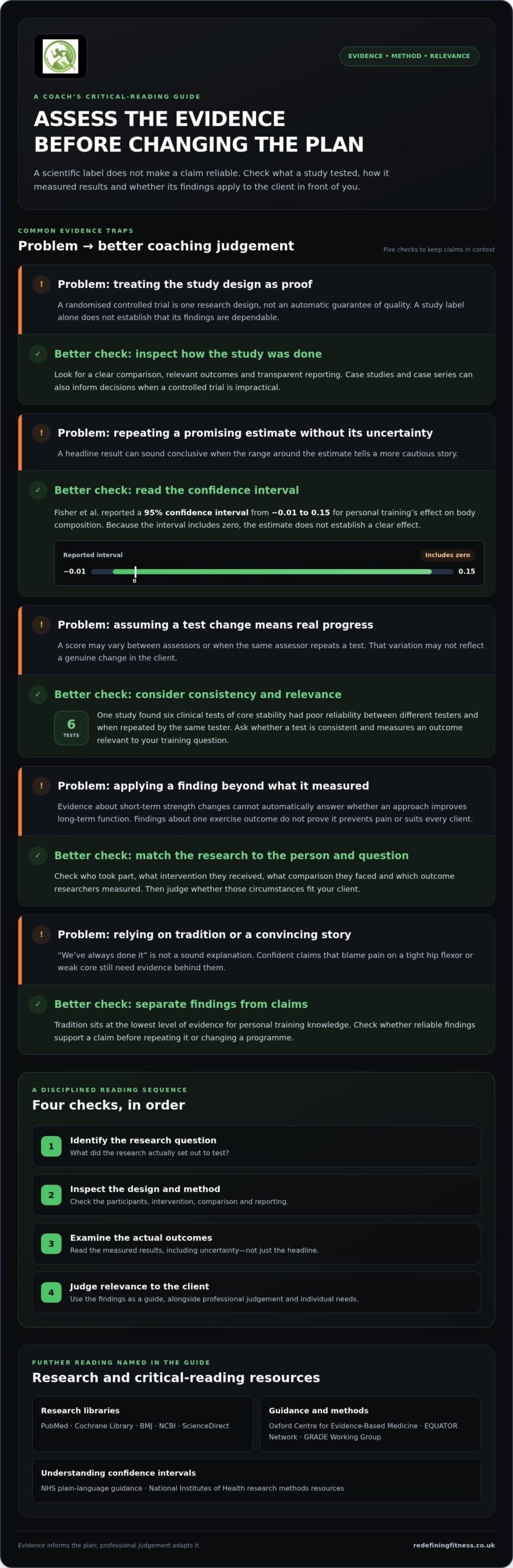
A scientific label doesn’t make a claim reliable. Assess the method, outcome and fit for your client before changing a programme. Tradition sits at the lowest level of evidence for personal training knowledge, so “we’ve always done it” is not a sound explanation. Search resources such as PubMed and the Cochrane Library, but judge each study on its merits.
Start by asking what question the research tested. A trial about short-term strength changes cannot automatically answer whether an approach improves long-term function. Check who took part, what intervention they received, what comparison they faced and which outcome researchers measured. Resources from the Oxford Centre for Evidence-Based Medicine and the EQUATOR Network can support critical reading and understanding of research reporting.
Study design matters, but it doesn’t settle quality by itself. Randomised controlled trials can help compare interventions, yet coaches should critically analyse their data rather than treating the label as proof. Look for a clear comparison, relevant outcomes and transparent reporting. The BMJ and NCBI provide research and reporting resources; case studies and case series can also inform decisions when a controlled trial is impractical.
Numbers need interpretation, not just repetition. Fisher et al. reported a 95% confidence interval from -0.01 to 0.15 for personal training’s effect on body composition. Because that interval includes zero, the estimate does not establish a clear effect. To understand confidence intervals, use plain-language guidance from the NHS or research methods resources from the National Institutes of Health. Don’t quote only the promising result.
Measurement quality matters too. One study found six clinical tests of core stability had poor reliability between different testers and when repeated by the same tester. If a measurement changes between assessors or repeat attempts, it may not show genuine client progress. Before using a test, consider whether its result is consistent and whether it measures an outcome relevant to your training question. The GRADE Working Group explains a separate approach to judging confidence in evidence.
Use a disciplined reading sequence: identify the research question, inspect the design, examine the actual outcomes, then judge relevance. Keep the subject narrow. For example, evidence about one exercise’s effect on strength doesn’t prove it prevents pain or suits every client. Separate what findings demonstrate from what a headline or social post claims. Review articles indexed by ScienceDirect with the same critical lens.
That standard takes practice. Compare a study’s conclusion with its methods and measured results, then record why you applied or rejected its findings. Confidence should come from sound judgement, not scientific-sounding language.
Evidence hierarchies and grading systems
An evidence hierarchy ranks research designs by how well they answer a question. For exercise training, systematic reviews of randomised controlled trials sit at the highest level in the hierarchy described here. That ranking helps coaches prioritise evidence, but it doesn’t make every review trustworthy. Appraise the methods, participants and outcomes carefully.
A systematic review brings together relevant studies using an organised method. A review of randomised controlled trials can show whether findings point in a consistent direction across studies. Yet a flawed review may still provide a weak answer if its included studies have limitations or address different questions. Read the methods and conclusion together, not just the title.
Below that top tier, evidence can include individual randomised controlled trials, non-randomised controlled trials, case reports and case series. These designs contribute different kinds of information. A case report may describe an individual response; a controlled trial can compare outcomes between groups. Expert opinion can offer practical insight, but it carries less weight than systematically gathered research in the hierarchy.
Think of the hierarchy as a starting point, not a verdict. A systematic review may address an exercise unlike the one your client performs, or measure strength when your client’s goal is daily function. The evidence may be methodologically strong yet poorly matched to the decision. Relevance matters as much as rank.
GRADE offers another way to assess evidence, using four levels to judge the evidence for an intervention’s effects. The distinction is that a hierarchy classifies evidence by design, while grading considers how much confidence to place in its conclusions. For a training decision, ask what outcome was measured, how consistently studies found it, and whether the evidence answers your question.
Apply both lenses systematically. First, define the decision, such as choosing between two exercise approaches. Next, locate the strongest relevant evidence and identify its design. Then examine its limitations and fit for the client’s goal. Finally, explain the decision in plain language and review whether the chosen outcome changes. This sequence turns an evidence label into practical coaching judgement.
Don’t treat a single study as the final answer. A small trial may raise a useful question, while a systematic review may show whether that finding appears across research. Equally, a high-ranking review cannot settle every individual programming choice. Strong practice weighs evidence quality, relevance and the client’s circumstances together.
Definition of evidence-based personal training
Evidence-based personal training combines scientific knowledge with the craft and creativity of programme design. It isn’t a fixed workout style or a promise that one method suits everyone. A coach uses research to inform choices, applies professional judgement to the client’s needs, and reviews whether the plan remains appropriate. The takeaway is clear: evidence guides coaching, it doesn’t replace it.
This standard matters because training decisions involve more than selecting exercises. A coach might use research to inform strength programming, then adapt exercise choice, workload and progression to the client’s experience and preferences. Nutrition can also affect training goals, but advice should stay within the coach’s competence. Evidence-based personal training means understanding what informs a decision and where its boundaries lie.
Consider a client who wants to improve strength. Agree on what progress means, select relevant exercises and record a suitable baseline. Review the client’s response and adjust the programme when performance, circumstances or goals change. This makes evidence-based personal training a process of informed decisions and ongoing review, rather than treating a controlled study as a ready-made prescription.
In the UK, Level 2 and Level 3 personal-training qualifications offer a structured route into the profession. Personal-training qualifications can provide a structured route into the profession. A qualification develops foundations, but coaches also need critical thinking: they must interpret research, communicate decisions clearly and recognise when a question falls beyond their expertise.
A personal trainer’s cost in the UK depends on factors such as session format, location and service provided; the price depends on the case and is given after a quote request. The deciding factors are the support involved and how the service is delivered.
Training carries risks if exercise choices, technique or progression don’t suit the person. Reduce avoidable risk by discussing relevant health history and goals, choosing manageable exercises, teaching technique and progressing in response to the client. If pain or other concerning symptoms arise, pause the activity and reassess the plan instead of pushing through.
Ultimately, evidence-based personal training is a standard for making decisions, not a trend or badge. It brings together research, professional skill and the client’s current needs, then uses review to keep the programme relevant. The test is direct: can you explain why a choice fits this person and adapt it when their needs change?
What does the scientific evidence say about effective strength and cardio training?
Research doesn’t hand every coach one perfect programme. It shows how outcomes vary across interventions, participants and measures, giving you evidence to interpret. Strength studies may measure lifting performance or lean body mass; cardio studies may focus on endurance or another defined outcome. Don’t treat one result as proof that a method works identically for every client.
Storer et al. reported that the independent-training group increased chest-press strength by 19% and leg-press strength by 25%. The supervised group gained 1.3 kg of lean body mass. These findings illustrate why outcome measures matter: strength and body composition are distinct results, not interchangeable labels for success.
Those figures need context. They describe the groups in a study, not a guaranteed individual outcome or a universal forecast for supervised training. Ask what the study compared, who participated and how researchers measured change. Then consider whether those conditions resemble the client’s starting point, goals and training experience.
For strength work, define the target before choosing a programme. If a client wants to lift more, track a relevant strength measure; if their priority is lean body mass, use a suitable body-composition measure. Keep the outcome, assessment and training decision aligned. Otherwise, a coach may claim progress without measuring the result the client wanted.
Cardio decisions need the same discipline. Identify whether the client’s aim concerns endurance, general activity or another outcome. Then choose an appropriate exercise mode and progression, and review the response against that aim. Cycling and walking are different methods; neither is superior without a clear comparison and relevant outcome.
Strength and cardio can both form part of a programme, but evidence doesn’t remove the need for individual judgement. Account for the client’s preferences, current ability and response as training develops. If progress stalls, revisit the exercise choice, outcome measure and plan’s fit before simply adding more work.
Use study findings to support decisions, not as sales claims or promises. For example, the Storer et al. results can inform discussion about supervised training and measured outcomes, but they don’t establish what every client will achieve. Explain the evidence accurately, set a meaningful measure and review it consistently. That is how research becomes useful coaching, not impressive numbers without context.
Build the skill to interpret training findings and apply them with care through evidence-led personal training education.
Redefining Fitness: Level 2 & 3 Personal Training Course
Redefining Fitness offers Level 2 and Level 3 personal trainer qualifications, delivered online and in person. If you’re building the foundations to coach with rigour, the course offers a structured route into personal training. Learning combines blended study with face-to-face workshops, bringing theory into practical coaching contexts.
Specialty workshops in kettlebells, circuits and indoor cycling can broaden your understanding of different training formats. Connect research with sound judgement: question claims, understand the client’s goals and choose an approach you can explain. That discipline gives your coaching a stronger foundation than copying a trend or relying on habit.
Ready to develop your coaching knowledge? Visit Redefining Fitness online to explore the courses or get in touch.
Make Rigour Your Next Coaching Standard
Your next step isn’t collecting more impressive-sounding claims. It’s building the judgement to ask better questions, choose meaningful measures and adapt your coaching when a client’s needs change. That work continues beyond any single qualification or programme. Make curiosity part of your practice, and let clear reasoning shape your choices on the gym floor.
Evidence-based personal training becomes meaningful when clients can see that their goals guide decisions, not trends or habit. You don’t need to pretend every answer is simple. You do need to explain your reasoning, recognise the limits of a finding and keep learning as your experience grows. That’s how you earn trust through professional substance.
Are you the fitness industry’s next best secret? Take the next step and contact Redefining Fitness Ltd to explore your development. Bring your ambition, do the work and keep raising your standard. Your coaching can make a difference when your decisions have thought behind them.
Frequently Asked Questions
Which sources of evidence should I use and which are most trustworthy?
For a practical coaching question, search peer-reviewed journals and research databases rather than relying on social media summaries or fitness magazine headlines. Check the publication date and whether the article is original research, a review or commentary. Then read beyond the abstract: the discussion may identify limits that change how you interpret the findings. Keep a record of useful papers, including their topic and conclusions, so you can revisit them when similar questions arise.
Who is Personal Training for?
Personal training suits people who want structured exercise support shaped around their circumstances. A beginner might need help learning gym equipment, while an experienced runner could seek strength work that fits their running routine. It can also suit someone rebuilding confidence after time away from exercise. The starting point isn’t a particular fitness level; it’s a goal the person wants to work towards and a coaching approach they can sustain.
What is evidence-based personal training?
Evidence-based personal training is a way of making coaching decisions that treats evidence as part of the process, not a slogan. In practice, a trainer can explain why a choice suits the client and what would prompt a change. For example, if a client’s work pattern shifts, the coach may need to reconsider the session structure. The approach values clear reasoning, flexibility and a plan connected to the person.
How do personal trainers use research to create and adapt training programmes?
Trainers can use research to inform exercise selection, progression and how to assess a goal. They then turn those choices into a workable routine, considering practical details such as equipment access, available time and the client’s preferred activities. A client who dislikes crowded gyms, for example, may engage better with a different setting or exercise format. Regular conversation helps the trainer notice when circumstances change.
How can I check whether a personal trainer’s advice is supported by evidence?
Ask for a clear explanation in everyday language, including what the recommendation is meant to achieve and how you’ll review it together. Notice whether the trainer listens to your concerns and adapts the explanation to your situation, rather than relying on jargon or presenting one approach as suitable for everyone. You can also ask what would lead them to change the plan. A thoughtful answer makes the reasoning understandable.
Where can I find a qualified evidence-based personal trainer in the UK?
Look for a UK personal trainer with a relevant qualification who can explain the evidence behind their decisions and connect it to your goals.

Nutrition Hacks for Personal Trainers: Drive Client Results
Nutrition Hacks for Personal Trainers: Drive Client Results Nutrition advice can help clients make progress, but a trainer’s role has clear…

Your First 90 Days as a New Personal Trainer: Success Plan
Your First 90 Days as a New Personal Trainer: Success Plan Your first 90 days as a new personal trainer should be about building confidence through…
