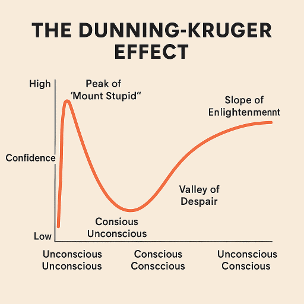
The Dunning–Kruger Effect in Fitness: Why Incompetent People Often Rise To The Top
The Dunning-Kruger effect in fitness is a term for explaining overconfidence in ones ability that is disproportionate to ones ability, knowledge and experience. The term doesn’t just apply to the fitness industry has no shortage of people who are absolutely certain they know what they are talking about. Some have impressive physiques, thousands of followers and an answer for every question. Others have completed a handful of qualifications and quickly develop strong opinions about exercise science, nutrition, biomechanics, rehabilitation and human behaviour. They speak with certainty, dismiss alternative perspectives and often appear convinced that anyone who disagrees simply does not understand the subject.
The problem is not that these people necessarily know nothing. In many cases, they know enough to be convincing, but not enough to recognise the limitations of their understanding. They may understand a handful of training principles without appreciating how those principles interact, have experience of one successful approach without knowing when it will fail, or understand a scientific concept without being able to evaluate the research supporting it. Their knowledge is real, but their assessment of its depth may be inaccurate.
This is where the Dunning–Kruger effect becomes relevant. The concept emerged from research by psychologists David Dunning and Justin Kruger, who investigated how accurately people assess their own abilities. Their work suggested that people with limited competence in certain tasks can struggle to recognise their own shortcomings, partly because the skills required to perform well are also needed to evaluate performance accurately. In other words, someone may lack not only the knowledge required to do something well, but also the knowledge required to recognise why they are doing it poorly.
In fitness, this can have consequences for the quality of advice people receive, the development of personal trainers and the way misinformation spreads online. However, the research is more nuanced than the popular internet version of the effect suggests. Understanding what the studies actually demonstrate—and what they do not—is essential if we want to use the concept to improve professional competence rather than simply insult people we disagree with.

What Is The Dunning–Kruger Effect?

The Dunning–Kruger effect takes its name from the 1999 paper by David Dunning and Justin Kruger, Unskilled and Unaware of It: How Difficulties in Recognizing One’s Own Incompetence Lead to Inflated Self-Assessments, published in the Journal of Personality and Social Psychology. In their experiments, the researchers assessed participants on tasks involving humour, logical reasoning and grammar. They found that participants who performed poorly tended to overestimate their relative performance, while stronger performers were generally better able to assess their abilities.
The explanation proposed by the researchers was particularly interesting. Competence requires more than knowing how to perform a task; it also requires the ability to recognise what good performance looks like. Someone with limited knowledge of grammar, for example, may struggle to identify grammatical errors in their own work. Someone who does not understand the principles of logical reasoning may have difficulty recognising flaws in their own arguments. The same general problem can arise when evaluating fitness information: if a person lacks the knowledge needed to assess a claim, they may also lack the knowledge needed to recognise that their assessment is incomplete.
Imagine a trainer who has learned that progressive overload is important for muscle growth. They may correctly explain that training needs to provide a sufficient stimulus over time. However, they might then conclude that every client should increase the weight or repetitions at every session, without considering fatigue, technique, recovery, training status or the purpose of the programme. The initial principle is valid, but the application is simplistic. If the trainer does not understand the variables they have overlooked, they may be unable to recognise the weakness in their own reasoning.
The effect is not simply about people being arrogant or unintelligent. It concerns the relationship between ability, self-assessment and the information available to a person when judging their own performance. Nor does it mean that everyone with limited knowledge is overconfident or that experts are always accurate about their own abilities. It describes a pattern observed in particular research settings, not a universal rule that can be used to diagnose someone from a social media post.
Why Limited Knowledge Can Produce Excessive Confidence
A major problem in learning is that beginners often do not yet know which questions they should be asking. When someone first encounters exercise science, they may discover a handful of powerful concepts: energy balance, progressive overload, specificity, recovery, protein intake and training volume. These concepts explain a great deal, and learning them can produce a genuine improvement in understanding. However, the initial simplicity can create the impression that the entire subject is now understood.
As knowledge develops, the picture becomes more complicated. The trainee discovers that a useful principle can have exceptions, that two apparently contradictory studies may be investigating different outcomes, and that recommendations depend on individual circumstances. They learn that understanding a concept is different from evaluating evidence for it, and that knowing what tends to work is different from knowing how to apply it to a particular person. Greater knowledge can therefore produce more careful judgements rather than greater certainty about every question.
Consider nutrition. A beginner may learn that weight loss generally requires an energy deficit and conclude that every weight-management problem is straightforward. The underlying principle is important, but applying it in practice involves appetite, food preferences, adherence, sleep, medications, environment, psychological factors and the person’s ability to sustain a change. Recognising these variables does not invalidate energy balance. It helps explain why a scientifically sound principle can still require considerable skill to apply effectively.
The same applies to programme design. Knowing that training volume influences hypertrophy is useful, but deciding how much volume an individual should perform requires consideration of training experience, exercise selection, effort, recovery, available time and response to the programme. A trainer who understands only the basic relationship may feel equipped to prescribe a universal answer. A trainer with deeper knowledge is more likely to ask what the evidence supports, what information is missing and how the recommendation should be adjusted.
The danger is mistaking the first layer of understanding for the whole subject. Initial learning often provides enough knowledge to explain an idea confidently, but not necessarily enough to recognise its limitations or apply it well in every situation.
The Original Research: What Dunning and Kruger Actually Found
The original 1999 research is often reduced to a cartoon version of human psychology: incompetent people think they are geniuses, while intelligent people doubt themselves. That is not an accurate description of the findings. Kruger and Dunning studied performance and self-assessment across several tasks, and their results suggested that people who performed poorly tended to overestimate their relative performance. However, the participants were not necessarily convinced they were exceptional. Their estimates were inaccurate in relation to their actual results, and the researchers proposed that limited competence also restricted their ability to identify their mistakes. Read the original paper via PubMed.
The distinction matters because the effect is frequently used as an insult rather than as a concept for understanding judgement. Calling somebody a victim of Dunning–Kruger because they disagree with you does not demonstrate that they are incompetent. It may simply mean that you disagree with them. To apply the concept meaningfully, you would need evidence of their actual performance, how accurately they assess it and whether their confidence is miscalibrated. A loud opinion, a bad argument or an irritating personality is not enough to establish the effect.
There is also an important scientific debate about how the original findings should be interpreted. Researchers have argued that some commonly used methods of demonstrating the effect can produce misleading patterns through statistical artefacts, including regression to the mean and the way people are divided into performance groups. A 2020 paper titled The Dunning–Kruger effect is (mostly) a statistical artefact argued that the conventional analytical approach can be confounded and found no significant evidence for the hypothesised pattern using two alternative statistical tests in its sample. This does not establish that people never overestimate their abilities; it shows that the size, interpretation and measurement of the effect deserve careful scrutiny.
The broader issue of inaccurate self-assessment remains important even if the popular version of Dunning–Kruger is oversimplified. People can be poor judges of their own performance, and confidence does not reliably track competence in every domain. A review of research on flawed self-assessment discusses these problems across health, education and workplace settings, highlighting the limitations of relying on self-perception alone. Read the review on PubMed.
For personal trainers, the useful takeaway is not that beginners are stupid or experts are always self-doubting. It is that self-confidence should be tested against external evidence, practical performance and feedback. The more consequential the professional decision, the less sensible it is to rely on confidence alone.
The Dunning–Kruger Effect in Fitness

The concept becomes more directly relevant to fitness when we move beyond general psychology experiments and examine actual coaching. A study by Philip Sullivan, Matthew Ragogna and Lori Dithurbide investigated the relationship between perceived and assessed coaching ability among 94 high-school volleyball coaches. The researchers compared coaches’ self-reported coaching efficacy with assessments of their coaching ability and found that coaches in the lowest performance quartile rated their efficacy higher than their assessed ability, while those in the highest quartile rated their efficacy lower than their assessed ability. Read the study, An investigation into the Dunning–Kruger effect in sport coaching.
This is particularly relevant because coaching involves more than knowing the theory. A coach must make decisions, observe performance, communicate instructions and adapt their approach when something does not work. If a coach cannot accurately identify weaknesses in their own practice, they may have difficulty recognising the need for development. A trainer might believe they are excellent at motivating clients, for example, when their communication style is actually making some clients feel judged or overwhelmed. Without meaningful feedback, that gap can remain invisible to the trainer while being obvious to the people they coach.
However, one study involving volleyball coaches does not establish that all inexperienced personal trainers overestimate their ability, nor does it prove that every confident coach is incompetent. The study provides evidence that discrepancies between self-perceived and assessed ability can occur in a real coaching environment. It is a useful reason to take assessment and feedback seriously, not a licence to diagnose people from their behaviour online.
A related question is whether the same pattern applies to physical performance itself. Research published in the International Journal of Sport and Exercise Psychology examined whether the effect could occur in a motor-performance task, using hand-grip strength and participants’ estimates of their performance. Read the study on motor performance and self-assessment. The wider point is that self-assessment can be difficult even when performance is measurable. In personal training, therefore, objective assessments, observed coaching sessions and client feedback can provide information that a trainer’s own confidence cannot.
Fitness Influencers: When Reach Is Mistaken for Expertise

Social media introduces another complication: fitness influencers are often rewarded for being visible, memorable and engaging rather than for demonstrating the accuracy of every claim they make. A creator who communicates with certainty, has an impressive physique and produces entertaining videos may attract a large audience. Those qualities can make their content appealing, but they do not independently establish scientific competence.
Research published in the Academy of Management Journal examined fitness and nutrition influencers on Instagram, following 488 social media entrepreneurs over six months. The study, titled I Don’t Need a Degree, I’ve Got Abs: Influencer Warmth and Competence, Communication Mode, and Stakeholder Engagement on Social Media, investigated how visual and written communication, along with perceived competence and warmth, related to different forms of audience engagement. The findings highlight that the signals which attract followers are not necessarily identical to those that encourage more active engagement.
This helps explain why popularity is a poor substitute for professional assessment. A viewer may interpret an impressive physique as evidence of knowledge about nutrition, or assume that a creator with millions of followers must be highly competent because so many people appear to trust them. Yet followers are not an examination board, and engagement is not a scientific peer review process. Audiences may be responding to humour, controversy, aspiration, appearance or the creator’s ability to simplify complicated topics.
Consider an influencer who confidently announces that one particular training method is the only effective way to build muscle. They may have an impressive physique and considerable experience using that method. Their personal results provide some evidence that the method can work for them, but they do not establish that it is the only effective approach or that it is optimal for every individual. The influencer may genuinely believe the claim because their experience has been successful. The problem is that their confidence has exceeded what their evidence can justify.
The same issue can affect qualified professionals. A trainer may have a degree, several certifications and years of experience but still become overconfident outside their area of expertise. The relevant question is not whether someone has qualifications or lacks them. It is whether their knowledge matches the claim they are making and whether they recognise the limitations of that knowledge.
Real-World Examples: The Difference Between Confidence and Competence
Public figures offer useful illustrations of how confidence can influence perception, but their cases should not be treated as direct evidence of the Dunning–Kruger effect. Establishing that effect requires information about someone’s actual ability and their self-assessment, not simply evidence that they are outspoken or controversial. The examples below illustrate the broader distinction between projected certainty and demonstrated competence.
Conor McGregor is a particularly useful example because his confidence was accompanied by genuine sporting achievement. His ability to promote fights, psychologically unsettle opponents and project certainty helped make him one of the most recognisable figures in mixed martial arts. He also achieved major competitive success, including becoming the UFC’s first simultaneous two-division champion. It would therefore be inaccurate to dismiss his confidence as nothing more than empty bravado. His career demonstrates that confidence and competence can coexist.
The more relevant lesson is that competence is domain-specific. McGregor’s success in combat sports does not automatically establish expertise in exercise science, nutrition, rehabilitation or personal training. Nor does sporting success guarantee that every future prediction will be correct. Performance has to be assessed in the domain where it is claimed. A successful athlete may have valuable practical experience, but the quality of their scientific or coaching advice still depends on its merits.
Andrew Tate illustrates a different issue: the persuasive power of a public persona built around certainty, status and dominance. His public image encourages audiences to associate confidence and displays of wealth with success. Those signals can influence perception, but they do not independently establish expertise or validate the claims he makes. It would be unjustified to diagnose Tate with the Dunning–Kruger effect based on his public persona alone. The relevant lesson is that confidence, popularity and perceived status are not reliable substitutes for examining evidence.
The same principle applies to the personal trainer who confidently dismisses all other training methods, the nutrition influencer who claims to have found a universal solution to weight loss, or the coach who treats years of experience as proof that their methods cannot be wrong. Their confidence may be genuine, but the quality of their knowledge must be assessed separately. The question is not how certain someone sounds; it is how well their claims withstand scrutiny.
Why Experts Sometimes Sound Less Certain
An experienced professional may sound less decisive than a beginner because they understand how many variables can affect an outcome. This does not mean that expertise necessarily produces self-doubt, nor that hesitation proves someone knows more. It means that deeper knowledge can reveal complexity that was invisible when the subject was unfamiliar.
A beginner might confidently prescribe the same programme to every client because they have learned a simple principle and have not yet encountered its limitations. An experienced trainer may recognise that the appropriate programme depends on the client’s training history, goals, recovery, preferences, available equipment and response to previous training. The experienced trainer can still make a clear recommendation, but they may be more careful about presenting it as universally correct.
This distinction is especially important when discussing research. Someone with limited scientific literacy may interpret one study as definitive proof. Someone who regularly evaluates research is more likely to consider study design, sample characteristics, measurement methods, limitations and consistency with the wider evidence. The result is not necessarily indecision. It is a more accurate understanding of what can be concluded.
A good professional should therefore be confident where the evidence is strong, cautious where uncertainty remains and willing to revise their position when new information warrants it. Confidence is useful when it reflects a sound basis for judgement. It becomes a liability when the desire to appear certain prevents someone from recognising a mistake.
How Personal Trainers Can Avoid Overestimating Their Competence
The practical response is to build systems that test self-assessment against reality. Trainers should seek feedback from clients, peers and suitably experienced mentors, and should be willing to have their coaching observed and assessed. Feedback is most useful when it concerns specific behaviours and outcomes rather than vague judgements about whether someone is a good or bad trainer. For example, asking whether a client understood an exercise demonstration or felt comfortable discussing barriers to training provides more actionable information than simply asking whether the session was good.
Objective measures can also help. If a trainer claims to be skilled at improving strength, client progress should be evaluated using appropriate assessments and consistent testing conditions. If they claim to be effective at retaining clients, retention and attendance data can provide useful evidence. If they believe their explanations are clear, they can ask clients to describe the plan back to them or explain what they understood from the session. No single measure captures the entire quality of coaching, but multiple sources of feedback are more informative than self-perception alone.
Continuing professional development is another safeguard. A trainer should regularly revisit their understanding, evaluate new evidence and recognise when a question falls outside their scope of practice. This is not an admission of incompetence; it is a normal part of responsible professional development. The aim is to become more capable while also becoming more accurate about the limits of one’s current knowledge.
Most importantly, trainers should be able to separate confidence from identity. If being seen as an expert becomes central to someone’s self-image, acknowledging uncertainty or correcting an error can feel like a threat. When the priority is delivering a good service, however, changing one’s mind becomes a sign of professional responsibility. A trainer who corrects a mistake is not necessarily less credible than one who never admits to making one. In many circumstances, the willingness to learn is a stronger indicator of professional maturity.
The Verdict: The Goal Is Not to Sound Like an Expert, but to Become One
The Dunning–Kruger effect is useful because it highlights a genuine problem in self-assessment: people cannot always recognise the limits of their own ability, and the knowledge needed to perform well can overlap with the knowledge needed to judge performance accurately. Research in coaching provides a relevant example of discrepancies between self-perceived and assessed ability. However, the popular version of the effect is oversimplified, and statistical debates mean it should not be used as a universal explanation for overconfidence.
For personal trainers, the central lesson is straightforward. Qualifications, experience, physique, confidence and social media popularity can all provide relevant information, but none independently guarantees competence. What matters is whether a trainer can apply their knowledge effectively, evaluate evidence, recognise uncertainty, respond to feedback and produce appropriate outcomes for clients.
A strong professional does not need to pretend to know everything. They need to know enough to make sound decisions, recognise when they need more information and seek help when a problem exceeds their expertise. The objective is not to eliminate confidence, but to calibrate it against reality.
The more useful question is not whether you think you are good at your job. It is what evidence you have that you are—and what you are doing to improve.
Frequently Asked Questions
What is the Dunning–Kruger effect in simple terms?
The Dunning–Kruger effect describes a pattern identified in research where people who performed poorly on particular tasks tended to overestimate their relative performance. The researchers suggested that limited competence can also make it harder to recognise mistakes. The concept does not mean that every inexperienced person is arrogant or that every expert lacks confidence.
Does the Dunning–Kruger effect apply to personal trainers?
Research involving high-school volleyball coaches found discrepancies between self-perceived coaching efficacy and assessed coaching ability, making the concept relevant to professional coaching. However, the findings should not be generalised to every personal trainer without further evidence. The practical lesson is to use objective assessment and feedback rather than relying entirely on self-evaluation.
Are fitness influencers affected by the Dunning–Kruger effect?
An influencer may overestimate their expertise, but popularity or confidence alone cannot establish that they are affected by the effect. The appropriate approach is to examine their actual knowledge, the accuracy of their claims and their ability to assess their own limitations. An impressive physique or large following is not proof of scientific competence.
Do experts always underestimate their abilities?
No. Some studies have found that high performers underestimate their relative performance on particular tasks, but this is not a universal rule. Experts can be confident, overconfident or poorly calibrated, depending on the person, task and context. The relationship between competence and self-assessment is more complicated than the popular internet diagram suggests.
How can you avoid the Dunning–Kruger effect?
You cannot eliminate every error in self-assessment, but you can reduce reliance on it. Seek specific feedback, compare your performance with objective standards where possible, examine the evidence supporting your decisions and remain open to correcting mistakes. Regular assessment and continuing development help ensure that confidence does not become disconnected from competence.
Develop Your Professional Competence with Redefining Fitness

At Redefining Fitness, fitness education is about more than learning exercises and memorising theory. Personal trainers need to understand exercise science, apply it in practice, evaluate information critically and develop the communication and professional judgement required to work with real clients. Qualifications provide a foundation, but practical development and a willingness to keep learning are essential to becoming a capable professional.
The Redefining Fitness team has collectively taught, assessed and mentored more than 2,000 students. The business has received industry recognition, including the Prestige Awards Fitness Training Provider of the Year for South East England in 2023, Fitness Education Company of the Year awards and recognition in the Elite Business Top 100 SMEs in 2024. These achievements provide context about the organisation, but the objective remains the development of professionals who can apply their knowledge responsibly.
If you are considering a career in personal training, explore the Redefining Fitness website to learn more about its approach to fitness education. You can also read about the team’s experience on the Meet the Team page and explore guidance on becoming a successful personal trainer.
The fitness industry does not need more people who simply sound convincing. It needs professionals who can evaluate evidence, recognise their limitations, respond to feedback and demonstrate their competence through the quality of their work.
References and Further Reading
-
Kruger, J. and Dunning, D. (1999). Unskilled and Unaware of It: How Difficulties in Recognizing One’s Own Incompetence Lead to Inflated Self-Assessments. Journal of Personality and Social Psychology.
-
Sullivan, P. J., Ragogna, M. and Dithurbide, L. (2018). An Investigation into the Dunning–Kruger Effect in Sport Coaching. International Journal of Sport and Exercise Psychology.
-
The Dunning–Kruger Effect Is (Mostly) a Statistical Artefact. Intelligence.
-
Dunning, D. and colleagues. Research on flawed self-assessment in health, education and the workplace.
-
Can the Dunning–Kruger Effect Occur in the Motor Performance Domain?. International Journal of Sport and Exercise Psychology.
-
Roccapriore, A. Y. and Pollock, T. G. (2023). I Don’t Need a Degree, I’ve Got Abs: Influencer Warmth and Competence, Communication Mode, and Stakeholder Engagement on Social Media. Academy of Management Journal.
-
CIMSPA professional standards, outlining professional expectations in sport and physical activity.