

To understand how to choose a personal trainer in the UK, start with their Level 3 personal training qualification, then judge whether their experience matches your goals and health needs. The right trainer should be able to explain how they’ll adapt your sessions, not just promise a hard workout. Your schedule, budget and comfort with their coaching style matter too.
It makes sense to look for someone who motivates you, but a confident pitch or impressive physique doesn’t prove they’re the right fit. Look for clear communication, relevant expertise and an approach to training you can sustain.
This guide explains how to compare qualifications, specialisms, costs, availability and coaching styles. You’ll also learn what to discuss if you have an injury or health condition, and how to decide whether a trainer’s approach works for you.
Table of Contents
Assessing time, budget and learning preferences
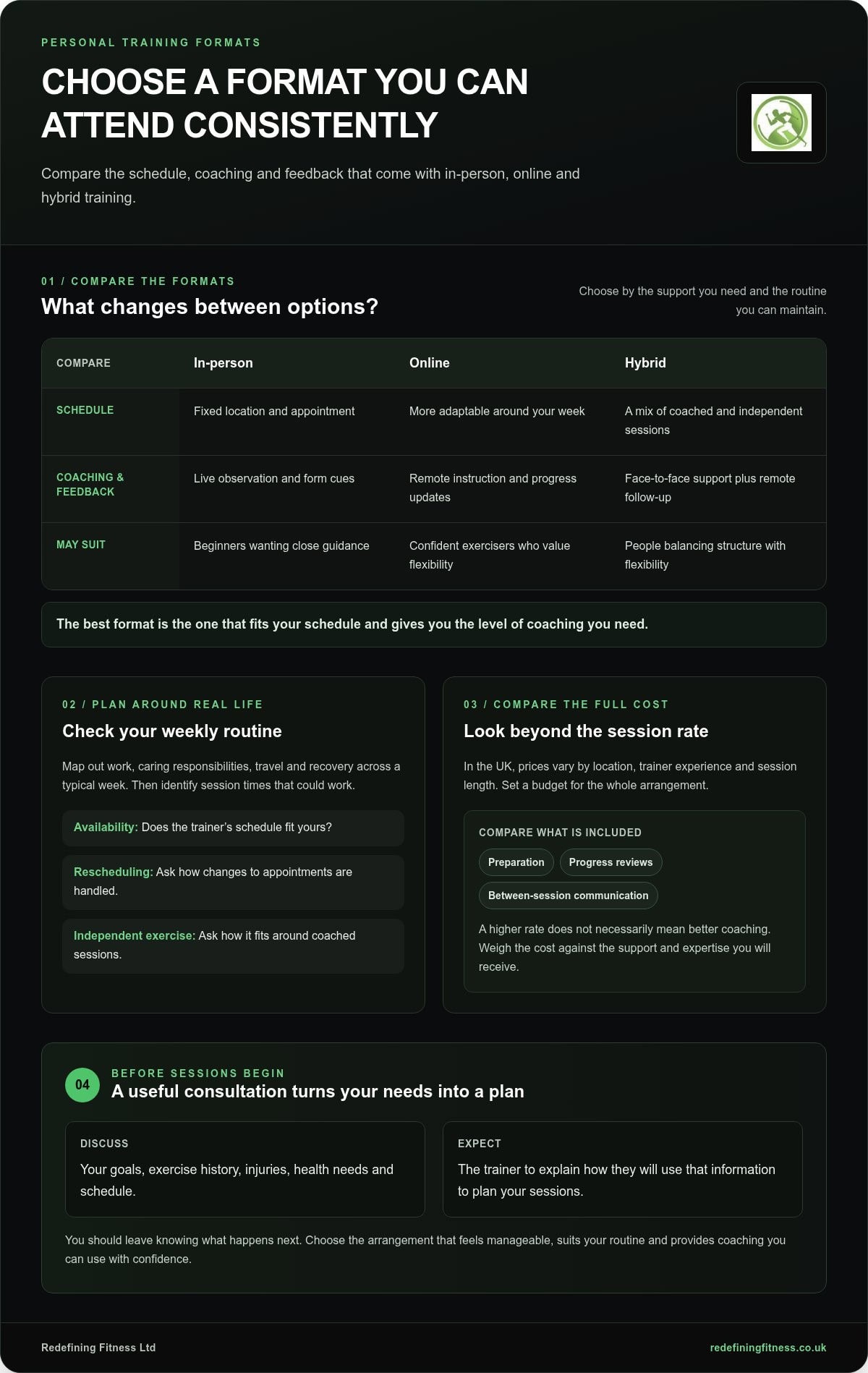
Should you choose in-person, online or hybrid personal training? Choose in-person for direct coaching, online for sessions that fit your routine, or hybrid for a mix of both. The best format is the one you can attend consistently and use with confidence.
What should a personal training consultation and assessment include? Expect to discuss your goals, exercise history, injuries, health needs and schedule. The trainer should then explain how they’ll use that information to plan your sessions. You should leave knowing what happens next, not having to guess.
Be realistic about the time you can commit. Map out work, caring responsibilities, travel and recovery across a typical week, then identify session times that could work. A trainer’s availability is only useful if it fits your routine. Ask how they handle rescheduling and how independent workouts fit around coached sessions.
Set a budget for the whole arrangement, not just the session rate. In the UK, personal training prices vary by location, trainer experience and session length. Compare what’s included, such as preparation, progress reviews and communication between sessions. A higher rate doesn’t necessarily mean better coaching: weigh the cost against the support and expertise you’ll receive.
| Option | Schedule | Coaching and feedback | Best fit |
|---|---|---|---|
| In-person | Fixed location and appointment | Live observation and form cues | Beginners who want close guidance |
| Online | More adaptable around your week | Remote instruction and progress updates | Confident exercisers who value flexibility |
| Hybrid | Mix of coached and independent sessions | Face-to-face support plus remote follow-up | People balancing structure with flexibility |
Choose a format that fits your schedule and the level of coaching you need.
Communication is part of the service, not a bonus. Notice whether the trainer listens, explains movements clearly and adapts their language to your experience. Ask how they support clients who lose momentum. A useful coach gives specific feedback, such as helping you adjust your squat depth, rather than relying on pressure or generic praise.
Look beyond the qualification title. Ask what practical assessments and portfolio work it involved, and how the course tested coaching skills as well as theory. A trainer should be able to explain how they assess your movement and progress. Ask what tutor feedback helped them improve: thoughtful answers suggest a learning mindset, not just a certificate.
Agree how your assessment will work. Your trainer should record relevant starting points, revisit them as your goals or abilities change, and explain any adjustments. If nutrition comes up, clarify whether their qualifications cover the support you want, as personal trainers don’t necessarily hold nutrition qualifications. A clear plan makes it easier to compare time, budget and coaching style.
Matching training style and specialisms to personal goals
Choose a trainer whose specialism matches your goals. For strength, ask how they build progressive resistance into sessions. For weight management, discuss how they’ll adapt exercise to your current fitness and routine. If you’re preparing for a sport, look for experience with its movement demands, not just general enthusiasm for exercise.
Ask what types of clients the trainer usually works with and how they adapt sessions for beginners and experienced exercisers. Someone who mainly coaches confident lifters may take a different approach from a trainer who regularly supports people returning to activity. Ask for a practical example: how would they modify a session if you struggled with a movement or found the planned intensity too high?
What is the difference between an independent personal trainer and a gym-based trainer? An independent trainer works on their own, while a gym-based trainer works within a gym. The setting can affect where sessions take place and what equipment is available, so consider which suits your preferences and training needs.
Match qualifications to the goal, too. If you’re pregnant or returning to exercise after giving birth, the guidance recommends a trainer with a Level 3 pre- and postnatal qualification. If you have another health concern, focus on relevant experience and the trainer’s ability to adapt sessions. A certificate alone doesn’t tell you how they coach; ask how their knowledge translates into your programme.
Set a clear starting point before training begins. Discuss your goal, exercise history and any relevant limitations, then agree on what progress will look like. This could mean improving a movement, building consistency or increasing the resistance you can manage. Choose measures that relate to your goal rather than relying on a single scale reading.
Review progress regularly rather than guessing. Ask how the trainer records your starting fitness, tracks changes and adjusts your programme when your ability or priorities shift. If strength is your goal, for example, they might review the loads and repetitions you complete with good technique. If your schedule changes, the plan should adapt instead of becoming an unrealistic test of willpower.
- Strength: ask about resistance training, technique and progression.
- Sport: discuss the movements and demands of your chosen activity.
- Returning to exercise: explain your experience and ask how sessions can scale.
- Changing goals: agree when progress and the programme will be reviewed.
Choose a trainer whose skills and coaching style fit your actual goal, rather than someone with the longest list of specialisms. A focused conversation about your needs should lead to a clear, adaptable plan.
CIMSPA accreditation and industry recognition
A recognised qualification is a starting point, not proof that a trainer suits your needs. Ask to see their fitness qualifications and note the awarding organisation and qualification level. UK guidance recommends looking for personal trainers registered with CIMSPA or qualified by REPS, YMCA Awards or Active IQ. If a certificate has an unfamiliar title, research its content before deciding whether it’s relevant.
Check that the qualification matches the work you want to do. Supporting general exercise needs different expertise from working with health-related needs. Ask what training and experience inform the trainer’s approach, and how they apply that knowledge in sessions. Clear answers should connect learning to practical coaching, not rely on impressive-sounding acronyms.
CIMSPA recognition can also apply to training providers. According to YOUR Academy, fewer than 5% of UK training providers have CIMSPA Enhancing Status. That figure describes providers, not an individual trainer’s ability or the outcome you’ll get. Treat it as one signal when comparing education standards, then assess the trainer’s qualification, relevant experience and communication for yourself.
What insurance and safety standards should a personal trainer have in the UK? Ask for evidence of insurance relevant to the sessions and setting, and ask how the trainer manages safety. Look for practical habits: discussing your exercise history, checking how you feel, demonstrating movements and correcting your position when needed. These are useful checks, not a claim that one policy or procedure applies to every arrangement.
Use this short review before committing:
- Qualification: record the level, awarding organisation and subject area.
- Recognition: compare CIMSPA registration and the named qualification routes above.
- Relevance: ask for examples of experience with your goals or health needs.
- Safety: discuss insurance, session setting and how the trainer adapts exercise.
- Learning: ask how the trainer keeps their knowledge current and uses it in practice.
Pay attention to the conversation itself. A qualified trainer should explain their methods in plain language, welcome reasonable questions and distinguish exercise guidance from medical advice. If you’re managing a health condition, relevant experience matters more than broad claims about motivation or expertise. Ask how they’d adapt a session if your symptoms, energy or movement changed.
Professional recognition can help you screen for a sound foundation, but it can’t replace relevant qualifications, safe coaching and a style that works for you. Compare the evidence, not just the badges, and choose the trainer whose skills best match your circumstances.
Changing trainers if the fit is not right
Good coaching should help you develop, not leave you dreading your next session. If you’re still uncomfortable after a few sessions, the trainer may not be the right fit. Take that feeling seriously. You don’t have to prove a coach is terrible before choosing another approach: a mismatch in communication, pace or goals can get in the way of progress.
What are warning signs of an unsuitable or unqualified personal trainer? Watch for signs of a bad personal trainer, such as someone who can’t show relevant qualifications, ignores your feedback, dismisses pain or uses the same plan regardless of your needs. In the UK, personal trainers are required to have a Level 3 qualification, so ask to see proof rather than relying on confidence or appearance.
Distinguish a challenging session from poor coaching. A demanding workout can still be well managed if the trainer explains its purpose, watches your technique and adapts when you struggle. Repeated exercises with no clear link to your goals, missed corrections or pressure to continue through pain are reasons to raise concerns. Good motivation challenges you without overriding your judgement.
If you feel comfortable, try a direct conversation before ending the arrangement. Name a specific issue and the change you need: “I need more explanation before new exercises,” or “Please adjust the session when my knee hurts.” Their response matters. A coach who listens and adapts may rebuild trust; dismissive replies or repeated behaviour may point to a deeper mismatch.
Use practical signals, rather than one bad day, to assess the coaching relationship:
- Communication: you leave confused about the plan or next steps.
- Adaptation: the trainer repeats a movement after you report discomfort.
- Organisation: sessions regularly start without a clear purpose or preparation.
- Professional boundaries: the trainer offers nutrition or injury guidance beyond their qualifications.
- Progress: your goals and feedback never shape the programme.
Then decide what you need from your next coach. Write down your priorities, such as calmer explanations, experience with a particular goal or more adaptable sessions. Use that list to compare options, and ask each trainer how they’d address your example. Specific answers reveal more than a polished pitch.
If you’re fitting training around work, repeated scheduling clashes can make the arrangement unsustainable. Look for a format and communication rhythm you can maintain, not a perfect week that never happens. Changing trainers isn’t failure. It’s a practical choice when the coaching no longer helps you achieve your goals.
Considering health conditions and injuries
Your health history should shape the programme before your first workout. Tell the trainer about relevant injuries, medical conditions, age-related considerations and movements that cause discomfort. For example, explain whether knee pain occurs on stairs, during squats or on longer walks. That detail gives the trainer a clearer basis for adapting exercise instead of guessing from a general label.
Ask about experience with situations like yours. A trainer who has supported clients returning after an injury may explain how they scale movements, monitor feedback and adjust sessions. Ask what they’d change if pain flared during a workout or a stressful week affected your energy. A helpful answer focuses on adapting the plan, not pushing through it unchanged.
Be clear about professional boundaries. A personal trainer isn’t a medical expert, so direct medical questions about an injury or condition to your GP. Trainers can adapt exercise in response to your feedback and progress, but they shouldn’t present coaching as diagnosis or treatment. If a trainer discusses nutrition, ask whether their qualifications cover the support they’re offering. Personal trainers don’t necessarily hold nutrition qualifications.
Take the same care with medication. If a trainer recommends supplements and you take medication, speak with your doctor before using them. Share relevant guidance with your trainer so they can understand how your health needs affect exercise. This isn’t a test of motivation: it’s a practical step towards a plan that suits your circumstances.
- Before the first session: explain relevant conditions, injuries and movement limits.
- During exercise: report pain, unusual fatigue or changes in how a movement feels.
- At review: discuss whether sessions match your feedback and recovery needs.
- For medical advice: speak with your GP about injury or diet questions.
Notice whether the trainer listens and adapts sessions when your needs change. If an old injury flares up, a suitable response may be to modify the movement or workout. If your energy is low, the trainer can adjust the intensity to suit your recovery. Your feedback should shape the plan, not be treated as an obstacle to completing it.
Qualifications matter, but a diploma alone doesn’t show how someone will respond to your individual needs. Ask how their training and experience inform safe adaptations, and how they keep their knowledge current. Good coaching should help you exercise with a plan that responds to your health, progress and day-to-day capacity.
A suitable coach can explain their experience with similar conditions and adapt the programme to your feedback, progress, energy and recovery, including after a flare-up or stressful week.
Redefining Fitness: Level 2 & 3 Personal Training Course
Redefining Fitness offers a Level 2 & 3 Personal Training Course for people ready to build the knowledge and practical skills behind a fitness career. Its courses combine online learning with in-person teaching, including face-to-face workshops. That blend can help you connect course content with the real demands of coaching and supporting different clients.
For aspiring trainers, specialist learning in kettlebells, circuits and indoor cycling can help shape the areas you develop alongside your core qualifications. If you’re weighing up whether to pursue training professionally, explore the course details and consider how the learning format fits your goals.
Visit Redefining Fitness online to explore the course and decide whether it’s the right next step for you.
Choose Your Next Step With Purpose
The right coaching relationship should clarify your next step, not leave you second-guessing your goals. Notice whether coaching helps you build confidence, make informed choices and stay engaged. If your needs change, your approach can change with them.
Knowing how to choose a personal trainer can also spark an interest in coaching others. Take that curiosity seriously. Consider which skills you want to develop, which communities you hope to support and what perspective you could bring to the fitness industry.
Are you the fitness industry’s next best secret? Explore the prospectus and consider your next step. Start with a clear goal, stay open to learning and back yourself to move forward.
Frequently Asked Questions
Do you specialise in working with clients who have my specific goals or conditions?
Ask the trainer to describe how they would adapt a session to your goal, such as building strength or returning to exercise after a health setback. Their answer should explain their coaching approach, not promise a particular result. For broader activity guidance, compare their plan with the NHS exercise guidance and Sport England’s resources, then discuss any health concerns with your clinician.
What qualifications should a personal trainer have in the UK?
In the UK, personal trainers are required to have a Level 3 qualification. Ask for the qualification’s full title and awarding organisation, then use the government qualification search to understand its status and details. You can also review CIMSPA’s professional standards to understand how recognised professional practice is described. Check that any specialist learning relates directly to the support you want.
How can I check a personal trainer’s qualifications and registration?
Compare the certificate’s exact wording with the awarding organisation’s records, and check any claimed professional registration directly. Relevant organisations include YMCA Awards, Active IQ and the Register of Exercise Professionals. Ask the trainer to clarify any difference between their job title, qualification and registration status. Keep a note of the qualification details for your own comparison.
What should I look for when choosing a personal trainer for my goals?
Look for a coach whose session structure supports the outcome you care about. If you want to feel more confident using gym equipment, ask how they’ll teach you to select and use it safely. If you want to return to regular activity, discuss how the plan can fit your routine. The NHS activity guidance offers a general reference point, not a personalised programme.
What questions should I ask a personal trainer before hiring them?
Ask how they plan sessions, communicate changes and handle your personal information. Clarify cancellation arrangements, payment terms and what happens if you need to pause training. A written agreement can make expectations easier to understand; the government’s consumer rights guidance explains general protections when buying services. Also ask how they’ll help you judge whether the coaching remains useful as your priorities change.
How much does a personal trainer cost in the UK?
Ask for a written quote that states what you’ll pay and what the arrangement includes. Check the session length, payment schedule, cancellation terms and any extra charges before agreeing. Compare like-for-like arrangements rather than relying on a headline figure. If a payment or service agreement is unclear, Citizens Advice consumer guidance can help you understand practical questions to raise before committing.
How can I check a personal trainer’s experience, reviews and references?
Look for detailed accounts that explain what the trainer did, how communication worked and whether the programme adapted to the client. Ask for a reference from someone with a similar goal, and consider whether the account describes the process rather than promising results. The Competition and Markets Authority provides consumer information, while the Information Commissioner’s Office explains privacy rights relevant to handling personal details.

10 Books Every Personal Trainer Should Read
10 Books Every Personal Trainer Should Read A personal training qualification gives you the foundations to begin working in the fitness industry, but becoming a
10 Techniques To Improve Memory, Understanding and Retention
10 Techniques to Improve Memory, Understanding and Retention Learning is one of the most valuable skills you can develop, yet most people spend considerably more
