

How Personal Trainers Can Use Motivational Interviewing Motivation isn’t something you can shout into a client. Understanding how a personal trainer can use motivational interviewing with clients starts with helping them find their own reasons for change, rather than pushing your agenda. The conversation should feel collaborative, not like a lecture.
A plan is more likely to work when a client can see themselves following it. Motivational interviewing gives you practical ways to explore their goals, doubts and readiness without judgement or confrontation. The client does most of the talking: you listen closely, ask thoughtful follow-up questions and help them build confidence in their next step.
This guide explains what motivational interviewing involves and how to use open questions, reflective listening and collaborative communication in real coaching conversations. You’ll also see how to respond when a client feels stuck, work through ambivalence and keep goals realistic after a setback. Finally, we’ll look at books and training resources that can deepen your understanding, because good intentions aren’t a substitute for developing your craft.
Table of Contents
- Collaborative Communication Between Coach and Client
- Eliciting Change Talk With Follow-Up Questions
- Listening Without Judgement or Criticism
- What Does Motivational Interviewing Involve?
- Books and Training Resources for Motivational Interviewing
- Redefining Fitness: Level 2 & 3 Personal Training Course
Collaborative Communication Between Coach and Client
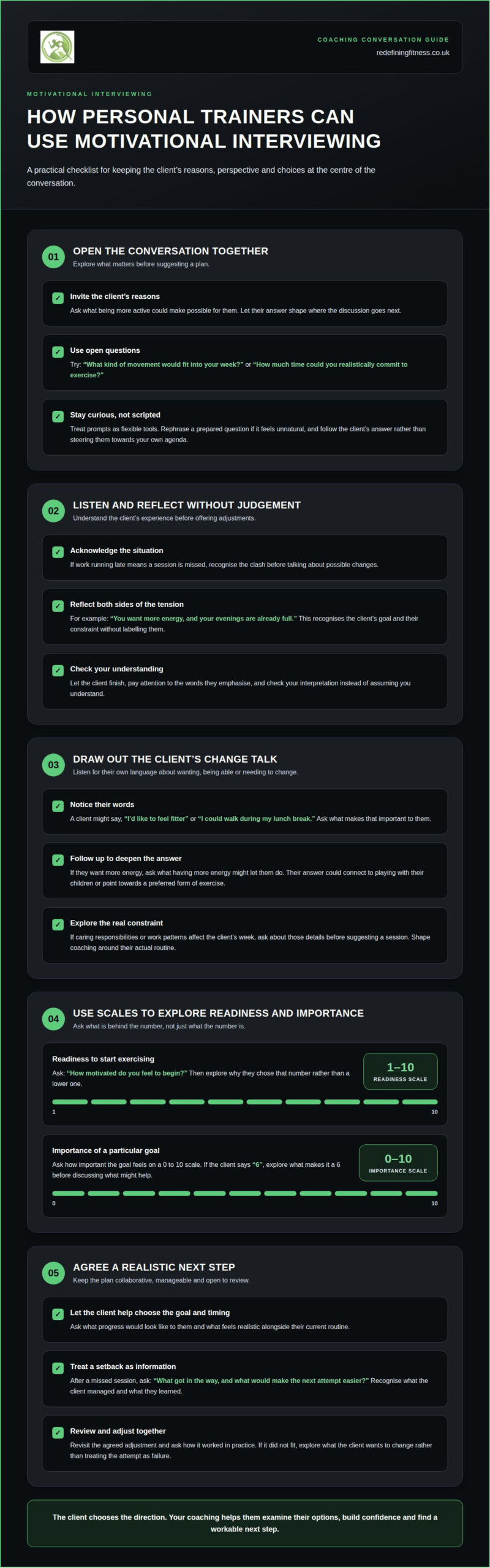
Motivational interviewing makes coaching a partnership: the client voices reasons for change while you guide the conversation. In a fitness session, explore what matters to them before suggesting a plan. Understanding how a personal trainer can use motivational interviewing with clients starts with giving the client space to shape the discussion.
Empathy builds rapport when you hear the client’s perspective without judging their choices. If someone misses a session because work ran late, acknowledge the clash before discussing adjustments. Find common ground around a goal they value, then invite their view. Trust grows through this exchange, giving clients room to speak honestly about barriers and progress.
Motivational interviewing prompts are flexible tools, not lines to recite. Try: “What would being more active make possible for you?” Then pause and follow their answer rather than steering them towards yours. If a prepared question feels unnatural, rephrase it. The method relies on genuine curiosity, not a polished performance or a checklist delivered without listening.
Keep the client’s voice central. If they say they want more energy but struggle to fit exercise around family commitments, ask what feels manageable. Avoid arguing about missed sessions: pressure can shut down conversation and make change harder. Instead, reflect the tension: “You want more energy, and your evenings are already full.” This recognises both sides without labelling the client unmotivated.
Use a 1-to-10 scale to explore readiness to start exercising: “How motivated do you feel to begin?” Follow with, “Why that number and not a lower one?” Their answer can uncover existing reasons for change. An importance ruler uses a 0 to 10 scale to ask how important a particular goal feels. If the client says “6”, explore what makes it a 6 before discussing what might help.
Optimism and encouragement should strengthen confidence, not dismiss difficulty. When a client describes a setback, recognise what they managed and ask what they learned. Then use motivational communication, progress tracking and goal reassessment to shape a workable next step. If their routine has slipped, review what got in the way and agree an adjustment together. The client chooses the direction; your coaching helps them examine options.
How a personal trainer uses motivational interviewing with clients also shows in the follow-up: revisit the agreed adjustment and ask how it worked in practice. If it didn’t fit, explore what the client wants to change rather than treating the attempt as failure. This keeps the conversation collaborative and makes the next decision more informed.
Eliciting Change Talk With Follow-Up Questions
Motivational interviewing can support exercise adherence and behaviour change by helping clients connect activity with reasons that matter to them. Follow-up questions then turn those reasons into realistic actions, which can be reviewed and adjusted as circumstances change.
Change talk is the client’s own language about wanting, being able or needing to change. Listen for phrases such as “I’d like to feel fitter” or “I could walk during my lunch break”, then ask what makes that important. The aim isn’t to persuade someone into agreement; it’s to help them develop their own reasons for change. That distinction matters: you can suggest a plan, but the client needs to find it worth doing.
Open-ended questions invite fuller answers than “Are you going to exercise this week?” Ask, “What kind of movement would fit into your week?” or “How much time could you realistically commit to exercise?” These questions let a client explain their routine, preferences and barriers. If they mention caring responsibilities or a changing work pattern, explore those details before suggesting a session. Listening for the actual constraint helps you shape coaching around real life, not an imagined ideal week.
Use follow-up questions to deepen the answer, rather than firing them like an interviewer. If a client says, “I want more energy,” ask, “What might having more energy let you do?” If they mention playing with their children, reflect that connection and ask what activity feels achievable. Their answer may point towards walking, strength work or another preferred form of exercise. Each question should clarify the client’s meaning, priorities or next step.
Open questions keep the client involved in choosing both the goal and its timing. Ask, “What would progress look like to you?” and “What feels realistic alongside your current routine?” Then agree when you’ll review progress, for example during a future conversation about their routine.
Nutrition can enter the conversation when the client raises it, but avoid turning a question about exercise into an unsolicited food lecture. Ask, “What changes, if any, would you like to make?” If they’re unsure, explore what they’ve tried and what felt sustainable. These techniques keep the client’s perspective central. A useful question opens a door; a leading question tries to push them through it.
After a missed session, ask, “What got in the way, and what would make the next attempt easier?” This treats a setback as useful information, not proof of failure. Agree a practical adjustment with the client, then revisit it in future coaching. This conversation helps connect intentions with manageable actions while leaving the client in control of their choices.
Listening Without Judgement or Criticism
Listening without judgement means hearing a client’s experience without labelling their choices as lazy, careless or wrong. Your first task in a coaching conversation is to understand what happened from their perspective. If they say, “I stopped because the gym felt intimidating,” don’t rush to defend the gym or prescribe a tougher routine. Ask what felt intimidating, then listen to the answer.
Active listening takes attention, not just silence. Put away distractions, let the client finish and notice the words they emphasise. A client might say, “I enjoyed walking, but I hated feeling watched during circuits.” That contrast tells you something useful about their preferences. Check your interpretation instead of assuming you understand: “Was the group setting the part that felt uncomfortable?”
Reflective listening means restating a client’s words in your own language and inviting them to correct you. For example: “You liked being active outdoors, but the busy class made it harder to keep coming. Have I understood that?” The client can clarify, disagree or add context. This exchange prevents your interpretation from becoming the coaching plan before the client has had a say.
Stay neutral when a client describes behaviour they feel embarrassed about. If they say, “I haven’t done any physical activity since our last session,” avoid a reprimand or instant pep talk. Try, “It sounds as though getting started felt difficult this week.” Then pause. That gives them space to explain rather than defend themselves against criticism.
Listen for mixed feelings without treating them as resistance to defeat. A client might want to improve their fitness and still dislike structured exercise. Reflect both sides: “You want to feel stronger, and you don’t want another routine that takes over your evenings.” This shows you heard both the ambition and the concern, helping the client consider options that respect both priorities.
Notice what emerges when you listen carefully. A client who says, “I could manage a short walk after lunch,” has identified a possible action in their own words. Ask what would make it workable, then let them shape the details. You’re not testing their commitment. You’re helping them consider whether the idea fits their week and their reasons for change.
After agreeing an action, reflect the client’s own reason for choosing it: “You picked the lunchtime walk because it fits your working day.” This keeps the decision connected to their priorities. At your next session, ask how the plan felt and what they noticed. Specific, non-judgemental listening helps clients review their experience honestly without turning every outcome into a pass-or-fail test.
What Does Motivational Interviewing Involve?
Motivational interviewing treats uncertainty about change as normal, not as a flaw to correct. A fitness professional works with that uncertainty rather than fighting the client.
Motivational interviewing has been studied in exercise behaviour interventions, including a review pooling 129 randomised trials. That figure describes the breadth of research, not proof that this method always outperforms other approaches; its usefulness depends on the client, context and intervention.
Recognising and Working with Ambivalence
Ambivalence means wanting change while also feeling unsure about making it. A client may want to improve their fitness yet worry that exercise will take time away from their career or relationship. Help them name both sides: “What appeals to you about becoming more active, and what gives you pause?” Their answers reveal what the goal means to them and what could get in the way.
Don’t treat hesitation as refusal. If a client wants to exercise but fears feeling out of place, explore what might make activity more comfortable. Their concern may point towards a different setting, pace or type of movement. The client’s perspective gives you a stronger basis for adapting the plan than assumptions about what should motivate them.
Normalising Resistance
Normalising reluctance means responding without anger, blame or a struggle for control. If a client says, “I’m not ready to add another session,” acknowledge the concern and ask what feels difficult about the idea. This keeps the conversation open and protects the coaching relationship.
Hesitation can signal that your suggestion doesn’t fit the client’s priorities or circumstances. Adapt rather than push: explore a smaller change, another form of physical activity or a different time. The client remains in charge of their decisions while you help them consider options. This can stop disagreement from becoming a barrier to progress.
Core MI Communication Techniques
Open questions, affirmations, reflections and summaries help draw out the client’s perspective. Ask, “What would being more active help you achieve?” Affirm a specific strength: “You’ve kept looking for options despite a demanding week.” Reflect their meaning, then summarise the main points and invite corrections. These techniques help bring the client’s reasons and choices into focus.
Use these techniques as responses, not a rigid script. If a client mentions low energy, reflect that concern before asking what kind of movement feels manageable. A brief summary can connect their concern with their goal: “You want more energy, but a long session feels unrealistic.” Then let them decide what, if anything, they want to try.
Adapting MI to Client Needs
Adapt motivational interviewing to the client’s confidence, circumstances and health needs. If someone doubts their ability, ask what activity they’ve managed before and build on that experience. Keep the next step specific and chosen by the client, such as considering a short walk rather than committing to an ambitious routine.
For a client with a health condition, explore their preferences and concerns without making assumptions about safe exercise. Stay within your professional scope, and use an appropriate referral pathway when their needs call for specialist input. A respectful conversation can still clarify what matters to them, even when another qualified professional needs to be involved in planning exercise.
Books and Training Resources for Motivational Interviewing
Reading about motivational interviewing gives you a framework; practising it develops usable coaching skills. Start with Motivational Interviewing, whose first edition was published in 1991, and compare its principles with your conversations about fitness goals.
The latest edition of Motivational Interviewing was published in 2023. The book had four editions at the time described in the source material, giving readers a way to follow how the approach has been presented across editions. Read actively: note how a practitioner responds to uncertainty, then consider how that response would sound in a fitness session.
Coaching with Motivational Interviewing was scheduled for publication in August 2024. Use coaching-focused material to think through the difference between giving instructions and drawing out a client’s reasons for change. For example, compare “You need to train twice this week” with “What kind of activity could fit your week?” The second invites the client to shape the next step.
Turn knowledge into practice with a role-play. One person plays a client who wants to become more active but feels unsure; the other practises asking open questions, reflecting answers and summarising the client’s priorities. Then switch roles. Review one specific moment: did the coach follow the client’s meaning or rush towards advice? This feedback can show where your approach supports collaboration and where it slips into directing.
Keep a learning log after practice. Record the client scenario, the question you asked, the response you heard and an alternative reflection. For instance, if the client says, “I keep starting, then stopping,” you might reflect, “You want a routine that lasts, but previous attempts haven’t felt sustainable.” Reviewing the exchange helps you refine your skills without turning examples into a script.
Ethical practice means respecting client choice, staying within your competence and not presenting motivational interviewing as a cure or a guaranteed route to change. The National Center for Biotechnology Information reports that no studies reported motivational interviewing as harmful, although none explicitly set out to assess adverse effects.
Choose resources that build understanding, then practise with feedback rather than relying on memorised lines. To develop your wider coaching knowledge and skills, explore personal trainer qualifications.
Redefining Fitness: Level 2 & 3 Personal Training Course
Redefining Fitness offers Level 2 and Level 3 personal trainer qualifications for people ready to build their coaching foundations. Delivered online and in person, the courses combine blended learning with face-to-face workshops. They offer a route into personal training, where skills such as motivational interviewing can help you communicate more thoughtfully with future clients.
Specialist learning includes areas such as kettlebells, circuits and indoor cycling. These subjects can broaden your understanding of fitness practice, whilst your ongoing development in communication helps you apply that knowledge with care. If you’re ready to take the next step towards a personal training qualification, contact Redefining Fitness to discuss the course.
Make Your Next Step Count
Knowing how a personal trainer can use motivational interviewing with clients is only the start. The real test comes in your next conversation: can you stay curious when a client hesitates and help them find a step that feels like their own? Build that capability through deliberate practice, honest reflection and a commitment to treating each person as more than a target or timetable.
Professional growth takes more than good intentions. It asks you to sharpen your coaching judgement, deepen your knowledge and keep learning how to support different people. If you’re ready to develop your future in fitness, take a closer look at the opportunities available through Redefining Fitness Ltd.
Are you the fitness industry’s next best secret? Explore the prospectus and contact Redefining Fitness Ltd to consider your next step. Bring your ambition, put in the work and keep raising your standard. Your coaching journey starts with the choice to begin.
Frequently Asked Questions
Why is motivation important in personal training?
Motivation helps a client decide whether exercise deserves a place in their routine, especially when work, family or fatigue compete for attention. Ask what they want activity to make easier in everyday life, rather than assuming appearance is their priority. For general context, the NHS guide to exercise and the UK Chief Medical Officers’ physical activity guidelines can inform a discussion without dictating an individual’s goals.
What is motivational interviewing and its core principles for personal trainers?
Motivational interviewing is a way to discuss change that respects client choice and draws on the client’s own reasons. A trainer can use it to explore readiness without treating uncertainty as disobedience. The Motivational Interviewing Network of Trainers provides information about the approach, while NICE guidance on behaviour change offers a UK health-sector perspective on supporting individual change.
What motivational interviewing techniques can personal trainers use with clients?
Use questions that invite detail, reflections that check your understanding, and summaries that help clients hear their own priorities. For instance, ask what they would like to feel more confident doing, then explore their answer before suggesting an activity. The NHS Get Active resource can help clients consider different ways of moving, while CIMSPA’s professional resources support broader development in the UK fitness sector.
How can trainers use motivational interviewing to help clients set fitness goals?
Start with a goal the client values, then make the first action small enough to fit their actual routine. Someone returning to running might choose a short walk-run session before committing to a demanding programme. The NHS Couch to 5K plan is one example of a structured running resource; its suitability depends on the individual’s circumstances and preferences.
What does a motivational interviewing session look like step by step?
A useful conversation can begin by agreeing what the client wants from the discussion, then exploring their perspective and deciding whether they want to consider an action. Before closing, clarify what they chose and how you’ll revisit it. For background on physical activity planning, the NHS strength and flexibility exercises offer examples a client may wish to discuss, rather than a plan every client must follow.
How can trainers respond to client ambivalence or resistance to exercise?
First, find out what the client’s hesitation means in their own circumstances. A person who avoids activity after a difficult experience may need a different setting or a conversation about what feels manageable, not another demand. Keep your response calm and offer the client control over whether to explore options. The National Library of Medicine’s research collection can support further reading on behaviour-change approaches.
What training or qualifications in motivational interviewing are available for UK personal trainers?
Redefining Fitness Ltd offers Level 2 and Level 3 personal trainer qualifications, delivered online and in person. These provide a personal-training qualification route, while developing motivational interviewing requires further learning and deliberate practice. For clients discussing activity alongside a health condition, stay within your competence and use appropriate referral pathways; the NHS information on type 2 diabetes and guidance on recovery after a heart attack illustrate why individual health context matters.
Are you the fitness industry’s next best secret? Explore the prospectus and contact Redefining Fitness Ltd to discuss your next step in fitness education.

Why Personal Trainers Need Multi-Disciplinary Teams
Great coaching has limits when you try to do everything alone. Why personal trainers should build multidisciplinary teams comes down to a simple…

Can Personal Trainers Prescribe Rehab? UK Guide
Can Personal Trainers Prescribe Rehab? UK Guide Can personal trainers prescribe rehab? No. In the UK, unless they’re also qualified physiotherapists,…
