

Can You Use a UK PT Qualification Abroad? Full Guide A UK personal training qualification can open doors abroad, but it isn’t a universal passport. If you’re wondering whether you can use your UK personal training qualification abroad, a UK Level 3 qualification is recognised in countries represented by ICREPs member registers. The destination country’s registration requirements still matter.
When asking, “Can I use my UK personal training qualification abroad?”, look beyond the certificate title. Employers and professional registers may consider the qualification framework and the competencies your training covers. Assuming every country uses the same system can leave you unprepared.
This guide explains how qualification recognition works, how ICREPs registration can support a move, and what framework comparisons can and can’t tell you. It also explores EuropeActive alignment, so you can understand how your UK training may fit and what to consider before working abroad.
Table of Contents
International delivery and qualification status
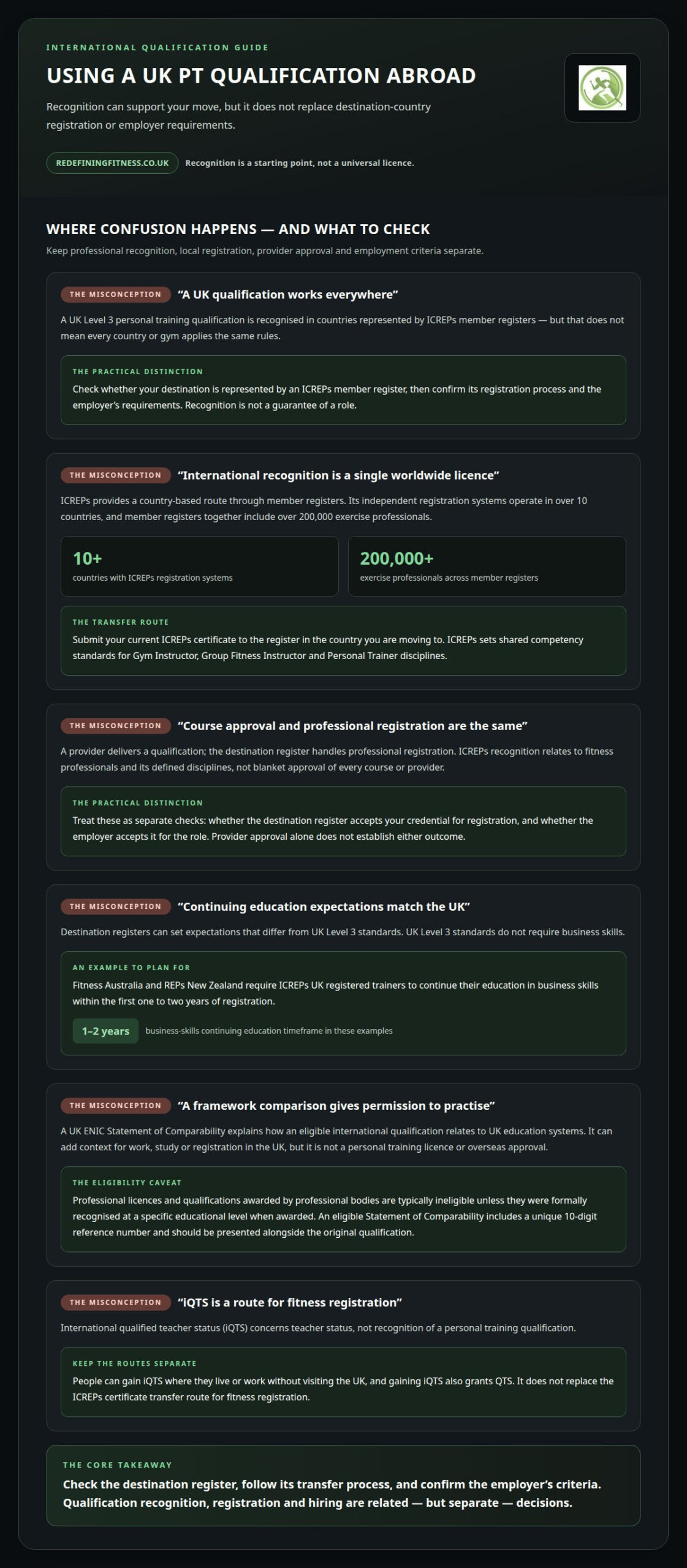
A UK Level 3 personal training qualification is recognised in the countries represented by ICREPs member registers. That recognition supports international mobility, but registration and workplace requirements still depend on the destination.
ICREPs standards and recognition
ICREPs sets shared competency standards for Gym Instructor, Group Fitness Instructor and Personal Trainer disciplines. Its independent registration systems operate in over 10 countries, and member registers together include over 200,000 exercise professionals. That framework gives a UK trainer a recognised reference point across participating countries, rather than a guarantee that every employer applies identical rules.
For a qualification transfer, submit your current ICREPs certificate to the register in the country you’re moving to. Fitness Australia and REPs New Zealand require ICREPs UK registered trainers to continue their education in business skills within the first one to two years of registration. UK Level 3 standards don’t require business skills, so that difference may shape your ongoing development.
International qualified teacher status (iQTS) is separate from fitness registration. People can gain iQTS where they live or work without visiting the UK, and gaining iQTS also grants QTS. It concerns teacher status, not recognition of a personal training qualification, so it doesn’t replace the ICREPs transfer route.
International provider approval
International provider approval concerns whether a training provider’s course meets the requirements of a particular recognition or registration system. It is not the same as a certificate being accepted by an overseas register. For example, ICREPs recognition relates to fitness professionals and its three defined disciplines, not blanket approval of every course or provider.
Keep the distinction clear: the course provider delivers the qualification, while the destination register handles professional registration. If you’re moving to an ICREPs country, the relevant transfer step is submitting your current ICREPs certificate to that country’s register. Provider approval alone doesn’t establish that you meet local registration or employment requirements.
Overseas gym qualification requirements
There is no single accreditation level that every overseas gym requires. Requirements depend on the country, employer, role and applicable professional register. A UK Level 3 personal training qualification is recognised in the countries represented by ICREPs member registers, but that does not mean every gym uses the same hiring criteria or registration process.
Before accepting a role, distinguish the gym’s employment criteria from the country’s professional registration process. A gym may assess the qualification relevant to the role, while an ICREPs register handles registration through its local system. These are separate decisions: recognition by a register doesn’t automatically settle every employer’s requirements.
Country acceptance of UK PT qualifications
A UK Level 3 qualification is accepted in the countries represented by ICREPs member registers. ICREPs provides a country-based route rather than a single worldwide licence: submit your current ICREPs certificate to the register where you’re moving. The member registers cover over 10 countries, so acceptance depends on whether your destination is represented.
As you plan your move, check the relevant country’s register and follow its transfer process. Fitness Australia and REPs New Zealand, for example, require continued business-skills education within the first one to two years of registration. This shows why international recognition is a starting point, not proof that every country’s continuing education expectations match the UK’s.
Comparison with the UK qualification framework
A framework comparison provides context between education systems, but it doesn’t automatically grant permission to practise. First, find out whether your personal training qualification is eligible for comparison.
Official qualification comparisons
A UK ENIC Statement of Comparability explains how an eligible international qualification relates to UK education systems. It can provide context when applying for a job, study programme or professional registration in the UK, but it isn’t a personal training licence or overseas approval.
The distinction matters because UK ENIC’s service is for international qualifications that can be compared with UK education systems. Professional licences and qualifications awarded by professional bodies are typically ineligible unless they were formally recognised at a specific educational level when awarded. A fitness certificate may therefore fall outside the comparison process, even if it supports professional practice.
Where eligible, the Statement of Comparability includes a unique 10-digit reference number. It doesn’t assess grades, specific subjects or English proficiency. Applicants should present it alongside their original qualifications, so the comparison adds context rather than replacing the underlying evidence.
A qualification alone can’t determine pay or job prospects abroad. Country, role, employer and professional registration all shape the opportunities and salary attached to a position.
Qualification conversion and validation
Qualification conversion or validation means having a credential assessed against another country’s education or professional requirements. You don’t automatically need a UK ENIC comparison to use a UK PT qualification abroad. That service compares eligible international qualifications with UK education systems.
For fitness work, the relevant route depends on the destination’s professional register and employer. In an ICREPs country, the register’s transfer process is distinct from an education-framework comparison. Treat these as separate questions: does the credential meet the register’s requirements, and does the employer accept it for the role?
An official comparison through UK NARIC has a cost, and additional costs may apply depending on whether the qualifications are in English. That cost is for comparison, not conversion into a new PT certificate. Translation requirements and assessment processes also depend on the service and destination, so don’t mistake a comparison document for proof of professional registration.
For a UK qualification, decide whether the destination register or employer asks for a formal comparison, a professional transfer, or both. If the qualification is a professional-body award rather than an education qualification recognised at a specific level, UK ENIC’s eligibility criteria are particularly relevant. Keep the original certificate central: a comparison provides context, while the qualification remains evidence of your training.
Eligibility of vocational qualifications
A vocational personal training qualification demonstrates practical training, but acceptance depends on the country’s registration and employment requirements. Visa permission is a separate issue: you need an immigration route that allows you to work in your destination country. There is no single visa or work permit for personal trainers worldwide.
Language, first aid and insurance requirements also depend on the country, register and employer. English may support communication in some workplaces, but it doesn’t replace any local language requirement. First aid certification and professional insurance are separate from qualification recognition, so a recognised PT certificate alone doesn’t establish whether either is required for a particular role.
Age can affect access to professional registration and employment. Learners may not be able to enter EREPs or employment until they are aged 18. That matters if you’re planning a move before reaching that age: holding a vocational certificate and being eligible to register or work are different questions.
Keep the teaching Assessment Only route separate from fitness qualification eligibility. It concerns UK qualified teacher status, not recognition of a personal training certificate. Its guidance requires teaching experience across two different schools, and the route is intended for experienced teachers with at least two years of classroom experience.
Those criteria don’t convert a PT qualification into a teaching credential. They apply to the teaching route, so they’re relevant only if your goal also involves qualifying as a teacher in the UK. A fitness role abroad follows a different path, shaped by the destination’s professional register and employment conditions.
For a vocational qualification, distinguish learning outcomes from permission to work. Your course records the skills and knowledge assessed; the destination’s register or employer determines how that evidence fits its requirements. An ICREPs transfer process, where available, is one registration route, but it doesn’t replace immigration permission or settle every workplace condition.
Build your decision around the specific role and country. Separate the questions into three parts: whether the qualification meets the relevant professional standard, whether you can obtain the right to work, and whether the role requires additional language, first aid or insurance provisions. This helps prevent qualification recognition being mistaken for a visa, licence or complete employment clearance.
For people seeking employment or career progression in the UK, English-language proficiency is another consideration alongside qualification recognition. Treat these as separate checks: evidence that a qualification is recognised does not, by itself, show whether your English is sufficient for the role or progression you want. Consider the language expectations for the specific opportunity rather than assuming recognition settles them.
The programme includes approximately 88 hours of guided learning, with some elements required to be taught or delivered live. This gives you a concrete detail to check when reviewing what the course involves, but guided learning hours and live delivery should not be confused with a decision by an overseas register or employer to accept the qualification. Use the course information as evidence about learning and delivery, then verify recognition and work eligibility separately for your intended destination.
EuropeActive and EQF alignment
EuropeActive alignment and an EQF comparison can help describe where a qualification sits, but neither phrase alone proves that a country or employer accepts it. Treat them as comparison tools, not replacements for professional registration. A framework can help explain training and skills, while permission to practise depends on the destination’s own requirements.
The European Qualifications Framework (EQF) provides a reference for comparing qualifications across education systems. For a UK personal training certificate, an EQF comparison is useful only when the qualification’s learning outcomes and level have been formally mapped. Don’t infer a specific EQF level from the words “Level 3” alone; UK framework levels and EQF references are not automatically interchangeable labels.
EuropeActive alignment is another reference point to interpret carefully. The name may appear in course or qualification information, but it doesn’t by itself establish that a particular overseas register accepts your certificate. Separate three things: the course’s stated alignment, the skills its assessment covers, and the destination country’s registration decision. Each answers a different question.
An employer may want evidence that your training prepares you for a personal training role, while a register may assess whether your qualification meets its professional criteria. A framework comparison can help explain the course’s academic or vocational position; a syllabus and assessment record can show what you learned. Neither document is automatic authorisation to work.
Use a comparison to make your evidence clearer. Match your qualification documents to the terms used by the destination register, such as learning outcomes, practical competence or assessment. If the destination uses EuropeActive or EQF references, identify what each reference applies to: the provider, programme, qualification or a particular outcome. This prevents an alignment claim from being stretched beyond its scope.
Keep the original UK qualification certificate with any framework statement or course documentation. If the register asks about a specific skill, use relevant course evidence rather than relying only on a level label. For instance, a statement about framework alignment cannot demonstrate a practical assessment unless the evidence records that assessment. Clear documentation strengthens the comparison without confusing it with registration.
Ultimately, EuropeActive and EQF references can help explain your qualification, but they don’t provide a universal answer about using it abroad. Read them in context, then consider the destination’s professional and employment requirements separately. This gives employers and registers a precise account of your education and skills without claiming that one framework governs every country.
Which countries accept UK personal training qualifications?
If you’re asking, “Can I use my UK personal training qualification abroad?”, a UK Level 3 personal training qualification is accepted in the countries represented by ICREPs member registers. That gives you a clear starting point: acceptance is tied to participating country registers, not a single worldwide licence. The destination register is central to understanding the professional route.
ICREPs member registers operate in over 10 countries. This network provides a framework for international recognition, but it doesn’t mean every country accepts qualifications through the same process. Distinguish between a country represented by an ICREPs register and one outside that network before treating recognition as transferable.
If you’re moving to a represented country, submit your current ICREPs certificate to the register there. This connects your existing registration evidence with the destination register. It is not the same as presenting a certificate to a gym, and it doesn’t create a universal licence for every role.
Australia and New Zealand show why acceptance and ongoing requirements are separate considerations. Fitness Australia and REPs New Zealand require ICREPs UK registered trainers to continue education in business skills within the first one to two years of registration. Recognition concerns entry into a professional system; continuing education relates to maintaining registration.
For countries outside the ICREPs member-register network, this shared acceptance route does not apply. So, can you use your UK personal training qualification abroad in a country outside that network? The destination may use its own registration process, and an employer may apply separate criteria for a specific job. These decisions are not interchangeable.
Plan around your destination, not a broad claim of global acceptance. Identify whether the country has an ICREPs member register, then distinguish professional registration from an employer’s hiring requirements. The register handles its own recognition process; the gym decides how your qualification fits the role. This gives you a more precise basis for planning your move.
The practical answer is that UK Level 3 personal training qualifications are accepted in countries represented by ICREPs member registers, which operate in over 10 countries. Fitness Australia and REPs New Zealand also illustrate that recognition can sit alongside continuing education requirements. If you’re still asking, “Can I use my UK personal training qualification abroad?”, focus on the destination’s register and its transfer route rather than assuming every country works alike.
Redefining Fitness: Level 2 & 3 Personal Training Course
Redefining Fitness offers a Level 2 & 3 Personal Training Course for building the foundations of a personal training career. The course is delivered online and in person, combining blended learning with face-to-face workshops. Strong practical knowledge matters wherever you plan to work, but qualification recognition and registration remain separate decisions made in the destination country.
If you’re developing your skills before exploring international opportunities, this course gives you a structured route into personal training. You can also build specialist knowledge through options including kettlebells, circuits and indoor cycling. Choose training that strengthens your professional foundations, then consider how your destination’s register applies your qualification.
To discuss the Level 2 & 3 Personal Training Course, contact Redefining Fitness.
Build Your Next Move With Purpose
Make your next move with intention. Decide what kind of coach you want to become, who you want to support and what standards you want your work to demonstrate. A clear direction gives your ambition focus and helps shape the opportunities you pursue.
Keep developing your practical experience and professional judgement. Build a career around skills you can stand behind, and take ownership of the practitioner you’re becoming. Your next step should reflect the standards you want to bring to the fitness industry.
Are you the fitness industry’s next best secret? Explore the prospectus with Redefining Fitness Ltd, and take your next step with purpose.
Frequently Asked Questions
Is a UK personal training qualification recognised internationally?
Yes, a UK Level 3 personal training qualification is recognised in countries represented by ICREPs member registers. Recognition doesn’t mean every overseas employer follows the same hiring process. For example, professional registration and a gym’s employment criteria are separate considerations. Treat the qualification as evidence for a participating system, then consider the specific role and any continuing education expectations connected with registration.
Can I work as a personal trainer abroad with a UK qualification and no additional certification?
That depends on the destination’s professional register, employer and immigration rules. These address different aspects of eligibility: registration concerns professional recognition, while immigration permission concerns your right to work in that country. For example, a register may accept your qualification while an employer has separate role requirements. Consider each independently when planning your move, rather than treating the certificate as complete clearance.
How can I check whether my UK training provider is recognised in my destination country?
Start with the destination country’s professional register and identify how it assesses your qualification. Then distinguish recognition of the qualification from approval of the provider. For example, a course’s stated framework alignment doesn’t automatically establish acceptance by a national register. Your qualification certificate and course evidence can help explain your training, while the register’s criteria show how that evidence fits its process.
What extra costs are involved in getting qualified or registered to work abroad?
Costs depend on the comparison or registration process required for your destination. An official comparison of overseas qualifications through UK NARIC has a cost, and additional costs may apply depending on whether the qualifications are in English, according to UK NARIC. Translation or assessment expenses may therefore affect your planning. Keep comparison costs separate from course fees, as they relate to different services and processes.
Are you the fitness industry’s next best secret? Explore the prospectus from Redefining Fitness Ltd and take your next step.

Can You Use a UK PT Qualification Abroad? Full Guide
Can You Use a UK PT Qualification Abroad? Full Guide A UK personal training qualification can open doors abroad, but it isn’t a universal passport….

Should You Pay Rent as a Personal Trainer? UK Guide
Should You Pay Rent as a Personal Trainer? UK Guide Free rent won’t fix a weak business model. If you’re weighing up whether you should pay rent as a…
