
A polished meal plan can look professional and still cross a line. In the UK, personal trainers can give healthy adults general, evidence-based nutrition guidance, but shouldn’t create bespoke, prescriptive meal plans or manage medical needs through diet. The Association for Nutrition, CIMSPA and HCPC offer relevant professional context; the NHS Eatwell Guide and government Eatwell Guide provide healthy-eating references.
It’s understandable to expect nutrition to be part of fitness coaching. Food habits affect training, and practical guidance can help you make changes that fit your goals. But a trainer’s qualification doesn’t automatically make them qualified to prescribe an individual diet. For health-related context, consult information from the British Dietetic Association, Diabetes UK, Allergy UK, Beat and the Sport and Exercise Nutrition Register.
This article explains what nutrition support a personal trainer can provide, where the boundaries lie, and when you need advice from a qualified professional. Clear scope matters: sound coaching can support your progress, while a plan that overlooks health needs or presents itself as clinical care can lead you in the wrong direction.
Table of Contents
- Can personal trainers write meal plans for their clients?
- What Nutritional Support Can Personal Trainers Provide?
- Permitted general food and nutrition guidance from personal trainers
- Professional collaboration and ethical practice
- Risks and red flags in trainer-provided diet plans
- Redefining Fitness: Level 2 & 3 Personal Training Course
Can personal trainers write meal plans for their clients?
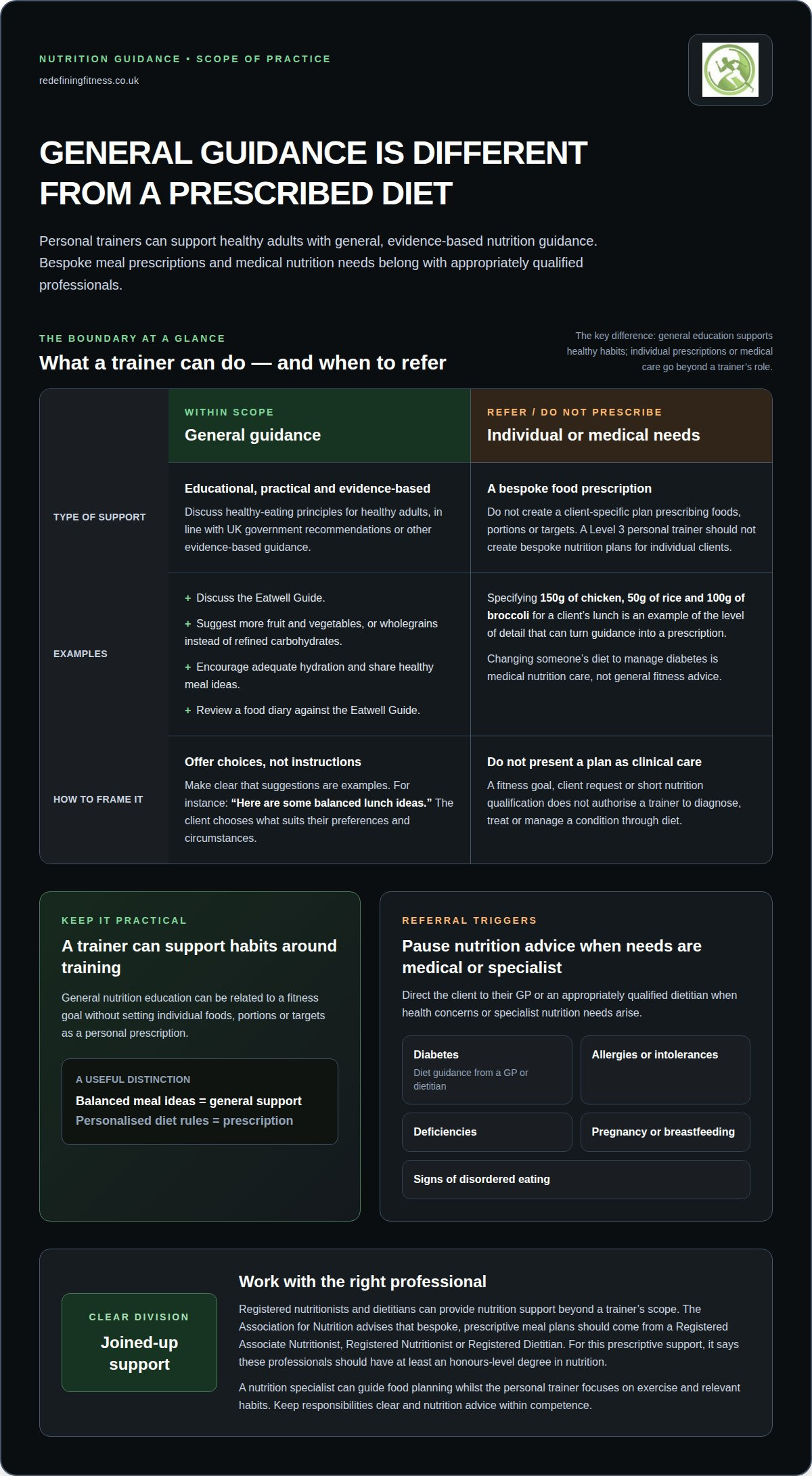
For healthy adults, a trainer can discuss evidence-based healthy eating and suggest practical changes. A bespoke prescription is different: it sets out individual foods, portions or targets, going beyond general guidance.
Bespoke Meal Planning for Clients
An individualised meal plan prescribes what a client should eat, often with specific foods and portion sizes. For example, a plan might specify 150g of chicken, 50g of rice and 100g of broccoli at lunch. That level of detail can appear precise, but it requires assessment of the client’s routine, current diet, preferences and health issues. A Level 3 personal trainer should not create bespoke nutrition plans for individual clients.
Meal planning can still help clients organise food around work, training and preferences. For a personal training business, clear boundaries matter: general suggestions can support coaching, but a plan that reads like a prescription can misrepresent the trainer’s role.
Using Safe Nutrition Language
Safe nutrition advice stays general, evidence-based and within a trainer’s competence. For a healthy adult, a trainer can discuss the Eatwell Guide, suggest eating more fruit and vegetables, or recommend wholegrains instead of refined carbohydrates. They can also encourage adequate hydration and share a few healthy meal ideas.
Make the difference between an example and a prescription clear. Say, “Here are some balanced lunch ideas,” rather than telling a client exactly what they must eat. CIMSPA’s Professional Standards for Personal Training say nutrition advice should align with UK government guidelines or other evidence-based guidance.
Recognising When to Refer
Refer a client for qualified advice when their needs involve a medical condition or specialist nutrition support. A client with diabetes should get diet guidance from their GP or a dietitian; a trainer can support exercise and relevant habits alongside that advice. Allergies, intolerances, deficiencies, pregnancy, breastfeeding or signs of disordered eating also call for referral.
Dietitians are trained to assess, diagnose and treat diet-related medical problems. A personal trainer should not diagnose, treat or manage a condition through diet. If a client raises a health concern, pause nutrition advice and direct them to their GP or an appropriately qualified dietitian.
Working With Nutrition Specialists
Registered nutritionists and dietitians can provide nutrition support beyond a trainer’s scope. The Association for Nutrition advises that bespoke, prescriptive meal plans should come from a Registered Associate Nutritionist, Registered Nutritionist or Registered Dietitian. It also says these professionals should have at least an honours-level degree in nutrition when providing prescriptive meal-plan support.
A referral doesn’t end the trainer’s contribution. The nutrition specialist can guide food planning while the trainer focuses on exercise and relevant habits. This division gives clients joined-up support without blurring professional responsibilities.
The distinction is straightforward: meal ideas and general education can support healthy clients, but individual prescriptions and medical nutrition needs belong with appropriately qualified professionals. Clear boundaries protect clients and keep fitness coaching focused on what a trainer is qualified to deliver.
What Nutritional Support Can Personal Trainers Provide?
Personal trainers can offer healthy adults general nutrition advice to support fitness goals. The dividing line is whether the guidance supports training or attempts to manage a medical condition.
CIMSPA’s Professional Standards for Personal Training say nutritional advice should align with UK government recommendations or other evidence-based guidance. For CIMSPA and REPs professionals, that means keeping advice educational, relevant to fitness and within their scope of practice.
Fitness Advice and Medical Nutrition
Fitness advice supports activity and everyday habits; medical nutrition advice addresses health conditions or specialist needs. The distinction matters because a client’s goal doesn’t authorise a trainer to manage a diagnosis through food. Discussing balanced meals with a healthy adult is different from changing someone’s diet to manage diabetes. Keep the focus on training and refer medical questions to an appropriate professional.
Nutrition Within a Trainer’s Scope
Within scope, a trainer can help healthy clients understand general recommendations and apply them to everyday routines. For example, they might review a food diary against the Eatwell Guide, suggest eating more vegetables or discuss wholegrain choices. They can relate these ideas to a fitness goal without turning general education into a prescribed meal plan. The client chooses what suits their preferences and circumstances.
Useful guidance is practical, not clinical. A trainer might discuss hydration around exercise or suggest a healthy swap, then explain the general principle behind it. This gives clients a reasoned choice without claiming to diagnose a nutritional problem or prescribe treatment.
Level 3 Nutrition Boundaries
A Level 3 personal trainer can discuss healthy eating principles in line with government recommendations, but should not create bespoke nutrition plans for individual clients. The qualification supports general guidance, not a clinical role. So a trainer may explain why balanced meals can support training, but shouldn’t set individual foods, portions or targets as a personal prescription.
The boundary still applies when a client asks for a detailed plan or has a clear fitness target. A short nutrition qualification doesn’t, by itself, authorise medical advice or expand a trainer’s scope of practice.
UK Professional Guidance
CIMSPA’s Professional Standards set the key principle: nutrition advice should follow UK government recommendations or other evidence-based guidance. For REPs professionals, the sound practical approach is also to keep advice general, evidence-based and separate from medical nutrition care. Don’t present an illustrative example as a prescription or claim that fitness guidance treats a condition.
These boundaries also shape professional development. A Level 2 and Level 3 personal training course can build the foundations for fitness coaching, while specialist nutrition decisions remain with appropriately qualified professionals. Strong practice means knowing where your expertise ends, not stretching it to satisfy every request.
Permitted general food and nutrition guidance from personal trainers
Personal trainers can offer healthy adults general food guidance, but vocational nutrition qualifications don’t authorise bespoke meal-plan prescriptions. A qualification at Level 2, Level 3, Level 4 or Level 5 doesn’t, by itself, qualify a trainer to write meal plans. Trainers can discuss calorie and macronutrient principles generally, but shouldn’t set individual prescription targets.
Qualification Levels and Their Limits
Level 3, Level 4 and Level 5 nutrition qualifications don’t, by themselves, qualify a personal trainer to write meal plans or provide bespoke or specialist nutrition advice. That distinction matters because a higher qualification level doesn’t automatically change a trainer’s scope. A trainer can explain broad healthy-eating recommendations, but an individually tailored plan remains different work. Further learning can deepen understanding without authorising specialist nutrition practice.
Nutrition Training Qualifications
Personal training and nutrition vocational qualifications can develop knowledge for fitness coaching, but the qualification title alone doesn’t grant authority to prescribe. Level 2 personal training or nutrition study doesn’t qualify someone to write meal plans; nor do Level 4 or Level 5 vocational qualifications. Consider the task itself: explaining general food guidance alongside exercise differs from assigning a client exact foods, portions or nutrient targets.
General guidance can still be useful. A trainer might explain how fruit, vegetables and wholegrains fit into balanced eating, then discuss how those choices support an exercise routine. Keep the advice educational, not a personal nutrition prescription.
Meal Plans and Nutrition Prescriptions
A personalised meal plan sets out what an individual client should eat, often specifying foods and portions. That makes it a prescription, not simply an example menu. The Association for Nutrition advises that bespoke, prescriptive plans should be provided by a Registered Associate Nutritionist, Registered Nutritionist or Registered Dietitian. A trainer can share generic meal ideas if clients understand they are examples, not instructions tailored to them.
For a structured plan, refer the client to a registered dietitian or a degree-qualified clinical nutritionist registered with the Association for Nutrition. A dietitian is also the appropriate option when nutrition needs relate to a medical condition.
Setting Calorie and Macronutrient Targets
A trainer can discuss nutrition changes relevant to a fitness goal, but shouldn’t turn the conversation into an individual prescription. For example, they might explain that protein and fibre are relevant topics for someone aiming to build muscle. Setting a client’s personal calorie target or exact macronutrient amounts goes beyond general guidance, particularly if medical conditions or specialist needs affect their diet.
Keep the boundary clear: explain general principles, connect them to exercise, and refer clients seeking personal targets or a structured diet plan to an appropriately qualified nutrition professional.
Professional collaboration and ethical practice
Ethical coaching means recognising when a client’s eating needs go beyond fitness guidance. A trainer can support exercise habits while a qualified nutrition professional handles specialist food advice. This boundary matters for healthy adults too: a plan should reflect someone’s routine, food preferences and health needs, not a template copied across clients.
The Association for Nutrition says UK personal trainers should not give performance nutrition advice to elite athletes, regardless of whether they hold a Level 3, Level 4 or Level 5 nutrition qualification. Elite sport demands specialist performance nutrition input; a general personal training or nutrition course does not make that advice appropriate.
A sensible food plan, prepared by an appropriately qualified nutrition professional, should suit the client rather than force them into a rigid schedule. Relevant details include their routine, current eating habits, preferences and health issues. Planning breakfast, lunch and dinner across seven days can make a plan practical, but the professional should review it at check-ins rather than hand it over and forget about it.
- Routine: meal timing should make sense around work, family life and exercise.
- Preferences: familiar foods can make healthy eating more workable.
- Health needs: medical conditions and food concerns require appropriate expertise.
- Review: check-ins allow the specialist to revisit the plan as circumstances change.
Working outside scope creates risks for clients and trainers. Advice intended to manage diabetes, allergies or another medical condition can affect health, so a trainer shouldn’t improvise a nutrition intervention. Refer the client to their GP or a dietitian, then keep fitness support focused on exercise and agreed habits. That is responsible collaboration, not a failure to coach.
Professional practice also means understanding insurance boundaries. Trainers should check the extent of their cover for fitness or nutrition advice and declare additional qualifications, such as a specialised Level 4 nutrition certification. A certificate does not automatically broaden scope; the advice must still match competence, professional guidance and the client’s needs.
For groups, keep healthy-eating discussions general and grounded in government recommendations. Don’t present one person’s targets as a universal rule for everyone in a class. If an athlete requests performance nutrition advice or a client asks for medical dietary support, explain the boundary and refer them to an appropriately qualified professional. You can then collaborate on the exercise programme without prescribing food.
Risks and red flags in trainer-provided diet plans
A polished document can still cross a professional boundary. Look beyond its design: warning signs include prescriptive portions, individual calorie targets, medical claims or advice that overlooks a client’s health needs. A plan specifying chicken, rice and broccoli in fixed quantities is not merely a healthy-eating example if it tells one client exactly what to eat.
That distinction matters because personal trainers can offer general guidance but shouldn’t diagnose, treat or manage medical conditions through diet. If a plan promises to control diabetes, correct a deficiency or work around an allergy, its writer has moved beyond ordinary fitness support. The client’s condition, medicines and nutritional needs require appropriate professional input.
- Personal prescriptions: fixed foods, portions or targets presented as required for one client.
- Medical claims: advice intended to manage diabetes, deficiencies, allergies or intolerances.
- Specialist needs: a plan for pregnancy, breastfeeding, disordered eating or elite sports performance.
- False authority: presenting a short nutrition course as permission to prescribe individual diets.
Check the language as carefully as the menu. “You must eat this exact breakfast” presents an example as a prescription; “here are balanced breakfast ideas” makes its general nature clearer. A trainer can suggest healthy swaps based on the Eatwell Guide, but specifying exact portions and daily targets for an individual changes the nature of the advice. Consider what the plan is meant to do and whether it claims to address a medical need.
The Association for Nutrition says UK personal trainers should not give performance nutrition advice to elite athletes, regardless of whether they hold a Level 3, Level 4 or Level 5 nutrition qualification. An athlete’s request for competition fuelling guidance is therefore a clear referral point, not a reason to improvise. A trainer can still support the athlete’s exercise programme within their role.
Another red flag is a plan handed over once without considering the client’s routine, preferences or health issues. These factors shape suitable food planning, and an appropriately qualified nutrition professional can review a tailored plan at check-ins. Trainers should also understand their insurance position and declare additional qualifications rather than assume a certificate changes their scope.
Use this standard: if advice tells an individual what to eat to address a health issue or specialist performance goal, stop and refer. If you’re building the foundations for responsible coaching, explore personal training education that keeps professional boundaries central.
Redefining Fitness: Level 2 & 3 Personal Training Course
Redefining Fitness Ltd offers a Level 2 & 3 Personal Training Course for people building their knowledge and capability in fitness coaching. Delivered online and in person, it provides a route into the profession while reinforcing an important principle: responsible trainers know the limits of their role and refer specialist nutrition needs appropriately.
Consider the course if you want to develop a foundation in personal training, then build further through options including kettlebells, circuits and indoor cycling. These practical areas complement exercise coaching; they don’t replace specialist expertise in personalised nutrition. Are you the fitness industry’s next best secret? Contact Redefining Fitness Ltd to discuss your next step.
Build Your Coaching Practice With Clear Boundaries
Understanding whether personal trainers can write diet plans is a starting point, not the whole craft. Professional judgement means knowing what to do next: offer sound general guidance, keep coaching focused on fitness or recognise when a client needs specialist support. Clear boundaries build trust and keep the client’s needs ahead of the pressure to have every answer.
If you’re considering a future in fitness, build your capability with purpose. Learn to coach with confidence, respect the limits of your role, and keep developing the skills that help clients move forward. Are you the fitness industry’s next best secret? Explore the Redefining Fitness Ltd prospectus and consider your next step.
Frequently Asked Questions
Is it legal for a personal trainer to give a meal plan in the UK?
There isn’t a simple yes-or-no rule that makes every meal plan lawful or unlawful. The key distinction is what the trainer provides and whether it falls within their competence and professional scope. General meal suggestions for a healthy adult differ from an individual prescription. If a plan addresses a health condition or sets exact foods and portions for one person, seek support from an appropriately qualified nutrition professional.
What Does the Association for Nutrition Say?
The Association for Nutrition distinguishes general healthy-eating suggestions from bespoke meal plans. It says a few healthy meal ideas can count as general advice, while prescriptive plans should come from a Registered Associate Nutritionist, Registered Nutritionist or Registered Dietitian. For example, suggesting a balanced lunch differs from assigning a client a fixed lunch menu as their personal nutrition prescription.
What Is the Difference Between Advising and Prescribing?
Advising explains general options; prescribing sets out what a particular person should eat. A trainer might explain how the Eatwell Guide can inform food choices, then let a healthy client decide what suits them. Prescribing means setting that client a specific menu, portion sizes or nutrition targets. The difference is the individual instruction, not whether the advice appears in a document or conversation.
Can personal trainers legally write diet plans in the UK?
Personal trainers can provide general healthy-eating guidance, but shouldn’t create bespoke, prescriptive plans for individual clients as part of ordinary training practice. The key question is whether the plan offers general examples or directs one person’s diet. A client seeking a structured plan should work with an appropriately qualified nutrition professional. Trainers should keep coaching focused on exercise and general habits within their competence.
What nutrition advice can a UK personal trainer provide within their scope of practice?
For a healthy adult, a trainer can discuss practical habits such as adding vegetables to meals, choosing wholegrain options or drinking enough around exercise. They can explain how these general choices relate to a fitness goal without promising a specific health result. A food diary can also prompt a broad discussion about habits, but it shouldn’t become a diagnosis or treatment plan.
What is the difference between general nutrition guidance and a personalised diet plan?
General guidance offers information that applies broadly, such as discussing balanced food choices with a healthy client. A personalised diet plan uses details about one person to prescribe meals, portions or targets. Sharing several breakfast ideas is general; telling a client exactly what to eat each morning is individual direction. That shift calls for appropriate nutrition qualifications and professional accountability.
What are the risks of following a diet plan from an unqualified personal trainer?
A plan that overlooks allergies, medical conditions, food preferences or a history of disordered eating may not suit the person following it. Risk also arises when a trainer presents general knowledge as treatment or gives elite athletes performance nutrition advice beyond their role. If a plan makes medical claims or imposes rigid rules, stop treating it as routine fitness guidance and seek qualified advice.
When should a personal trainer refer a client to a registered dietitian or GP?
Refer a client when diet advice involves diabetes, allergies, intolerances, suspected deficiencies or another medical concern. A GP can assess health concerns, while a dietitian can support people with diet-related medical problems. Pregnancy, breastfeeding, concerns about disordered eating and elite sports performance also call for specialist input. Where appropriate, the trainer can continue supporting exercise without taking over the nutrition professional’s role.