

Nutritionist vs Dietitian UK: Key Differences Explained. Same subject. Different professional standing. The difference between nutritionists and dietitians in the UK starts with regulation: “Dietitian” is a legally protected title, while “nutritionist” is not. That distinction affects the training and registration behind each title, and the work each professional is qualified to do. The Health and Care Professions Council regulates dietitians, while the Association for Nutrition oversees the UK Voluntary Register of Nutritionists.
It’s easy to assume the titles are interchangeable because both professions work with food and health. They aren’t. A registered dietitian can assess, diagnose and treat nutrition-related problems, including those linked to medical conditions. Nutritionists’ qualifications and roles vary, though registration as a Registered Nutritionist signals that professional standards have been met. For further context, professional resources include the British Dietetic Association, NHS, National Institute for Health and Care Excellence, and British Nutrition Foundation.
This guide breaks down UK regulation, protected titles, training, responsibilities and specialities, so you can understand which professional’s expertise fits the situation. It also compares dietitians, registered nutritionists, nutritionists using the unprotected title, and nutritional therapists. Look beyond the label: the right distinction is about the work involved and the professional’s credentials. Related professional information is available from the Complementary and Natural Healthcare Council, Royal Society for Public Health, and National Careers Service.
Table of Contents
What are the differences between dietitians and nutritionists?
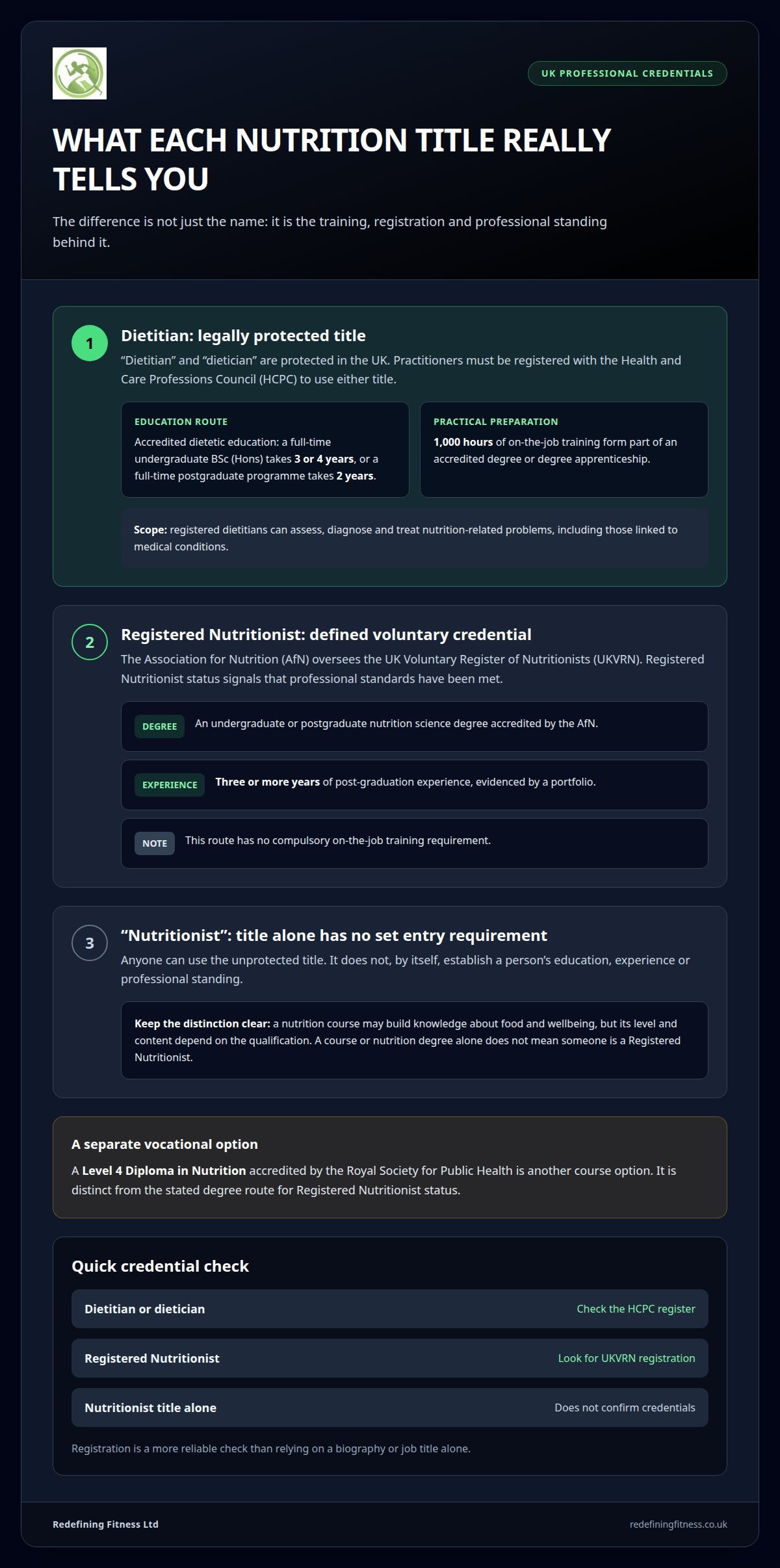
In the UK, dietitians follow an accredited education and supervised-practice route, while nutritionists’ qualifications vary. Registered Nutritionists need an Association for Nutrition-accredited degree and at least three years of post-graduation experience evidenced by a portfolio. So, what qualifications do UK nutritionists need? It depends on the credential: anyone can use “nutritionist”, but registration has defined requirements.
Dietitian education and supervised practice
UK dietitians complete accredited dietetic education with supervised practical training. A full-time undergraduate BSc (Hons) in Dietetics takes 3 or 4 years; full-time postgraduate Dietetics programmes take 2 years and lead to a PgDip or MSc. The UK route also includes 1,000 hours of on-the-job training as part of an accredited degree or degree apprenticeship. This clinical preparation distinguishes it from nutritionist routes.
The US pathway differs from the UK route. Aspiring registered dietitians complete an ACEND-accredited programme, supervised practice and a national examination; at least 1,000 hours of supervised practice are required. Since January 1, 2024, a master’s degree has been required for the US national credential. These are US requirements, not UK dietitian requirements.
Nutritionist education and experience
For Registered Nutritionist status in the UK, candidates need an undergraduate or postgraduate degree in nutrition science accredited by the Association for Nutrition. They also need three or more years of post-graduation experience, evidenced by a portfolio. Unlike the dietitian pathway, this route has no compulsory on-the-job training. A Level 4 Diploma in Nutrition accredited by the Royal Society for Public Health is another vocational course option, but it is distinct from the stated Registered Nutritionist degree route.
The title “nutritionist” is not protected, so using it does not require a specified qualification. Distinguish the title from a credential: registration signals assessed education and experience, while the title alone does not. A nutrition course may build knowledge about food and wellbeing, but its level and content depend on the qualification.
| Route | Education | Practice or experience | Professional standing |
|---|---|---|---|
| UK dietitian | Accredited dietetic programme | 1,000 hours of on-the-job training | Structured clinical preparation |
| UK Registered Nutritionist | AfN-accredited nutrition science degree | Three or more years after graduation, evidenced by a portfolio | Registration requires defined criteria |
| Nutritionist title alone | No specified qualification required for the title | No specified experience required for the title | Title alone does not establish credentials |
| US registered dietitian | ACEND-accredited programme and master’s degree | At least 1,000 supervised hours | National examination required |
Choose according to the work and credential you need: clinical dietetic training, registered nutrition science expertise and general nutrition guidance are not interchangeable.
Continuing education and ethics also matter. Registered dietitians commit to a profession-specific code of ethics, and dietitians in many countries undertake continuing education to keep their expertise current. In the US, registered dietitians complete continuing education during each five-year cycle. A doctor’s involvement may be relevant to a health concern, but it does not replace the distinction between dietetic and nutritionist training.
Legal protection and registration of dietitian titles in the UK
In the UK, legal protection distinguishes the dietitian title from the broader nutritionist label. Registration gives you a practical way to tell protected professional status from voluntary credentials.
Dietitian title protection and HCPC registration
“Dietitian” and “dietician” are protected titles in the UK. Practitioners must be registered with the Health and Care Professions Council (HCPC) to use them. This legal protection makes the title a clear indicator of registration, unlike “nutritionist”, which anyone may use regardless of training.
To register, dietitians must meet the HCPC’s standards of proficiency. Registration applies to professional practice, not simply possession of a degree. Registered dietitians can assess, diagnose and treat nutrition-related problems, including those involving disease and medical nutrition.
Checking qualifications and registration
UK dietitians need an accredited bachelor’s degree followed by a Master’s in Dietetics or a Doctorate. To check a practitioner’s status, search the HCPC register by name and confirm the protected title, rather than relying on a biography or job title alone. Registration is the decisive distinction.
For nutritionists, look for Registered Nutritionist status on the UK Voluntary Register of Nutritionists (UKVRN). The Association for Nutrition (AfN) grants this title to nutritionists who meet its professional standards. A nutrition degree or course alone does not mean someone holds the registered credential.
“Nutritionist” is not legally protected in the UK, so the title alone does not establish a person’s education, experience or professional standing. Registration changes what the title communicates: Registered Nutritionist indicates a recognised credential, while the unqualified label carries no comparable legal requirement. Treat these as separate checks, not interchangeable labels.
Nutritional therapy has a different status. “Nutritional therapist” is not a statutory or legally regulated title, although practitioners can join the voluntary register held by the Complementary and Natural Healthcare Council (CNHC). This is not HCPC registration and does not make the practitioner a dietitian.
Use the register that matches the exact title. Look for “Dietitian” on the HCPC register or “Registered Nutritionist” on the UKVRN. Using “nutritionist” without the registered title does not, by itself, demonstrate a regulated qualification. CNHC registration for nutritional therapists is voluntary and indicates a different kind of professional registration. The distinction matters when you need someone qualified to assess, diagnose and treat a medical nutrition concern.
Legal regulation and protected professional titles
Registration is only one part of professional standing. Professional bodies, credentials and relevant expertise each tell you something different about a practitioner’s preparation.
Protected titles and professional regulation
Separate the legal status of a title from the practitioner’s area of expertise. Registration can establish professional standing, but it does not automatically show that someone specialises in your concern. For example, a complex dietary need calls for relevant clinical competence, not simply a title that sounds nutrition-related. Match the practitioner’s remit to the work required.
Can nutritionists give medical nutrition advice or treat illnesses in the UK? The general title alone does not establish clinical qualifications to treat illness. The practical question is whether the practitioner’s credentials and professional remit cover the specific medical need, not simply whether they offer nutrition advice.
Professional associations and voluntary registers
Professional associations and registers serve different purposes. The British Dietetic Association represents over 10,000 members and supports networking, knowledge exchange, ethical standards and practice guidance. Those functions help build professional community; they are distinct from a legal registration record. The Association for Nutrition recognises both Registered Nutritionist and Registered Associate Nutritionist credentials, which distinguish assessed professional standing from an unqualified use of a broad job label.
Nutritional therapy is another distinct route. Its voluntary professional register is held by the Complementary and Natural Healthcare Council. Registration may help identify a practitioner’s professional affiliation, but it does not mean they have the same remit as a dietitian. Read each title and credential on its own terms rather than treating every nutrition-related register as equivalent.
Roles and scope of practice
What should you check before choosing a dietitian or nutritionist in the UK? Start with the exact credential, then consider whether the practitioner’s stated expertise fits your situation. General support with food choices differs from help with a diagnosed condition. For clinical care, look for dietetic expertise relevant to that concern. For broader nutrition guidance, consider a registered nutrition professional whose work aligns with your goal.
What conditions can dietitians help treat in the UK? Their clinical work can address nutrition-related needs linked to diabetes, heart disease, kidney disease, eating disorders and gastrointestinal disorders. The condition matters, as does the specialist focus. Professional standing alone does not demonstrate expertise in every condition. Choose based on the support required, the relevant speciality and the practitioner’s stated scope.
Dietitian and nutritionist roles and responsibilities
The practical distinction is the kind of problem each professional handles. Dietitians assess clinical nutrition needs; nutritionists apply nutrition science to health, wellbeing and food choices.
In a hospital, a dietitian may assess a patient’s nutritional status using medical history, laboratory findings, dietary patterns and lifestyle. These details shape treatment for a specific condition, rather than a generic healthy-eating plan. For example, a person with diabetes may need dietary support tailored to their medical needs. Dietitians can also work in dialysis centres, nursing homes and community health organisations.
Medical nutrition therapy is one part of dietetics, but dietitians’ work extends beyond hospital wards. They can support people with chronic conditions, help plan meals, set nutrition goals and improve their relationship with food. They also work with healthy people, so dietetic care is not limited to illness. Their assessment connects food choices with health needs and the effects of treatment.
Does the NHS employ dietitians, and can you get an NHS referral? Dietitians work in hospitals and other healthcare settings, including roles that may sit within NHS services. NHS access follows the relevant service’s referral pathway, which depends on the service and reason for support.
Nutritionists focus on how food and nutrition affect health and wellbeing. A Registered Nutritionist may advise individuals or communities, while nutritionists may also contribute to menu planning in schools, businesses or care homes. In fitness and wellness settings, their work can include general healthy-eating guidance. The emphasis is nutrition knowledge and practical advice, rather than clinical diagnosis or treatment.
The setting often clarifies the task. A hospital dietitian may assess an individual’s needs after illness or during treatment. A nutritionist advising a care home may help shape menus for a group. Nutritionists can also work in food and beverage companies, government organisations or supplement firms. These examples show how nutrition science can support clinical care, community health or commercial planning.
Scope matters more than a broad job label. A dietitian assesses and treats dietary problems for individuals or communities; a nutritionist provides guidance within their qualifications and role. If a health condition affects eating, clinical assessment is central. For general wellbeing or menu planning, nutrition advice may address the broader need. Match the professional’s work to the task, not just their shared focus on food.
Dietitian and nutritionist specialities
Specialities show how nutrition expertise is applied, not just what professional titles promise. Dietitians often focus on clinical conditions; nutritionists may work across public health, food, wellbeing and commercial settings.
Dietitians can specialise in diabetes management, eating disorders, paediatric nutrition and oncology nutrition. Each field involves different dietary needs. A paediatric dietitian considers a child’s nutrition; an oncology dietitian supports nutrition care around cancer. These are clinical specialities, grounded in assessing individual health needs and applying medical nutrition expertise.
Dietitians may also support people with heart disease, kidney disease, gastrointestinal disorders, food allergies, osteoporosis and wound healing. They can work with concerns about weight, sports nutrition or whether someone’s diet provides adequate nutrition. The condition shapes the work: a dietitian may assess dietary patterns and tailor advice to medical requirements rather than offer a standard meal plan.
Nutritionists’ areas of focus depend on their education and experience. Registered Nutritionists provide guidance on how food affects human or animal health and wellbeing. Some work in public health or help businesses, schools and care homes plan menus. Others work in food companies, government organisations, fitness and wellness settings. These roles apply nutrition knowledge in different contexts, but the title alone does not establish clinical qualifications.
There is overlap, but the setting and purpose matter. A qualified dietitian may support someone managing diabetes or an eating disorder. A nutritionist may provide general healthy-eating guidance or help a care home plan balanced menus. In a fitness setting, nutrition guidance may support general wellbeing; a medical condition requiring dietary treatment calls for clinical expertise. Do not choose by speciality label alone. Consider the condition, the support needed and the professional’s relevant training.
Dietitians may pursue a master’s degree or doctorate as their careers develop, including to deepen expertise in a speciality. Further study can sharpen a clinical focus, but the speciality should still match the person’s needs. Paediatric nutrition and kidney disease, for example, involve distinct populations and dietary concerns. A clearly relevant area of practice tells you more than a broad claim of expertise.
If your interest is applying fitness knowledge professionally, take a focused next step with fitness training qualifications.
Redefining Fitness
Redefining Fitness Ltd helps people build practical foundations for a career in fitness through its Level 2 & 3 Personal Training Course. If this comparison has clarified that your interest lies in exercise and fitness rather than clinical nutrition, this offers a relevant next step. Kettlebells, circuits and indoor cycling develop skills in distinct fitness disciplines.
Keep the professional boundaries clear: a personal training qualification is not a dietetics qualification and does not qualify you to diagnose or treat medical conditions through nutrition. It can support a fitness-focused career pathway, while dietetic or nutrition credentials prepare people for different roles and responsibilities.
Contact Redefining Fitness Ltd to discuss your next step in fitness training.
Choose the path that fits your purpose
Understanding the difference between nutritionists and dietitians helps you choose a direction, whether you need clinical nutrition support or want to build a career in fitness. These paths involve different knowledge and responsibilities. Be clear about the work you want to do, then take a step that develops the right skills.
For aspiring fitness professionals, progress comes from learning the craft, building practical competence and taking your development seriously. You do not need every career decision mapped out before you begin. Choose a starting point that matches your ambition, and stay ready to grow.
Are you the fitness industry’s next best secret? Explore the prospectus with Redefining Fitness Ltd and consider your next step. Back your ambition with action, and keep moving towards the professional you want to become.
Frequently Asked Questions
How are dietitians regulated?
Dietitians are regulated through statutory registration with the Health and Care Professions Council (HCPC). The professional title is tied to registration, not simply a job description or course certificate. For a practical check, search the HCPC register by the practitioner’s name and confirm their status. This is especially relevant before seeking clinical nutrition support for a condition affecting eating or health.
How are nutritionists regulated?
The title “nutritionist” is not legally protected in the UK, so the word alone does not establish someone’s training. Qualified professionals can gain a recognised credential through the Association for Nutrition (AfN), including Registered Nutritionist status. This professional registration is voluntary, unlike statutory dietitian regulation. A profile saying “nutritionist” and one saying “Registered Nutritionist” make different claims about professional standing.
What about other nutrition roles?
Other titles include “nutritional therapist” and “nutrition consultant”, but their status differs from protected dietitian registration. “Nutritional therapist” is not a statutory title; practitioners can join the Complementary and Natural Healthcare Council’s voluntary register. Someone using “nutrition consultant” may have varied training, since the title is not legally regulated. Treat each title as a starting point, then identify the qualification and register behind it.
What is the role of a dietitian?
A dietitian assesses, diagnoses and treats nutrition-related problems for individuals and communities. Someone managing a long-term condition, for instance, may need food advice shaped around medical requirements rather than general healthy-eating guidance. Dietitians can also support people without an illness, including with meal planning and nutrition goals. Their preparation to provide clinical dietetic care, not simply an interest in food or wellness, is the defining feature.
What is the difference between a nutritionist and a dietitian in the UK?
In the UK, the difference between nutritionists and dietitians comes down to protected status, registration and scope. A dietitian must be registered with the HCPC to use the protected title. “Nutritionist” is unprotected, although Registered Nutritionist is an AfN credential. For clinical needs, the distinction matters: dietitians are qualified to assess and treat medical nutrition problems, while a nutritionist’s work depends on their specific education and credentials.
Are dietitians regulated by law in the UK?
Yes. UK law protects the title “Dietitian”, and practitioners must be registered with the HCPC to use it. This gives the public a clear way to distinguish a registered dietitian from someone using a broader food- or health-related job title. Before seeking the service, confirm the practitioner’s HCPC registration rather than relying only on promotional wording.
Is the title nutritionist protected or regulated in the UK?
No. “Nutritionist” is not a legally protected title in the UK, and someone can use it without a specified qualification. That does not mean every nutritionist lacks expertise; it means the title alone cannot demonstrate it. Look for the exact credential: Registered Nutritionist indicates AfN registration, while the general nutritionist label does not. For medical nutrition treatment, distinguish general nutrition advice from clinical dietetic practice.

Can Personal Trainers Prescribe Rehab? UK Guide
Can Personal Trainers Prescribe Rehab? UK Guide Can personal trainers prescribe rehab? No. In the UK, unless they’re also qualified physiotherapists,…

Nutritionist vs Dietitian UK: Key Differences Explained
Nutritionist vs Dietitian UK: Key Differences Explained. Same subject. Different professional standing. The difference between nutritionists and…
