
Personal Trainer Injury Advice: UK Scope & Guidelines. What if the safest thing you can do for an injured client is refuse to play clinician? That’s the standard behind professional personal trainer injury advice: support the person in front of you without pretending to diagnose what’s wrong. When a client reports pain, uncertainty is understandable. But pushing through, guessing at the cause or adapting exercises without considering your limits can make a difficult situation worse.
You can still be useful. Your role is to listen, pause or modify activity where appropriate, and recognise when a concern needs assessment by a healthcare professional. This guide will help you respond clearly, support your client responsibly and decide when to stop, adapt or refer, including when symptoms may need urgent attention.
We’ll also look at practical steps such as recording what happened and communicating a referral without crossing into diagnosis or treatment. Good coaching isn’t about having an answer for everything. It’s about knowing your scope, acting with care and protecting your client by bringing in the right professional when the next step is beyond your expertise.
Personal Trainer Injury Advice: What Is Your Role When a Client Reports Pain?
Not every injury question needs an exercise-based answer. If a client tells you something hurts, your first job isn’t to name the problem or invent a workaround. It’s to listen, understand what they’ve told you and stay firmly within your professional limits. That boundary is the foundation of useful 7. personal trainer injury advice: support the client without acting as their clinician.
Fitness coaching helps clients pursue exercise and fitness goals through training; clinical care assesses, diagnoses and treats health conditions. A client’s account of pain is important information, but it isn’t a diagnosis. Don’t label it as a strain, tendon problem or injury based on where it hurts or when it started. Similar experiences can have different causes, and identifying those causes belongs with an appropriately qualified healthcare professional.
What Can a Personal Trainer Responsibly Help With?
Start by giving the client space to explain what they’re experiencing. You can ask when they first noticed it, what activities seem to affect it and how it is influencing their training. Keep the questions neutral and let the client describe their own experience; don’t steer them towards a condition you suspect. Record relevant details in your session notes as the client reports them, clearly separating their words from your observations.
You can also discuss the client’s preferences and their immediate training plans. They may want to pause a movement, avoid a particular activity or stop the session. Any adjustment you consider must sit within your education and competence, and it must not become a disguised treatment or rehabilitation plan. If you’re unsure whether a session can proceed safely, don’t bluff. Pause and recommend clinical advice before returning to the activity in question.
General support is not a diagnosis, treatment plan or promise that the client will recover. You can acknowledge their concern, explain what you can and can’t do, and help them think about how to manage training while they seek appropriate advice. That’s responsible coaching, not a failure to help. Specialist learning, including Exercise Referral, can strengthen your understanding of boundaries and appropriate support; it doesn’t authorise you to diagnose or treat.
Why Pain Does Not Give You a Diagnosis
Pain is a report of someone’s experience, not proof of a specific cause. Two clients might describe similar discomfort but need different clinical assessments. Guessing from a movement, a body part or a training history can create false reassurance or unnecessary alarm. Your task is to gather information relevant to coaching and decide whether training should pause or change, not to interpret symptoms as a clinician would.
Ask, “What have you noticed?” or “Which activities are affecting your training?” Avoid leading questions such as “Is it a muscle tear?” and don’t perform tests intended to establish what’s wrong. Scope also depends on jurisdiction: the US-focused Physical Therapy Practice Act offers context on regulated clinical practice, but it isn’t UK guidance. For UK practice, follow your professional standards and refer clinical questions to a suitable healthcare professional.
How to Assess an Injury Concern Without Stepping Outside Your Competence
Don’t turn an injury concern into an impromptu diagnosis. You need a calm, repeatable way to decide what happens next, not a clinical protocol borrowed from somewhere else. Keep your role clear: listen to the client, clarify what they need you to know, consider whether it’s safe to continue and choose an appropriate next step. That’s the practical core of 7. personal trainer injury advice.
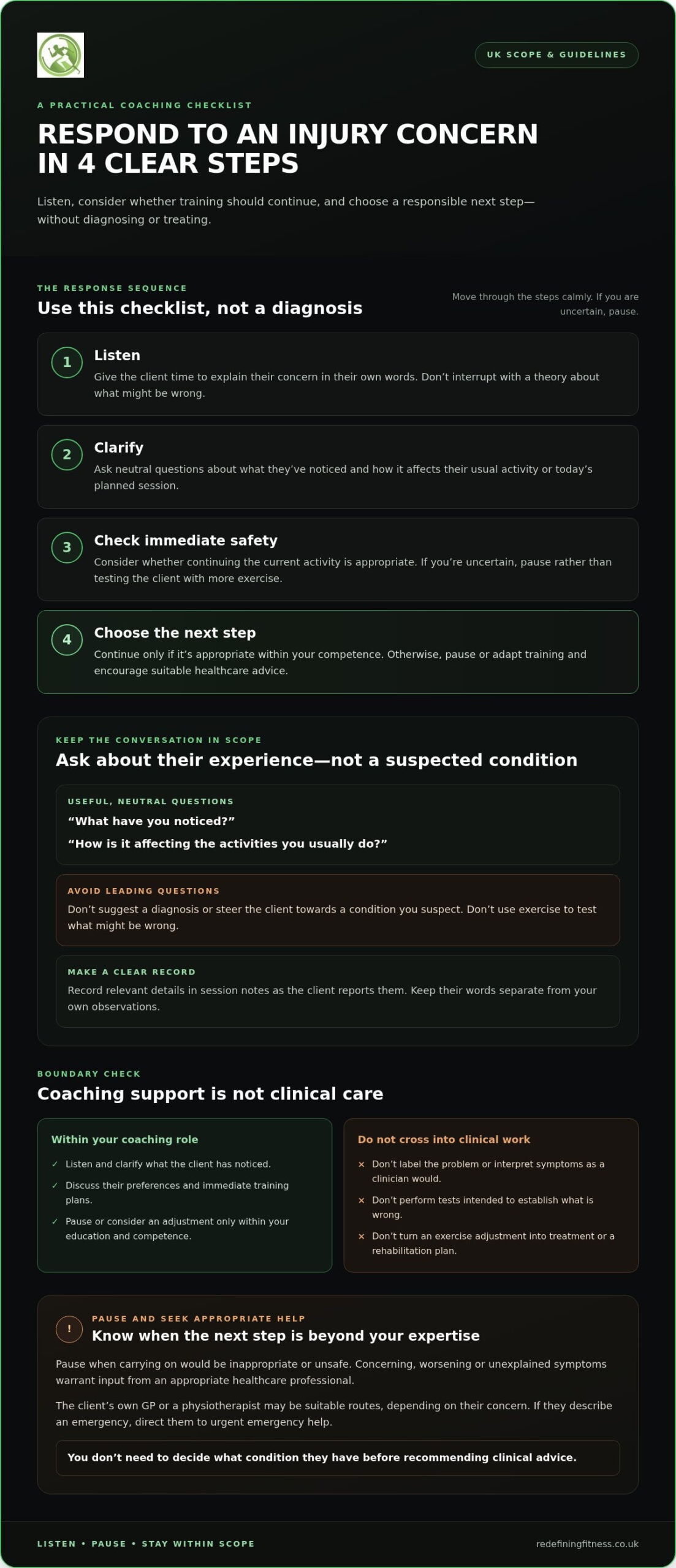
Trainers should not diagnose or prescribe treatment outside their competence. Use this sequence to guide the conversation, not to assess or classify an injury:
- Listen. Give the client time to explain their concern in their own words. Don’t interrupt with a theory about what might be wrong.
- Clarify. Ask neutral questions about what they’ve noticed and how it affects their usual activity or today’s planned session.
- Check immediate safety. Consider whether continuing the current activity is appropriate. If you’re uncertain, pause rather than test the client with more exercise.
- Decide the next step. Continue only if it’s appropriate within your competence. Otherwise, pause or adapt training and encourage suitable healthcare advice.
Questions That Clarify the Client’s Training Needs
Keep the conversation factual and client-led. Ask, “What have you noticed?” and “How is it affecting the activities you usually do?” These questions help you understand the client’s training needs without steering them towards a diagnosis. If the client says a healthcare professional has already given advice relevant to exercise, ask what guidance they were given and whether they’re comfortable sharing it. Don’t ask them to prove, interpret or expand on clinical advice you’re not qualified to assess.
Avoid leading questions such as “You’ve probably strained something, haven’t you?” or “It’s fine if it only hurts a little, right?” Those prompts can shape the answer and create misplaced reassurance. If the client can’t explain what’s happening, that doesn’t make your guess more reliable. Record their account in plain language and separate what they told you from what you observed during the session.
When to Pause Training and Seek Appropriate Help
Pause when carrying on would be inappropriate or unsafe, and don’t use a modified exercise as a way to test what’s wrong. Concerning, worsening or unexplained symptoms warrant input from an appropriate healthcare professional. The client’s own GP or a physiotherapist may be suitable routes, depending on their concern; if they describe an emergency, direct them to urgent emergency help. You don’t need to decide what condition they have before recommending clinical advice.
Exercise guidance has limits too. The US government’s Physical Activity Guidelines for Americans covers activity for general health, not therapeutic exercise or rehabilitation. Treat it as general context, not a substitute for UK clinical assessment or your professional standards. For structured learning on referral boundaries, the Exercise Referral Qualification UK guide provides a distinct learning context. Relevant study can sharpen your judgement without expanding your authority to diagnose or treat. Explore Exercise Referral learning as part of building that competence.
Injury Advice for Personal Trainers: Scope, Rehabilitation and the Hard Boundary
Exercise knowledge can make you a capable coach. It doesn’t make you a clinician. A qualification supports the work it prepares you to do; it doesn’t automatically grant clinical authority or specialist competence in injury assessment, treatment or rehabilitation. UK personal trainers should work within their education and professional scope, using relevant standards such as those set by CIMSPA to guide their practice. Confidence is useful in the gym. It is no substitute for clinical expertise.
The distinction is practical: you can make a training decision based on what the client tells you and what falls within your competence. You can’t turn that decision into a diagnosis or a clinical rehabilitation plan. Use this comparison as a boundary, not a loophole.
Supportive Training Adaptation Versus Clinical Treatment
An adaptation is a coaching choice, not a treatment method. If a client says a planned activity doesn’t feel appropriate, you can discuss pausing it or changing the session, provided that decision remains within your competence. Don’t add exercises or techniques with the aim of treating an injury, and don’t set recovery timelines. The moment you’re designing rehabilitation around a condition you haven’t assessed clinically, you’ve crossed the line this article is drawing.
That boundary matters especially with persistent or recurring concerns. The client may want an immediate answer, but a confident guess can mislead them. Clear 7. personal trainer injury advice means explaining what you can support in training and directing clinical questions to an appropriate healthcare professional, without dressing uncertainty up as expertise.
When Exercise Referral or Specialist Learning Is Relevant
Exercise referral is a specialist learning pathway that can strengthen your understanding of working within an appropriate referral context. It isn’t a replacement for healthcare assessment and doesn’t give you permission to diagnose or treat. The Health Referral Fitness Qualification article can provide related UK context, while the Lower Back Pain Management for Fitness Professionals article explores a separate area of specialist development. Neither turns a trainer into a clinician.
Further study should sharpen your judgement, not blur your limits. Lower Back Pain Management learning can deepen your professional understanding, but it doesn’t justify prescribing exercises for a client’s undiagnosed back pain. Keep the client’s healthcare advice central, stay within your own competence and refer clinical decisions to the relevant professional. That is disciplined coaching, not a lack of ambition.
A Practical Conversation Framework for Personal Trainer Injury Advice
In a difficult moment, clients need clarity, not a confident guess. Keep your response steady and repeatable: listen without judgement, state your limits, agree a safe next step, then follow up appropriately. This framework helps you show care without taking on a clinical role. It’s the practical standard behind 7. personal trainer injury advice: be present, be clear and don’t claim expertise you don’t have.
- Listen without judgement. Let the client explain their concern in their own words. Acknowledge what they’ve said without labelling it or minimising it.
- State your limits. Explain plainly that you can support training decisions, but you can’t diagnose the cause or prescribe treatment.
- Agree a safe next step. Decide whether to stop, pause or adjust the planned session, and encourage appropriate healthcare input if the concern is beyond your competence.
- Follow up appropriately. Record what was agreed and, at a later point, ask whether the client has guidance relevant to training. Don’t assume they’ve been assessed or set a date for their return.
Transparent boundaries can strengthen trust because they show clients you’ll put their wellbeing ahead of pretending to have every answer. Respectful honesty is not a brush-off. It gives the client a clear explanation and preserves your relationship without false reassurance.
How to Recommend Healthcare Support Without Losing Trust
Try: “Thanks for telling me. I can help you think about today’s training, but I can’t assess what’s causing this. It would be sensible to get advice from a healthcare professional before we plan around it.” The language is calm, direct and respectful. It doesn’t name a suspected condition, prescribe a treatment or pressure the client into a particular decision.
If the session needs to stop, say so clearly and explain that you don’t want to continue in a way that may be inappropriate. You can offer to discuss training again once the client has guidance relevant to exercise, without promising when that will be or what they’ll be able to do. Leave room for their choice, and don’t frame referral as punishment or failure.
What to Record and Review Afterwards
Make a prompt, factual note of the conversation and your response. Record the date and session context, the client’s account in their words where useful, what you observed, what you changed or stopped, and the next step you both agreed. Keep client statements distinct from your observations; write “client reported discomfort” rather than presenting an unverified cause as fact. Avoid speculation and unnecessary personal detail.
In the UK, health information can be special category data under data-protection law. The Information Commissioner’s Office explains that organisations need an appropriate lawful basis and an additional condition to process this type of data. Follow the ICO’s guidance on special category data, and keep records secure with access limited to appropriate people. Afterwards, review whether your actions stayed within competence and whether further learning would help. If you want to strengthen your referral knowledge, explore Exercise Referral learning.
Build Better Injury Judgement Through Personal Trainer Education
Good judgement isn’t a single qualification or a confident answer in the moment. It’s the combination of foundational training, honest self-appraisal and a commitment to keep learning. Your qualification gives you a base for coaching; your professional responsibility is to recognise when a question has moved beyond that base. Further study can help you understand your role more clearly, but it cannot turn you into a healthcare professional or authorise diagnosis and treatment.
What Specialist Learning Can and Cannot Add
Exercise Referral and Lower Back Pain Management learning can deepen your understanding of relevant topics and help you make more informed decisions within your educational remit. They can support professional development and reinforce the importance of working within your competence. They don’t replace an individual clinical assessment, healthcare expertise or appropriate medical advice. Keep that distinction firm: learning builds knowledge; it doesn’t expand your authority by default.
Explore the Exercise Referral Qualification UK topic to understand the learning pathway and its place in fitness practice. Use specialist study to improve how you communicate, recognise boundaries and respond to client needs, not to take over a clinician’s role. A course is not a shortcut around referral, and additional knowledge doesn’t make an unassessed injury safe to manage yourself.
Turn Professional Boundaries Into Better Practice
Make self-appraisal part of your routine. After an injury-related conversation, consider what you handled well, what felt uncertain and whether a knowledge gap affected your decision. Then identify relevant continuing professional development that addresses that gap. This is how you strengthen your practice without drifting into work you aren’t qualified to do. The standard behind 7. personal trainer injury advice is not knowing everything; it’s knowing what you need to learn and when another professional should take the lead.
Redefining Fitness Ltd offers Exercise Referral and Lower Back Pain Management learning, alongside Level 2 and Level 3 personal trainer qualifications. Its blended learning model includes online and in-person teaching, giving learners different ways to engage with their development. Choose further study to build understanding, sharpen your professional judgement and support responsible coaching. Keep clinical assessment and treatment with appropriately qualified healthcare professionals.
Ready to build your knowledge with clear professional boundaries? Explore the prospectus and see how relevant fitness education could support your next step. Are you the fitness industry’s next best secret?
Make Professional Judgement Your Next Strength
Your next step isn’t to collect knowledge for its own sake. It’s to build the judgement to use what you know responsibly, recognise where your expertise ends and keep developing without losing sight of that boundary. Let 7. personal trainer injury advice stand for a higher professional standard: clear communication, thoughtful decisions and respect for the expertise healthcare professionals bring.
Redefining Fitness Ltd is a multi-award-winning training organisation focused on developing capable fitness professionals. If you’re ready to strengthen your foundations or explore further learning, take a deliberate step towards the kind of practice clients can trust. Growth doesn’t mean claiming to know everything. It means building your capability with purpose and having the discipline to work within it.
Are you the fitness industry’s next best secret? Explore the prospectus and take your next step with confidence.
Frequently Asked Questions
Can a Personal Trainer Give Injury Advice in the UK?
A personal trainer can discuss training choices, but shouldn’t diagnose an injury or recommend treatment. Professional standards from CIMSPA can help frame your role. For example, if a client asks whether they’ve torn a muscle, explain that you can’t determine that and they’ll need appropriate clinical advice. Keep your response focused on training decisions you’re competent to make, rather than naming or interpreting a condition.
Can a Personal Trainer Train a Client With an Injury?
Possibly, but there’s no blanket yes. Consider the client’s circumstances, any guidance they’ve received and whether the proposed coaching falls within your competence. If their concern is back pain, NICE guidance on low back pain and sciatica provides clinical context, but it isn’t a personal assessment or an individual training plan. If you can’t establish that training is appropriate, pause and defer the decision.
Should a Personal Trainer Recommend a Physiotherapist for an Injury?
Yes, you can suggest that a client seek assessment from an appropriate healthcare professional when their concern needs clinical input. The NHS overview of physiotherapy explains the role of physiotherapists, and the HCPC register lets the public check whether a professional is registered. Keep your recommendation neutral: don’t name a suspected condition or prescribe the care they should receive.
Can Personal Trainers Prescribe Rehabilitation Exercises?
No, not as a clinical treatment plan for an injury. General exercise coaching within your competence is different from prescribing movements to treat a condition or restore function after injury. If a clinician has given the client exercise guidance, don’t reinterpret or alter it as treatment. Keep your role to the coaching you’re qualified to provide, and direct questions about the clinical plan back to the healthcare professional responsible for the client’s care.
What Should a Personal Trainer Do if a Client Reports Pain During a Session?
Stop the activity the client has raised a concern about and ask what they need in that moment. Don’t make them repeat a movement to test it or tell them it’s harmless. If they need urgent medical advice but it isn’t an emergency, NHS 111 can help them find the right support. For a life-threatening emergency, call 999 and follow the operator’s instructions.
Should Personal Trainers Keep Records When Clients Report an Injury?
Yes. Record the client’s account, what you observed, the action taken and any agreed follow-up, keeping opinion separate from fact. Health information may be sensitive personal data, so handle it with care. The Data Protection Act 2018 is part of the UK data-protection framework; the ICO guidance on special category data explains relevant considerations.
Does an Exercise Referral Qualification Allow a Personal Trainer to Diagnose Injuries?
No. An Exercise Referral qualification can develop knowledge for work within its educational remit, but it doesn’t make a personal trainer a clinician or authorise injury diagnosis. If a client asks whether exercise is suitable for a specific injury, don’t turn course learning into an individual clinical judgement. Refer that question to an appropriate healthcare professional, then keep any subsequent coaching within your competence and relevant guidance.
Are you the fitness industry’s next best secret? Explore the prospectus and take your next step in fitness education.