
Rate of Perceived Exertion and Reps In Reserve Explained Explained: How to Measure Training Intensity Properly
Understanding how hard a set should feel is an important part of effective resistance training. Two methods commonly used to assess training intensity are Rate of Perceived Exertion (RPE) and Repetitions in Reserve (RIR). Both aim to describe how close a set is to muscular failure, helping lifters and coaches make decisions about training effort, fatigue and progression.
However, these methods are not interchangeable with objective measurements of strength, and neither eliminates guesswork entirely. Both rely on a person’s ability to judge their own effort accurately. That ability can vary with training experience, exercise selection, fatigue and familiarity with the sensation of approaching muscular failure. Research into resistance-training autoregulation supports the practical use of RIR, but also identifies limitations in how accurately people estimate their remaining repetitions. Helms et al. (2020), Methods for Regulating and Monitoring Resistance Training.
For personal trainers, the distinction matters. Understanding RPE and RIR can help you adapt a programme to a client’s performance on a particular day, but these tools should be applied alongside sound programming principles, appropriate load selection and objective performance data where available.
Rate of Perceived Exertion and Reps In Reserve Explained: What Is RPE?
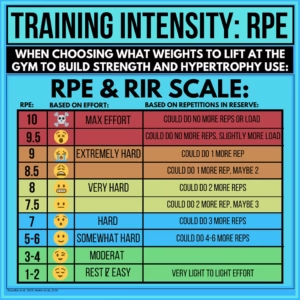
Rate of Perceived Exertion describes how difficult an exercise or set feels to the person performing it. In resistance training, a commonly used scale runs from 1 to 10, with higher numbers representing greater perceived effort. The resistance-training-specific version developed by Zourdos and colleagues links RPE to the estimated number of repetitions remaining before failure. Read the original research.
On this scale, RPE 10 represents a set performed to the point at which no additional repetition could be completed with the prescribed technique. RPE 9 indicates that approximately one repetition remains, while RPE 8 indicates that approximately two repetitions remain. Each reduction in RPE corresponds broadly to an increase in estimated repetitions in reserve.
This creates a useful relationship between perceived effort and proximity to failure. If a lifter completes eight repetitions of a squat and believes they could have completed only one more, the set would be rated around RPE 9. If they believe they could have completed another three repetitions, the rating would be around RPE 7.
The important qualification is that RPE describes perceived effort, not an objectively measured physiological state. Two people can perform the same exercise with the same load and repetition count but assign different RPE ratings. The same person may also rate an identical workload differently depending on sleep, accumulated fatigue, stress, motivation and familiarity with the movement.
RPE can therefore provide useful information about a training session, but it should not be mistaken for a precise measurement of strength or a reliable standalone method for deciding what weight someone should lift.
What Is RIR?
Repetitions in Reserve refers to the number of additional repetitions a person estimates they could complete before reaching muscular failure at the end of a set. Unlike RPE, which expresses effort using a rating, RIR asks a more direct question: how many repetitions did you have left?
If a client completes ten repetitions and believes they could have completed another two with the required technique, the set is rated at 2 RIR. If they could have completed five more, it is rated at 5 RIR. If they cannot complete another repetition under the defined technical standard, the set is approximately 0 RIR.
RIR is particularly useful when prescribing how close a client should work to failure. A programme might specify three sets of eight to ten repetitions at 2 RIR. The client would select a load that allows them to complete the target repetitions while finishing each set with an estimated two repetitions remaining.
The load does not necessarily remain fixed throughout the entire programme. If the client becomes stronger, the prescribed repetitions may become easier at the same weight. They can then increase the load, provided they maintain the required technique and remain within the intended effort range.
Research by Lovegrove and colleagues investigated RIR as a method of prescribing resistance-training loads for the bench press and deadlift. The findings support its practical application, while the study’s limited sample means the results should not be interpreted as proof that every lifter can estimate RIR accurately in every exercise. Read the study.
Watch: Rate of Perceived Exertion and Reps In Reserve Explained Explained
Videos can help demonstrate how these concepts are applied during actual resistance training. The following resources provide practical explanations of the scales and their relationship to muscular failure.
Repetitions in Reserve and Rate of Perceived Exertion
Watch: RIR and RPE Explained — Geoffrey Verity Schofield
This video explains repetitions in reserve, proximity to muscular failure and how these concepts can inform training decisions.
Practical Applications of RPE and RIR
Watch: RPE/RIR Explained — Athletic Over 40
This video covers the relationship between RPE and RIR, gives practical examples and discusses some of the limitations of using subjective effort ratings.
These videos are supplementary learning resources. Their explanations should be considered alongside the scientific literature and the practical requirements of the individual being trained.
How RPE and RIR Relate to Each Other
In resistance training, RPE and RIR are often used as two ways of describing the same underlying concept: how close a set is to failure. On the commonly used ten-point resistance-training scale, the relationship is approximately inverse. RPE 10 corresponds to 0 RIR, RPE 9 to 1 RIR, RPE 8 to 2 RIR, and RPE 7 to 3 RIR.
This relationship is useful because it allows a coach to communicate training intensity using either system. However, the numbers should not be treated as universally precise equivalents. The estimate depends on the lifter’s perception of effort and their ability to recognise how many repetitions they have left.
For example, an inexperienced lifter may finish a set of ten repetitions believing they have two repetitions remaining, when they could actually have completed four or five. Another lifter may underestimate their remaining capacity because the final repetitions felt uncomfortable, even though their muscles could have continued producing the force needed to complete more repetitions.
This is one reason why RPE and RIR require practice. Coaches should explain the intended effort level, observe technique and compare subjective ratings with actual performance. A rating becomes more useful when it is interpreted in the context of the exercise, load, repetition range and the individual’s training history.
Zourdos and colleagues examined the relationship between resistance-training RPE, RIR and different loading intensities. Their work helped establish a scale that could be used to estimate proximity to failure, but it does not mean subjective ratings are perfectly accurate in every situation. Read the research.
Why RPE Is Not the Best Primary Method for Prescribing Weights
RPE is often presented as a way to select the appropriate weight for a resistance-training session. However, using subjective effort as the primary method of prescribing load has significant limitations.
The main problem is that perceived effort is not a stable or objective measure of the weight a person should lift. A set can feel unusually difficult because the client slept poorly, has accumulated fatigue or is unfamiliar with the movement. Conversely, a client who feels energetic and motivated may perceive the same load as easier than usual. These changes in perceived effort do not necessarily correspond to equivalent changes in strength or physical capacity.
RPE also varies from repetition to repetition. The first repetition of a set may feel easy, while later repetitions become progressively more demanding. Even within the same set, a person’s perception can change with breathing, bracing, technique, discomfort and concentration. A single rating therefore cannot capture every relevant factor affecting performance.
This does not make RPE useless. It means that it should not be treated as an objective measurement of load or used in isolation to determine what weight a client should lift.
When the goal is to prescribe resistance-training weights, a percentage of one-repetition maximum (%1RM) provides a more objective starting point. If a client’s tested 1RM is 100 kg, for example, 70% 1RM corresponds to 70 kg. This creates a measurable reference point for selecting and progressing loads. However, percentage-based prescriptions also have limitations: the number of repetitions a person can complete at a given percentage varies between individuals and exercises, and daily performance can fluctuate.
RIR can complement percentage-based programming by helping a coach assess how close a set is to failure. For example, a programme might prescribe a target load based on a percentage of 1RM while also specifying an intended RIR range. The percentage provides the objective loading reference, while RIR helps interpret how demanding the set was in practice.
The evidence does not support claiming that one approach is universally superior for every training goal. Helms and colleagues compared RPE-based and percentage-based loading within periodised resistance-training programmes, illustrating that both methods can be studied as approaches to load prescription. The practical choice depends on the individual’s experience, the training objective and how well the method is implemented. Read the study.
For most general-population clients, a sensible approach is to establish an appropriate load using a structured programme and objective performance criteria, then use RIR as an additional measure of effort. RPE can provide useful context, but it should not replace sound load prescription.
How Accurate Is RIR?
RIR is useful only to the extent that the person can estimate their remaining repetitions with reasonable accuracy. Research shows that this ability is imperfect and can be affected by several variables.
One important factor is training experience. Someone who regularly trains close to muscular failure may develop a better understanding of how their final repetitions feel. However, experience alone does not guarantee accuracy, and even trained lifters can misjudge their remaining capacity.
Exercise selection also matters. The sensation of approaching failure can differ between a bench press, squat, leg extension and biceps curl. Technical breakdown, balance, cardiovascular demand and discomfort may influence when a person stops a set. The point at which a repetition becomes impossible may therefore be difficult to judge consistently across different movements.
The total number of repetitions completed can also affect estimation accuracy. Research by Zourdos and colleagues investigated how proximity to failure and the total repetitions performed in a set influence the accuracy of RIR-based ratings. The findings reinforce the importance of treating RIR as an estimate rather than a direct measurement. Read the research.
For coaches, the practical implication is straightforward: RIR should be taught and calibrated rather than assumed. A client who consistently reports 3 RIR but repeatedly stops with substantial capacity remaining may need further instruction and carefully supervised practice.
Where appropriate, a coach can occasionally use a controlled set taken closer to failure to help a client understand the sensation of their final repetitions. This should be done only when the exercise, equipment, technique and client are suitable for the task. There is no need to test every set to failure simply to improve RIR awareness.
Does Training to Failure Produce Better Results?
Muscular failure occurs when a person cannot complete another repetition under the defined conditions of the exercise. Training to failure is often associated with muscle growth, but it is not a universal requirement for developing strength or hypertrophy.
The relationship between proximity to failure and adaptation depends on factors including training volume, load, exercise selection, recovery and the individual’s experience. Training close to failure can provide a substantial stimulus, but repeatedly reaching failure can also increase fatigue and make it more difficult to maintain performance across subsequent sets.
A 2023 systematic review and meta-analysis by Refalo and colleagues examined the relationship between resistance training to failure and muscle hypertrophy. The findings do not establish that every set must reach momentary muscular failure to maximise muscle growth. Read the review.
A subsequent study by Refalo and colleagues compared resistance training to momentary muscular failure with training using repetitions in reserve. The study reported similar quadriceps hypertrophy after eight weeks in resistance-trained participants, demonstrating that training with repetitions remaining can still produce meaningful muscle growth. The findings should be interpreted within the study’s duration, population and training protocol rather than generalised to every programme. Read the 2024 study.
For many clients, finishing most working sets with approximately one to three repetitions in reserve can be a practical way to balance training stimulus with fatigue management. The appropriate target will vary with the exercise, the client’s experience, the training phase and the intended outcome. Some sets may be performed further from failure, while selected exercises may be taken closer to failure when doing so is appropriate and safe.
The important distinction is between training hard enough to produce an effective stimulus and assuming that every set must be maximally demanding. A well-designed programme manages effort across the session and training week rather than treating failure as the only indicator of productive training.
How Personal Trainers Should Apply RPE and RIR
RPE and RIR are most useful when they serve a clear purpose within a structured training programme. They should help a coach interpret performance and adjust training when necessary, rather than become numbers that clients are expected to guess without guidance.
Start by establishing the client’s training objective, movement competency and appropriate loading range. Use an established programme to determine the exercises, sets, repetitions and initial loads. Where reliable strength data are available, percentage-based loading can provide an objective reference point. RIR can then be used to assess whether the selected load produces the intended level of effort.
For example, a client might be prescribed three sets of eight repetitions on the bench press at a load based on their current strength. If the target is 2 RIR, they should finish each set believing they could complete approximately two further repetitions with acceptable technique. If they consistently finish with substantially more repetitions available, the load or prescription may need reviewing. If they cannot complete the target repetitions while maintaining the required technique, the load may be too demanding.
Adjustments should not be made mechanically after every set. A coach should consider whether the deviation reflects a genuine loading issue, unfamiliarity with the movement, accumulated fatigue or an inaccurate estimate. Recording the load, repetitions, RIR and relevant performance observations over time can help reveal patterns that are not obvious from a single session.
RIR can also support autoregulation: the process of adjusting training in response to the individual’s performance rather than following a fixed prescription regardless of circumstances. A client who is unusually fatigued may need a modification, while a client who is consistently outperforming the programme may be ready for progression. The adjustment should be based on the wider training context, not solely on a subjective rating.
A review by Pelland and colleagues discusses the challenges of controlling and reporting proximity to muscular failure, including the need for clearer methods and consistent interpretation. This is particularly relevant when coaches use RIR to communicate training intensity or compare programme outcomes. Read the review.
RPE and RIR Explained: Common Mistakes When Using RPE and RIR
One common mistake is assuming that a numerical rating is automatically accurate. Asking a client to finish at 2 RIR does not guarantee that they understand what two remaining repetitions feel like. The coach must explain the concept, observe performance and help the client develop a more reliable estimate.
Another mistake is using RPE as a substitute for load prescription. A client may report that a weight feels like RPE 8, but that rating alone does not tell the coach whether the load is appropriate for the exercise, repetition range or training objective. RPE needs to be interpreted alongside the programme and the client’s performance.
A third mistake is treating training to failure as essential for progress. Although proximity to failure matters, the research does not establish that every set must reach failure to produce hypertrophy. The cost of excessive fatigue may outweigh the benefit of pushing every set to its limit, particularly when doing so compromises technique or reduces the quality of later work.
Finally, coaches should avoid comparing RIR scores between clients as though they were standardised measurements. A rating of 2 RIR from one person may not represent exactly the same physical state as 2 RIR from another. These ratings are most useful for interpreting an individual’s training over time, provided the method is applied consistently.
Conclusion: Use RPE and RIR as Tools, Not Rules
RPE and RIR provide useful ways to describe training effort and proximity to muscular failure. They can help coaches understand how demanding a set feels, manage fatigue and adjust a programme in response to performance. RIR is particularly useful when prescribing how close a client should work to failure, while RPE can provide a broader description of perceived exertion.
Neither method removes subjectivity, and neither should be mistaken for an objective measure of strength. RIR estimates can be inaccurate, especially when a client has limited experience of working close to failure. RPE is also influenced by factors that can change from one session or repetition to the next.
Effective load prescription should therefore begin with sound programming principles and measurable performance criteria. Percentage-based loading can provide an objective reference point when reliable strength data are available, while RIR can help assess how closely a set matches the intended effort level. RPE is best treated as supplementary information rather than the primary determinant of the weight a client should lift.
For personal trainers, the goal is not to use the most complicated method. It is to select an approach that the client understands, apply it consistently and use the resulting information to make better training decisions.
Rate of Perceived Exertion and Reps In Reserve Explained Explained: References and Further Reading
- Zourdos, M. C. et al. (2016). Novel Resistance Training-Specific Rating of Perceived Exertion Scale Measuring Repetitions in Reserve. PubMed.
- Helms, E. R. et al. (2018). Research comparing RPE-based and percentage-based loading in periodised resistance training. PubMed.
- Helms, E. R. et al. (2020). Methods for Regulating and Monitoring Resistance Training. PubMed.
- Zourdos, M. C. et al. Research on how proximity to failure and repetitions performed influence RIR estimation accuracy. PubMed.
- Lovegrove, S. et al. (2022). Repetitions in Reserve Is a Reliable Tool for Prescribing Resistance Training Load. PubMed.
- Pelland, J. C. et al. (2022). Methods for Controlling and Reporting Resistance Training Proximity to Failure: Current Issues and Future Directions. PubMed.
- Refalo, M. C. et al. (2023). Systematic review and meta-analysis examining resistance training to failure and muscle hypertrophy. PubMed.
- Refalo, M. C. et al. (2024). Similar Muscle Hypertrophy Following Eight Weeks of Resistance Training to Momentary Muscular Failure or With Repetitions-in-Reserve in Resistance-Trained Individuals. PubMed.
- Geoffrey Verity Schofield. RIR and RPE Explained (ESSENTIAL!) YouTube.
- Athletic Over 40. RPE/RIR Explained! YouTube.
Develop Your Knowledge with Redefining Fitness
Understanding concepts such as RPE, RIR, progressive overload and training intensity is part of becoming a competent personal trainer. Applying them effectively requires a broader understanding of anatomy and physiology, programme design, exercise technique, client assessment and the principles underpinning evidence-based coaching.
Redefining Fitness offers a combined Level 2 Gym Instructing and Level 3 Personal Training qualification, with online learning resources, mock exams, tutor support and practical workshops. The course is designed to take learners through the foundational knowledge and practical development required for personal-training education.
If you want to build your knowledge, develop your coaching skills and work towards a recognised personal-training qualification, explore the course details and available support.
Explore the Redefining Fitness Level 2 and Level 3 Personal Training Course
Visit Redefining Fitness to learn more about its personal-training qualifications and further education opportunities and learn not just how to qualify as a personal trainer but how to build a long and successful career too. We are interested in developing the next generation of personal trainers in the UK and internationally so if you think you have what it takes to be the industries next best secret, have a chat with our team and find out the right career path for you.