
What if the certificate that looks strongest on paper leaves you least ready to lead a class? If you’re searching for an indoor cycling instructor qualification uk, don’t judge a course by its title alone. Look at what you’ll learn, how you’ll practise and what the assessment asks you to demonstrate.
Course names and qualification claims can be difficult to compare, particularly when syllabuses, teaching practice and assessment differ. Focus on the skills a course develops, and whether its format fits your experience and learning needs. The right training should help you build towards the kind of teaching you want to do.
This guide explains what to look for in indoor cycling training, how to compare course formats and assessment, and how specialist study can complement broader fitness education. Redefining Fitness offers indoor cycling training as part of its specialist course and CPD provision, with blended learning, face-to-face practical workshops and inclusive learner support. Use the guidance below to choose a course for its substance, not just its certificate title.
Key Takeaways
- Indoor cycling training develops specialist skills for leading cycling sessions, while a broader fitness qualification covers a wider range of instruction.
- Compare learning outcomes for session planning, communication, safety and practical teaching rather than assuming every course covers the same ground.
- When assessing an indoor cycling instructor qualification uk, consider its scope, learning format, practical instruction, assessment and learner support.
- Use a five-step checklist to match your teaching goal and experience to the syllabus, assessment approach and support available.
- Redefining Fitness offers specialist indoor cycling training within a wider provision that includes blended learning and face-to-face practical workshops.
Indoor cycling instructor UK: what does it prepare you for?
Specialist indoor cycling training develops the knowledge and teaching skills needed to lead cycling sessions. That involves more than riding a bike. You need to organise a class, explain the session clearly and guide a group through it with purposeful instruction.
It’s a focused skill set, not a substitute for broader fitness education. A cycling qualification centres on instructing studio cycling classes; a wider fitness qualification can prepare you for a broader range of exercise instruction. The two can complement each other, but they aren’t interchangeable. A certificate title tells you what a course is called; practical competence develops through learning, practice and feedback.
Titles and qualification scope vary, so don’t assume courses with similar names teach or assess the same things. Compare the course specification with any awarding-body or endorsement statements, and verify those details through official information. The overview of indoor cycling offers useful context on the activity and how classes are structured, but it doesn’t establish what a particular qualification covers.
What does an indoor cycling instructor teach?
An instructor guides participants through a structured studio cycling session, explaining the plan and helping the group follow it. Depending on the class, this can involve cueing changes in effort or position and keeping instructions clear while participants ride. You’ll also need to adapt your delivery to the group, so participants with different levels of experience can follow the session.
Who should consider an indoor cycling qualification?
If you’re aspiring to teach, specialist training can help you develop the skills for leading cycling classes. If you’re already a fitness professional, it can broaden the ways you teach without making cycling your whole career. Entry criteria differ between courses, so compare the stated prerequisites with your experience before choosing.
Start with the work you want to do. If your aim is to teach indoor cycling, focus on preparation for that setting. If you want a broader foundation across fitness instruction, compare specialist study with a Level 2 and 3 personal training diploma guide. The question isn’t which title sounds bigger. It’s which learning fits your next step and gives you room to develop as an instructor.
Then look beyond the headline. Can you explain a session clearly, keep your cues purposeful and adjust your approach to the group in front of you? These are practical teaching demands, not decorative extras. A useful qualification should help you understand the instructor’s role and apply that learning in a class. Keep that distinction in view as you compare course content and assessment.
What should a strong indoor cycling instructor course teach and assess?
A course title can sound convincing and still reveal little about what you’ll be able to do. Judge the learning outcomes. For an indoor cycling instructor qualification uk, look for preparation in session planning, group instruction, communication, participant management and practical application. Course content varies, so don’t assume similarly named qualifications cover the same ground.
Separate what the course teaches from what the assessment asks you to demonstrate. A syllabus may mention safety or class planning, but a topic on a list doesn’t show whether you can apply it. Examine the stated outcomes and assessment evidence rather than relying on broad claims about confidence or readiness.
How to judge the course content
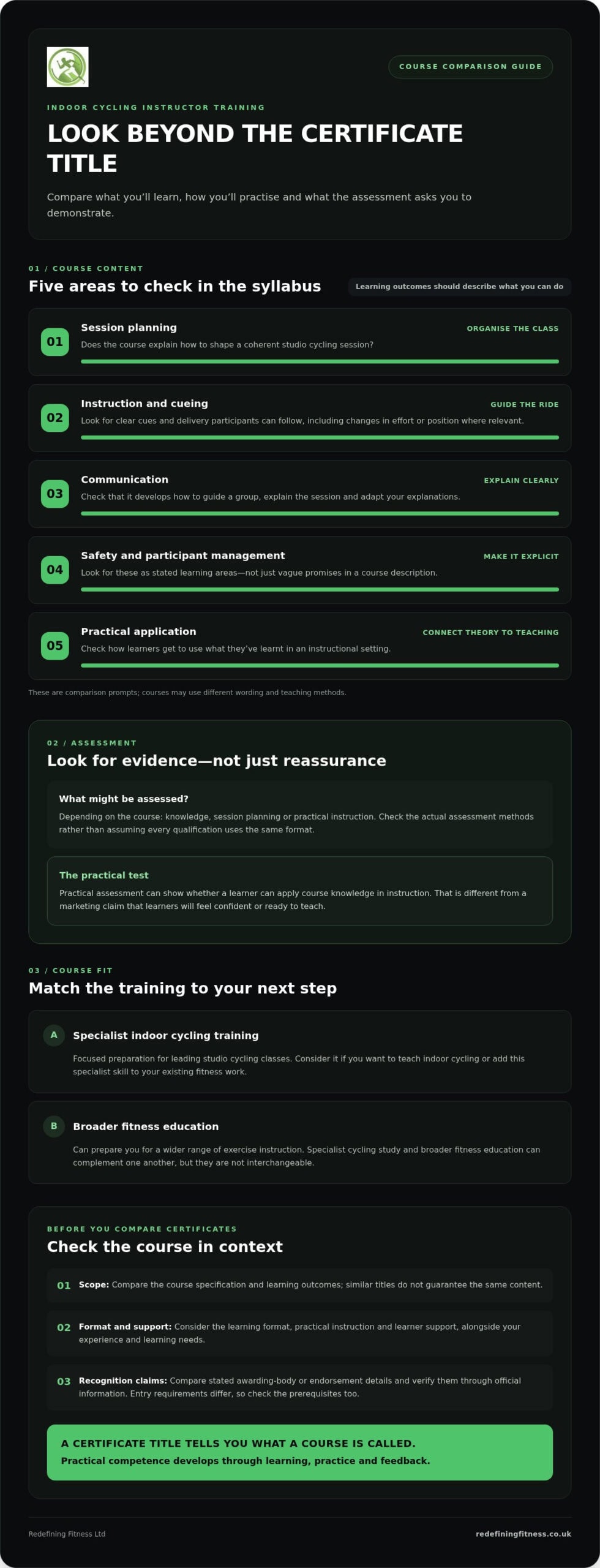
Look for learning outcomes that describe what you’ll be able to do, not just topics you’ll encounter. A useful course outline should explain how it addresses class structure, session planning, instructor communication, safety and participant management. It should also show how learners connect relevant theory with practical application.
- Session planning: Does the course explain how to organise a class into a coherent session?
- Instruction: Does it develop clear cues and delivery that participants can follow?
- Communication: Does it cover guiding a group and adapting explanations?
- Safety and management: Are these explicit learning areas rather than vague promises?
- Application: Is there a practical element that lets you use what you’ve learnt?
These are comparison prompts, not a claim that every qualification must use identical wording or teaching methods. For broader context on exercise science, the ACSM Certified Exercise Physiologist page outlines a distinct professional pathway. It can help frame the difference between specialist class instruction and wider exercise-science roles, but it isn’t a benchmark for indoor cycling course content.
What meaningful assessment should demonstrate
Assessment should provide evidence that you can use what you’ve learnt. Depending on the course, it may test knowledge, session planning or practical instruction. Check the course information for the actual assessment methods rather than assuming every qualification uses the same format.
Practical assessment shows whether a learner can apply course knowledge in instruction. That evidence is different from a marketing statement that learners will feel confident or ready to teach. Confidence matters, but it isn’t proof of competence on its own.
- Identify the learning outcomes the assessment is designed to measure.
- Check whether it asks you to demonstrate relevant teaching skills.
- Look for information about feedback or support connected to assessment.
Use these criteria to make a sharper comparison, then explore indoor cycling training with Redefining Fitness as a specialist development option within fitness training and CPD.
How to compare indoor cycling qualifications, formats and recognition
Compare the substance, not just the badge. An indoor cycling instructor qualification uk can differ in scope, delivery and assessment, even when course titles sound similar. A specialist course and a broader fitness qualification serve different purposes: one focuses on cycling instruction, while the other develops wider fitness teaching knowledge.
| Compare | What to look for | Ask yourself |
|---|---|---|
| Qualification scope | Clear learning outcomes and what the qualification is designed to cover. | Does it match the kind of teaching I want to do? |
| Learning format | Online study, face-to-face workshops or a blend of both. | How do I learn best, and what fits my schedule? |
| Practical instruction | How learners apply class-planning and teaching skills in practice. | Will I have a chance to practise instruction? |
| Assessment | The knowledge, planning or teaching competence being assessed. | What evidence will show what I can do? |
| Support | How learning guidance and support are described. | What helps me stay engaged and progress? |
Qualification title, awarding body and recognition
A qualification title names the award or course. An awarding body is the organisation responsible for the qualification, while endorsement or recognition describes a separate status or relationship. These terms aren’t interchangeable, and certificates don’t all carry identical status. Treat qualification names and claims as specific to the course, then verify current details through official awarding-body or professional-body information.
Don’t infer recognition from a familiar-sounding title. Check the exact qualification name, awarding body and any endorsement claim together, using current official sources. This gives you a clearer picture of what the credential represents, without assuming every indoor cycling course follows the same route or carries the same standing.
Online, practical and blended course formats
Online learning may suit you if you need flexibility to study around work or other commitments. Face-to-face practical workshops provide space to practise instruction and engage directly with tutors and other learners. Blended study combines online learning with in-person practical learning, although the balance varies by course. Choose according to your schedule, learning preferences and need to practise, rather than assuming one format is automatically best.
Support matters too. Clear guidance and inclusive teaching can make learning more accessible for people with different needs, including neurodivergent learners. Redefining Fitness combines blended learning with face-to-face practical workshops across its course provision and emphasises inclusive support. Its neurodivergent-friendly personal trainer course guide explores what inclusive learning can look like in fitness education.
Use the table to compare what each course is designed to develop, how you’ll learn and what the assessment demonstrates. Then weigh those details against your teaching goals. A strong fit supports the skills you need to build, not simply the course with the most impressive-sounding label.
How to choose an indoor cycling instructor qualification that fits your goals
The right course isn’t the one with the loudest claims. It’s the one that fits your teaching goal, experience and learning needs, then gives you a clear path to build skills for class. Use this five-step checklist to make your choice deliberately.
Match the course to your starting point
If you’re new to instructing, consider what foundations you need alongside cycling-specific skills. If you’re already a fitness professional, focus on how specialist study could broaden your teaching practice. Your starting point can help you compare options, but check each course’s stated entry requirements rather than making assumptions.
- Define your teaching goal. Picture the class you want to lead and the setting you’re aiming for. The clearer your goal, the easier it is to judge whether a course’s scope matches your next step.
- Assess your experience. Be honest about your current teaching skills and what you still need to practise. If you’re new to instructing, prioritise a course that supports skill development; if you already teach, look for relevant specialist learning.
- Compare the syllabus. Review the stated learning outcomes and see whether they relate to the instruction you want to deliver. Don’t choose by title alone; course names can conceal differences in scope.
- Inspect the assessment. Identify what you’ll need to demonstrate and whether assessment relates to the skills you want to build. Consider whether the format gives you a suitable way to show what you know.
- Review the support. Consider how the study structure, guidance and learner support fit your circumstances. A course should be workable as well as relevant.
Check learning support and practical readiness
Think about what helps you learn well: a clear structure, time to revisit material, opportunities to practise or feedback as you develop. Inclusive support can benefit learners with varied needs; you don’t need a diagnosis to value accessible explanations and thoughtful teaching. Set aside time for practice and reflection alongside formal study, so you can work on applying new ideas as teaching skills.
Be practical about your schedule, too. Online study may suit independent learning, while face-to-face workshops provide in-person practical learning. Blended approaches combine both. The best fit depends on how you learn and how much supported practice you want, not on a universal ranking of formats. Consider whether the course structure gives you a manageable way to keep progressing.
Ready to turn specialist study into a purposeful next step? Explore indoor cycling training with Redefining Fitness, where indoor cycling is part of specialist fitness training and CPD provision.
Study indoor cycling with Redefining Fitness: turn training into teaching
You now have a framework for judging course scope, learning format, assessment and support. Redefining Fitness offers indoor cycling as specialist development within its fitness training and CPD provision. It is a focused option for aspiring instructors and established fitness professionals looking to broaden their teaching practice.
A practical, inclusive approach to specialist fitness training
Practical subjects need more than information on a screen. Redefining Fitness’s course model combines online learning with face-to-face practical workshops. This brings independent study and in-person learning together, giving learners different ways to engage with course material and practise skills.
Learning should make room for different needs and ways of engaging with material. Redefining Fitness emphasises inclusive teaching and support for neurodivergent learners. Clear structure and accessible learning support can matter in practical training, and you don’t need a diagnosis to value an environment where learners are treated as individuals. The organisation is also multi-award-winning, reflecting its wider work in fitness education, not a promise of any particular result for each learner.
A supportive learning environment can help you engage with training, but development still depends on what you practise, reflect on and take forward. As you assess an indoor cycling instructor qualification uk, compare the course’s scope, delivery and assessment with your aims, as well as the teaching approach that shapes your learning experience.
Take your next step towards teaching indoor cycling
If you’re new to instruction, specialist study can be a purposeful starting point for developing towards leading cycling classes. If you already teach fitness, it can help you add a distinct area of practice to your professional toolkit. In either case, make your decision against your own goal: review the course scope and format, then weigh those details against the skills you want to build.
Be ambitious, but be deliberate. A course is a step in your development, not a guarantee of employment or teaching opportunities. Choose training that aligns with the work you want to do and gives you a meaningful foundation for continued learning. Explore indoor cycling training with Redefining Fitness.
Take the next step towards leading with confidence
Your next move isn’t simply to collect a certificate. Choose training that helps you develop as an instructor, then keep building your craft through preparation, practice and reflection. When selecting an indoor cycling instructor qualification uk, stay focused on the teaching you want to do and the support that will help you progress.
You don’t need to have every detail of your future mapped out. You do need a clear reason for taking this step and the willingness to put learning into action. Whether you’re preparing to teach for the first time or adding a specialist skill to your fitness career, choose deliberately and make your next move count.
Redefining Fitness offers indoor cycling training as part of its specialist fitness course and CPD provision. Review the course information and consider how its scope, learning format and support align with your goals. Explore indoor cycling training with Redefining Fitness and take a confident step towards developing your teaching practice.
Frequently Asked Questions
Do I need a personal training qualification before taking an indoor cycling instructor course?
Not always; entry criteria are set by the individual course. If you’re new to teaching, look for information about whether the course is intended for aspiring instructors. If you already work in fitness, specialist CPD may suit your development. For an indoor cycling instructor qualification uk, read the prerequisites and intended audience together. Personal training develops broader fitness skills, while cycling study focuses on a specialist area of instruction.
Is an indoor cycling instructor qualification the same as a spin instructor certificate?
Not necessarily. “Spin” is often used informally to describe group cycling, but a specific branded or qualification title can refer to a particular programme. Don’t rely on the wording alone. Compare the course’s stated outcomes, awarding details and assessment, and note whether its name refers to a branded scheme. This helps you describe your training accurately and avoid treating different certificates as interchangeable.
Can you become an indoor cycling instructor through online study?
Possibly, but the label “online” doesn’t tell you everything about the learning experience. Look at how the course develops practical instruction and how you’ll demonstrate what you’ve learnt. For example, consider whether you’ll plan a sample session, practise explaining transitions or receive feedback on your teaching. Course structures differ, so base your decision on the actual study and assessment details, not assumptions about online learning.
How long does an indoor cycling instructor qualification take?
There’s no single duration that applies to every UK course. The time needed can depend on how the learning is organised, what assessment involves and how much preparation you’ll do. A short workshop date may not represent the whole study commitment. Before planning around work or other responsibilities, review the course timetable and allow time to revisit material and practise beyond scheduled sessions.
Does an indoor cycling qualification let you teach other group exercise classes?
Usually, you shouldn’t assume that it does. Indoor cycling training focuses on that teaching context, and other group exercise formats can call for different knowledge and skills. If you hope to teach circuits as well as cycling, for example, identify the separate competencies each class requires and look for training that addresses them. Read the stated scope carefully before presenting one qualification as covering several disciplines.
What should I look for in an indoor cycling course assessment?
Look for assessment information that makes clear what you’ll need to demonstrate. Consider whether it covers knowledge, planning or practical instruction, and how each element relates to the course outcomes. For instance, if you’ll need to lead a session, look for an explanation of how teaching ability is assessed. Don’t confuse completing learning materials with demonstrating that you can apply them in an instructional setting.
Can I take an indoor cycling instructor course if I am neurodivergent?
Neurodivergence alone doesn’t determine whether a course will suit you; learning preferences and support needs differ from person to person. Consider whether the study structure and teaching approach feel accessible, including how information is presented and how you can engage with practical learning. Redefining Fitness emphasises inclusive teaching and support for neurodivergent learners. Choose a setting that respects different ways of learning and helps you take part fully.