

Should You Pay Rent as a Personal Trainer? UK Guide Free rent won’t fix a weak business model. If you’re weighing up whether you should pay rent as a personal trainer, the answer depends on whether the space helps you earn more than it costs. A low-rent or rent-free deal can protect your margins, but only if the location, access and terms suit the way you train clients.
It’s reasonable to see rent as a major risk while building a client base. But choosing the cheapest space without considering how you’ll use it can cost you in other ways. Compare the full cost of each option with the sessions you can realistically deliver.
This guide shows you how to assess a training space, compare fixed rent with a percentage-based arrangement, budget for wider costs and work out how many sessions you need to break even. You’ll have a clearer basis for deciding whether rent gives your business room to grow or adds pressure before your income can support it.
Table of Contents
Assessing personal training space requirements
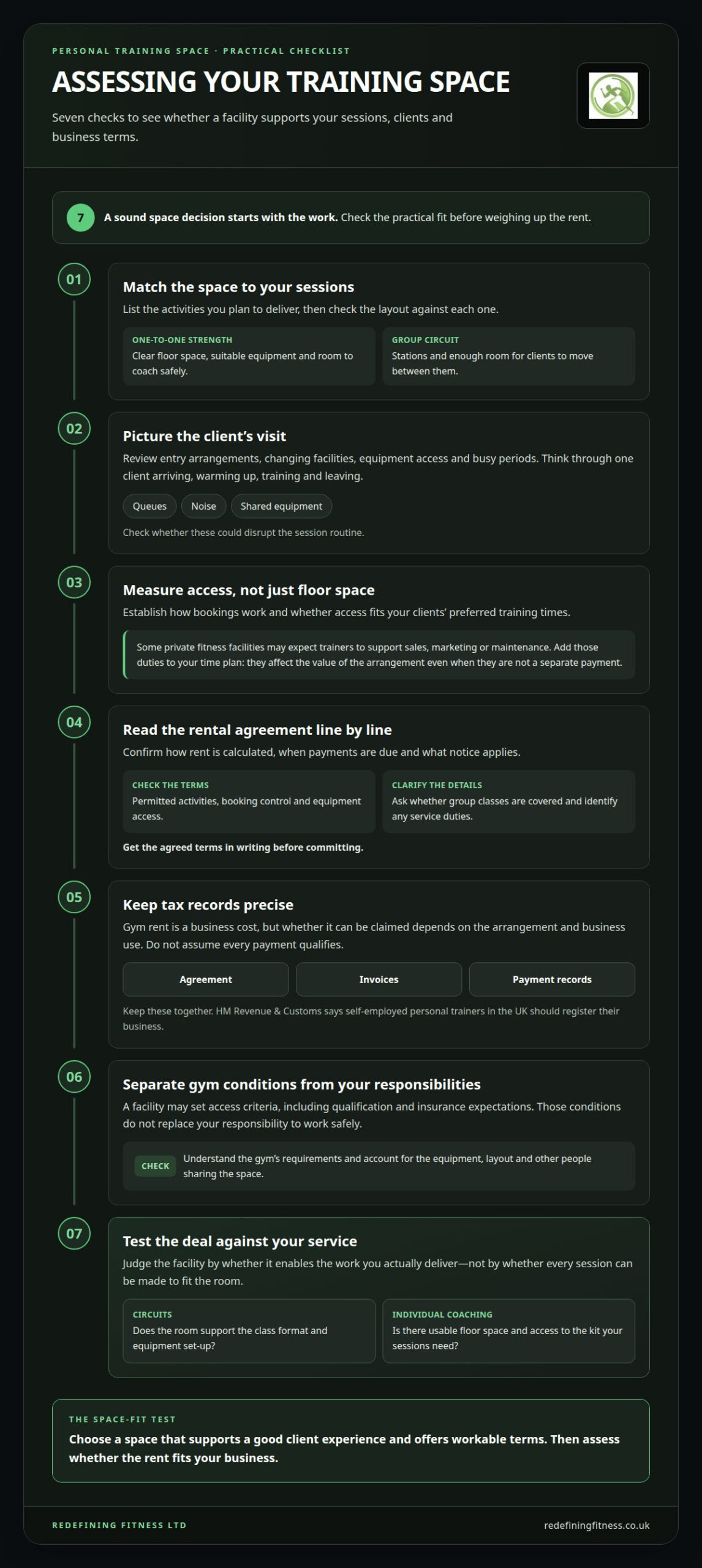
If you’re asking, “Should I pay rent as a personal trainer?”, start with the work the space needs to support. Gym access conditions vary, and facilities may require relevant qualifications and insurance. Make sure you have appropriate insurance and follow health and safety regulations.
- Match the space to your sessions. A one-to-one strength session needs clear floor space, suitable equipment and room to coach safely. A group circuit needs stations and room for clients to move between them. List the activities you plan to deliver, then check whether the available layout supports each one without forcing you to change your coaching approach.
- Check how clients will use the facility. Review entry arrangements, changing facilities, equipment access and busy periods. A room that seems workable during a quiet visit may feel cramped when members train nearby. Picture one client arriving, warming up, completing a session and leaving. Note where queues, noise or shared equipment could disrupt that routine.
- Measure access, not just floor space. Establish how bookings work and whether access fits your clients’ preferred training times. Some private fitness facilities expect trainers to support sales, marketing or maintenance. Add those duties to your time plan. They can affect the value of a rental arrangement even if they don’t appear as a separate payment.
- Read the rental agreement line by line. Identify how rent is calculated, when payments fall due, and what notice applies. Check permitted activities, booking control, equipment access and any service duties. If you plan to deliver group classes, clarify whether the space arrangement covers them. Get the agreed terms in writing before committing.
- Keep tax records precise. Gym rent is a business cost, but whether you can claim it depends on the arrangement and business use. Keep the agreement, invoices and payment records together. Don’t assume every payment qualifies. According to HM Revenue & Customs, self-employed personal trainers in the UK should register their business.
- Separate gym conditions from your responsibilities. A facility may set its own access criteria for trainers, including qualification and insurance expectations. Those conditions don’t replace the need to work safely. Understand what the gym requires and make sure your training practice accounts for the equipment, layout and other people sharing the space.
- Test the deal against your service. For circuits, assess whether the room supports the class format and equipment setup. For individual coaching, focus on usable floor space and access to the kit your sessions need. Whether you should pay rent as a personal trainer depends partly on whether the facility enables your actual work, rather than making you adapt every session to the room.
Choose a space that supports a good client experience and offers workable terms. That gives you a sound basis for deciding whether the rent fits your business.
Budgeting for gym space rental
A rent figure means little without your income, workload and agreement beside it. Compare the full monthly commitment with the business you can actually sustain, not an optimistic forecast.
- Use UK figures as a starting point. These ranges show how widely terms can differ, not what every trainer pays.
- Test the rent against your gross income. Use your expected revenue to calculate the share rent would consume. If too little remains for other business costs and personal income, the space may be unaffordable, even when its facilities look attractive.
- Compare the facility’s scale with its fee. A city gym with 5,000 members will typically charge a higher personal-training fee than a suburban club with 1,500 members. That premium only makes sense if the location and access help you reach suitable clients. Weigh the opportunity against the service you can deliver, rather than assuming more members automatically mean more bookings.
- Add every work requirement to the cost. Some gyms reduce rent when trainers work unpaid service hours on the gym floor. Treat those hours as part of your payment: they use time you could spend coaching, finding clients or delivering fitness classes. Private facilities may instead expect sales, marketing or maintenance work. Compare the total commitment, not just the headline rent.
- Budget separately for group sessions. Running your own group classes may involve an additional space fee. Include that charge in the class budget before deciding whether the format earns its place in your timetable. A low base rent can still become expensive if each class adds another facility cost.
- Build a cautious monthly forecast. List rent, required service hours and class-space fees separately, then compare them with expected training income. Keep a buffer for quieter periods instead of building the budget around a full diary. This makes the trade-off visible: a larger fee needs a clear business benefit, while a smaller fee can still demand too much time.
Strong financial decisions need strong professional foundations. As you plan your next move, explore fitness career foundations.
Before accepting an arrangement, list the money due and any service hours required. Then compare the full commitment with the time you can realistically devote to paid coaching. Some gyms let personal trainers reduce rent by working unpaid service hours on the gym floor. Account for that exchange rather than treating lower rent as a cost-free saving. If the arrangement crowds out work that supports your income, the apparent discount may not suit your plans.
Personal trainers who run group classes may need to pay a fee for the space they use. Include that cost when deciding whether a class is worthwhile, and use a cautious attendance estimate rather than relying on a best-case turnout. Review your assumptions as your schedule develops so you can spot when the rental arrangement no longer suits your business.
Calculating break-even sessions and expenses
If you’re deciding whether you should pay rent as a personal trainer, include every cost that affects your coaching income. Count rent or commission, class-space charges, insurance, equipment, travel and payment-processing costs. Include any required unpaid floor, marketing or maintenance hours too, since they reduce the time available for paid sessions.
- Separate fixed costs from session costs. Record monthly rent and other regular commitments separately from costs that rise with each session. Flat rent stays constant as bookings change, whilst commission takes a share of session revenue. Add any separate group-class space fee to the relevant class costs. This distinction shows which expenses remain during a quiet month.
- Calculate what each session contributes. Start with the client’s payment, then subtract costs directly tied to delivering that session. Under commission, subtract the gym’s share as well. The remainder contributes towards fixed expenses; it isn’t your take-home income. If you’re asking whether you should pay rent as a personal trainer, this figure reveals what each booking actually adds to the business.
- Work out the rent-only break-even point. Divide monthly rent by the amount each session contributes. That gives you the sessions needed to cover rent alone. For example, if rent is £R and your contribution per session is £C, calculate £R ÷ £C. Add insurance and other fixed business costs to the rent for a fuller overhead break-even figure.
- Compare flat rent with commission at the same workload. Apply each arrangement to the same expected sessions and income. With flat rent, subtract the payment once. With commission, subtract the gym’s share from every session. This like-for-like calculation shows how the models behave as bookings rise or fall, without confusing gross revenue with money left after space costs.
- Build a realistic schedule, not a perfect one. Use sessions you can deliver consistently, then allow for cancellations, travel between clients and unpaid duties. If break-even depends on every available slot being full, your plan has no breathing room. Count bookable coaching time, not every hour you could theoretically spend at the gym.
- Track the result against all expenses. Add equipment replacement, insurance, travel and class-space charges to your monthly forecast. Compare paid sessions with actual costs, then see whether the rental model covers its overheads. A rent-only break-even is a starting point; it doesn’t show whether the full business leaves enough income after its other commitments.
Use the calculation to assess your realistic workload, not an ideal diary. Work out how many sessions cover the commitment and whether your schedule can sustain them alongside the rest of your business.
Comparing rental options using income and session numbers
Compare each arrangement using the same coaching income and weekly workload. A headline rent figure means little without the payment model beside it.
Compare rental payment models
Compare fixed rent, commission and pay-per-session terms using your expected bookings. Fixed rent stays constant as sessions rise or fall; commission takes a percentage of each session fee, whilst pay-per-session charges for space only when you use it. Under a 40% commission example, you keep 60% of each session fee. Check whether extra duties or class-space charges change the real cost.
Compare renting with employment
Compare renting with an employed role by looking at income structure, costs and control. Renting gives you space for your own coaching business, but you carry the rent commitment as bookings fluctuate. Employment may structure work and pay differently. Assess the actual duties, hours and payment terms for each option rather than assuming one model automatically pays more.
- Use session volume as a decision point. A percentage arrangement is usually preferable below 20 sessions per week, because the gym’s share rises with the sessions you deliver. A flat fee can be the smarter financial choice above 20 sessions per week when you have a full book or waiting list. Treat this as a comparison point, not a substitute for calculating your own figures.
- Compare both models at the same workload. Write down expected weekly sessions and session income, then calculate the gym’s share under commission. Set that against the fixed rent for the same period. At 20 sessions per week, a 25% gym share and the flat-rent example produce the same amount for the trainer. Above or below that workload, recalculate rather than carrying over the result.
- Account for location and facility type. Rental terms vary with the gym and its market. In 2002, rent at LA Fitness London City sites was 40-60% higher than the author’s rent. That historical comparison shows why a single rate cannot represent every location; weigh the facility’s access and client potential against its specific fee.
- Choose the model your diary can withstand. A new trainer with uneven bookings may value costs that move with sessions. A trainer with a consistently full diary can compare that flexibility against a fixed commitment. Include unpaid service hours in the calculation, because time spent on gym-floor duties reduces availability for paid coaching.
Setting up a home or commercial training space
Choose a setting that suits your coaching model, not just the appearance of an empty room. Work through these steps before committing to a home setup or commercial premises.
- Define the sessions the space must support. List the equipment, movement patterns and coaching style your clients need. A strength-focused session demands different floor space from a circuits class. Build the layout around safe movement and clear sightlines, rather than buying equipment first and squeezing sessions around it.
- Map the usable floor area. A personal trainer considering a small commercial space may look at premises of around 1,000 square feet. Treat that as a planning reference, not a target that every business needs. Measure the area available for training, storage and client movement before deciding whether the premises fit your delivery model.
- Assess a home setup honestly. Identify where sessions would take place, where equipment would be stored and how clients would enter and leave. Consider privacy, household routines, noise and interruptions. If a client cannot train comfortably without disrupting the home, a spare room may be cheaper but still unsuitable.
- Separate training space from supporting areas. A commercial layout needs more than exercise floor space. Allow for equipment storage, changing needs and a clear route through the room. For example, kettlebells left beside a doorway can obstruct movement. Plan each area around how clients and equipment will move during a real session.
- List the operating demands before signing. Write down who handles cleaning, equipment storage, access and day-to-day maintenance. Include any sales or marketing duties in your time plan. These responsibilities affect how much time remains for coaching, even when they don’t appear as a separate rental charge.
- Compare flexibility with commitment. A home setup can keep your work close, whilst a commercial unit gives you a dedicated training environment. Weigh each against your client experience, session format and realistic workload. A large room offers little value if you cannot fill it; a compact home space fails if it restricts the coaching you want to deliver.
- Make the decision from the finished plan. Sketch the layout, list essential equipment and note every operational task. Then compare the space with your planned sessions and the experience you want clients to have. If the setup forces compromises in movement, privacy or coaching quality, choose a different arrangement before committing.
Some private fitness facilities let trainers support the business through sales, marketing or facility maintenance instead of reducing rent through service hours. Clarify which arrangement applies before agreeing to use the space.
Redefining Fitness: Level 2 & 3 Personal Training Course
Redefining Fitness offers Level 2 and Level 3 personal trainer qualifications, delivered online and in person. If you’re preparing to coach clients in rented or dedicated space, build your professional foundation before committing to overheads. The course combines blended learning with face-to-face workshops, helping you develop the knowledge to plan your next steps with greater purpose.
When you’re ready to develop your practice, specialist options include kettlebells, circuits and indoor cycling. These can help shape the sessions you plan to deliver, whether you’re assessing a gym’s equipment or designing a training space around your coaching. Choose education that supports your intended work, not a shortcut around it.
Contact Redefining Fitness to discuss your personal training qualification options.
Build a business you can sustain
Your next move is to build a coaching business around the work you want to deliver, not simply the space you can access. Decide which skills and services you want to develop, then shape your professional learning around that direction. Redefining Fitness Ltd offers a Level 2 & 3 Personal Training Course, alongside options in kettlebells and circuits, to support your development.
Are you the fitness industry’s next best secret? Turn that ambition into a clear development plan, then choose training that supports it.
Explore the prospectus from Redefining Fitness Ltd and take your next step. Keep building your craft and shape a business that reflects the coach you’re determined to become.
Frequently Asked Questions
Free Rent for Personal Trainers: Does it Improve Your Chances of Success?
Free rent lowers one overhead, but it won’t bring in paying clients or strengthen your coaching. Treat it as useful only if the arrangement gives you workable access and time to build your business. Read the conditions closely: required duties, restricted training times or extra charges can reduce the value of a rent-free offer. Success still depends on delivering a service clients want to book and continue.
How much do personal trainers pay to rent gym space in the UK?
In London, location and facility type affect rent, so use any national average as context rather than a local quote. Compare the full cost of usable access, including service duties or separate class-space charges. Two arrangements with similar headline rent can have different business costs once time commitments and access conditions are included.
How many clients or sessions are needed to break even on personal trainer rent?
There’s no fixed client count: break-even depends on what each session contributes after the gym’s share and your other costs. A client who books consistently contributes differently from one who attends irregularly. Base your calculation on paid sessions delivered, not just names on your client list. If clients train in different formats, calculate each separately, since a class-space charge can change what a session contributes.
What are the risks of paying rent at a gym before building a client base?
The main risk is taking on a recurring cost before your bookings can reliably support it. A quiet start can leave less cash for marketing, equipment or other business needs. You may also spend time on required gym duties instead of developing client relationships. Before committing, understand the notice terms and access conditions, and consider how you would manage rent during a slower period.

Should You Pay Rent as a Personal Trainer? UK Guide
Should You Pay Rent as a Personal Trainer? UK Guide Free rent won’t fix a weak business model. If you’re weighing up whether you should pay rent as a…

Why Personal Trainers Need Multi-Disciplinary Teams
Great coaching has limits when you try to do everything alone. Why personal trainers should build multidisciplinary teams comes down to a simple…
