

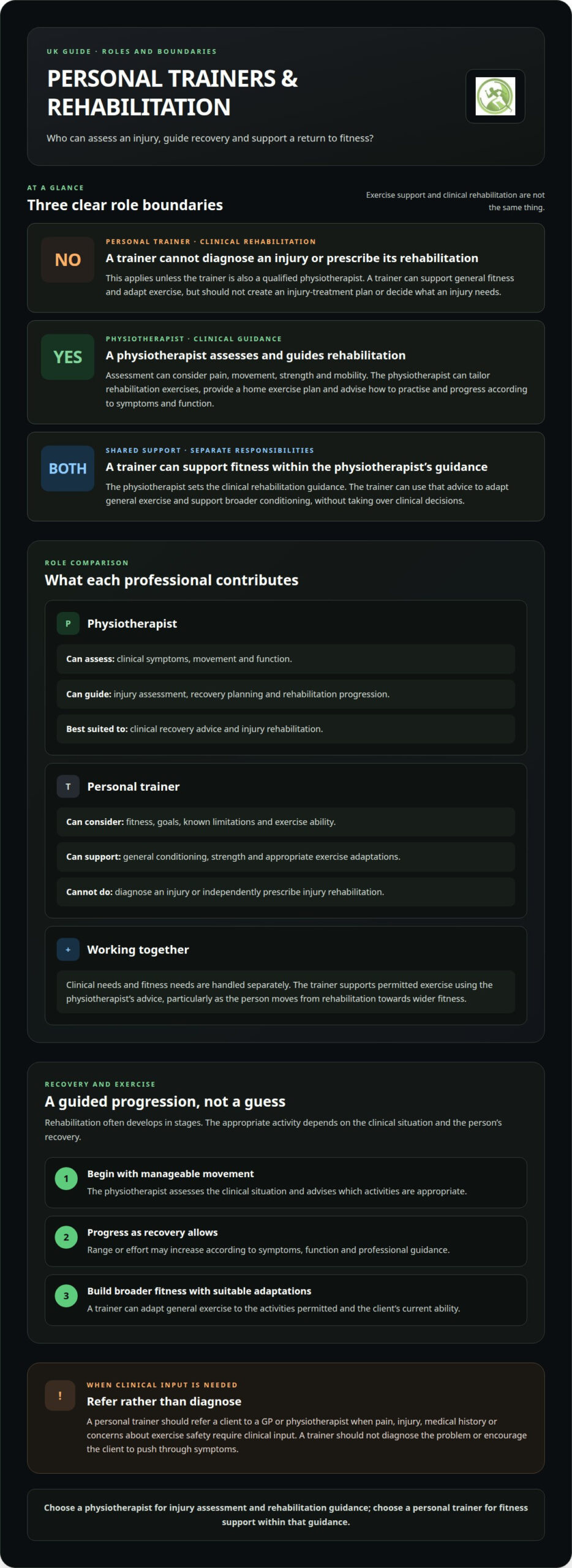
Can Personal Trainers Prescribe Rehab? UK Guide Can personal trainers prescribe rehab? No. In the UK, unless they’re also qualified physiotherapists, personal trainers can’t diagnose injuries or prescribe rehabilitation programmes. They can support fitness and strength, but that isn’t the same as assessing an injury or setting a clinical recovery plan.
It’s easy to blur the line because both roles use exercise to help people move better. But the distinction matters: a physiotherapist assesses injuries and guides rehabilitation, while a personal trainer supports fitness and can adapt general exercise once the client is ready.
This guide explains what personal trainers can and can’t do during recovery, how their role differs from a physiotherapist’s, and when working with both may help. You’ll find a clear way to decide what support fits your situation, without confusing exercise coaching with clinical care.
Table of Contents
- Can a Personal Trainer Treat Musculoskeletal Conditions Similar to a Physical Therapist?
- Can a Personal Trainer Help With Rehabilitation?
- Working With Both a Physiotherapist and Personal Trainer
- Personal Trainer Qualifications and Accreditation
- Whether Personal Trainers Can Prescribe Rehabilitation
- Redefining Fitness: Level 2 & 3 Personal Training Course
Can a Personal Trainer Treat Musculoskeletal Conditions Similar to a Physical Therapist?
No. In the UK, a personal trainer who isn’t also a qualified physiotherapist can’t diagnose an injury or prescribe a rehabilitation programme. Their role is to provide exercise and fitness support within their training and competence.
Personalised Rehabilitation and Home Exercise Plans
A physiotherapist can assess pain, movement, strength and mobility, then tailor rehabilitation exercises to the injury and recovery goals. They may provide a home exercise plan, with guidance on how to practise and progress according to symptoms and function.
A personal trainer’s tailored programme has a different purpose. They can consider a client’s fitness, goals and limitations, then adapt general exercise to their abilities. That isn’t a clinical assessment: a trainer shouldn’t diagnose the cause of pain or create an injury-treatment plan.
For example, someone returning to general strength training may benefit from exercises adapted to their current ability. If those exercises form part of injury rehabilitation, the physiotherapist’s plan and advice should guide them.
Assessment, Progression and Referral
A trainer can observe how a client performs an exercise, take known limitations into account and adjust the exercise’s difficulty. They can help build general strength and fitness, but shouldn’t decide what an injury needs or independently prescribe rehabilitation exercises.
Rehabilitation often progresses in stages: manageable movements come first, followed by increases in effort or range as recovery allows. A physiotherapist assesses the clinical situation and advises which activities are appropriate. A trainer can support general exercise within that guidance, rather than replace it.
After surgery, follow the consultant’s advice and staged rehabilitation plan. Movement may be limited at first, so complex exercises aren’t automatically appropriate. The surgeon’s or physiotherapist’s instructions should guide exercise choices and progression.
A personal trainer should refer a client to a GP or physiotherapist if pain, injury, medical history or concerns about exercise safety require clinical input. They shouldn’t diagnose the problem or encourage the client to push through symptoms.
| Option | Can assess | Can prescribe injury rehabilitation | Best suited to |
|---|---|---|---|
| Physiotherapist | Clinical symptoms, movement and function | Yes, within their professional role | Injury assessment and recovery planning |
| Personal trainer | Fitness, goals and exercise limitations | No | General conditioning and fitness support |
| Both working from shared guidance | Clinical and fitness needs, separately | The physiotherapist sets rehabilitation guidance | Moving from rehabilitation towards wider fitness |
Choose a physiotherapist for injury assessment and rehabilitation guidance, and a personal trainer for fitness support within that guidance.
Can a Personal Trainer Help With Rehabilitation?
Yes, a personal trainer can support a return to general fitness after injury, surgery or illness. Rehabilitation itself should be guided by a suitably qualified healthcare professional, with training adapted to that professional’s advice and the client’s recovery stage.
Rehabilitation After Injury, Surgery or Illness
After a sprain or strain, a trainer may help someone rebuild general strength and return to familiar activities through suitable exercise. That support isn’t injury treatment: the trainer focuses on fitness, while a healthcare professional guides rehabilitation and clinical decisions.
After surgery or illness, follow the consultant’s or physiotherapist’s guidance before increasing exercise. For example, someone with limited movement should follow their staged plan rather than jump straight into demanding circuits. A trainer can adapt general exercise to the activities permitted and the client’s current ability.
Injury Rehabilitation Goals and Strengthening
Rehabilitation aims to restore function, mobility and strength in the affected area, while helping reduce the risk of future injury. A healthcare professional monitors recovery and guides progression. Within that guidance, a trainer can support broader conditioning and confidence with everyday movements.
Progress should be gradual: start with manageable movements, then increase range or effort as recovery allows. For example, someone returning to walking might build towards more challenging activity only when their rehabilitation guidance permits it. Stronger muscles can support function, but no exercise plan guarantees an injury won’t recur.
Personal training can also help after formal rehabilitation, when the goal shifts from treating an injury to rebuilding overall fitness. A trainer can consider fitness level, goals and limitations, then tailor exercise accordingly. That might mean modifying a strength exercise, choosing a lower-impact option or rebuilding confidence with a movement the person has avoided.
Does personal trainer insurance cover injury rehabilitation in the UK? There’s no single answer: cover depends on the policy and whether it includes the activity being delivered. Insurance doesn’t give a trainer authority to diagnose an injury or prescribe clinical rehabilitation.
For trainers developing the skills to assess fitness and adapt exercise responsibly, personal training education can build a stronger foundation.
Working With Both a Physiotherapist and Personal Trainer
A physiotherapist handles clinical assessment and rehabilitation guidance; a personal trainer supports exercise and broader fitness. Which UK professionals are qualified to guide rehabilitation after an injury? A physiotherapist or another suitably qualified healthcare professional, such as a sports medicine specialist, can provide that guidance.
The distinction matters because diagnosis, recovery planning and general exercise coaching aren’t interchangeable. A physiotherapist assesses symptoms and function, then advises which movements suit the person’s recovery stage. A trainer can use that advice to support appropriate exercise, but shouldn’t take over clinical decisions.
In the UK, “physiotherapist” is a protected title, and practitioners must be registered with the Health and Care Professions Council (HCPC). The NHS advises people choosing a private physiotherapist to check that they’re chartered and registered with the HCPC. This distinguishes a registered clinical professional from a fitness coach.
Good coordination turns clinical advice into practical action. A handover should explain permitted exercises, movements to avoid, relevant warning signs and how to progress without worsening symptoms. For example, if a physiotherapist recommends rebuilding walking tolerance before strength work, the trainer can keep sessions within that guidance.
After surgery, the surgeon or physiotherapist advises which exercises to do and for how long. A trainer can help the client follow that guidance and adapt exercise intensity to their recovery stage. They shouldn’t override post-operative precautions or replace clinical review if symptoms change.
The two roles also have different primary aims. Physiotherapy addresses clinical aspects of pain or injury and supports rehabilitation goals; personal training focuses on general conditioning, strength and fitness. Working together can help someone return to wider activity, provided each professional stays within their role.
Keep the handover practical: share current exercise guidance, restrictions, warning signs and progression criteria. This gives the trainer clear boundaries and helps carry the physiotherapist’s plan into exercise, without turning fitness coaching into diagnosis or treatment.
Recovery can be a shared effort, rather than a choice between clinical care and fitness support. Physiotherapists, doctors and personal trainers can each contribute by working within their professional roles. Clear communication helps: the client can share current guidance with the trainer, while questions about symptoms, restrictions or changes in recovery should go to an appropriate clinical professional. This keeps exercise support connected to the recovery plan without blurring responsibility for clinical decisions. It also gives the client consistent boundaries to follow as activity changes.
After surgery, a physiotherapist can help interpret discharge guidance and safely progress walking, stair use, swelling management and strength. A trainer can use that guidance to shape exercise while leaving clinical interpretation and changes to the plan with the physiotherapist or physician. Training should follow the patient’s current advice, rather than assume that a previous level of activity remains suitable. The length of professional education is another distinction, though it should not be confused with an individual practitioner’s scope: a physical therapist doctorate programme averages 3 years after a completed bachelor’s degree. Whatever the professional background, coordination works best when each person contributes within their role and the patient understands how their exercise relates to the guidance they have received.
Personal Trainer Qualifications and Accreditation
Personal trainers and physiotherapists have different training, professional roles and responsibilities. A fitness qualification doesn’t make someone a medical professional or qualify them to diagnose an injury.
Rehabilitation Trainer Qualifications and Experience
A trainer may hold personal training certificates and have experience adapting exercise for clients with limitations. That experience can support general fitness, movement and weight-management goals, but it doesn’t replace clinical training. For example, a trainer can modify a strength exercise to suit someone’s ability, but shouldn’t decide what injury caused their pain or prescribe treatment.
What qualifications or registration are required for UK personal trainers and physiotherapists? Personal trainers aren’t licensed professionals, and they aren’t required to hold personal training certificates. “Physiotherapist” is a protected title in the UK, and practitioners must register with the Health and Care Professions Council.
Professional Licensing and Qualifications
The distinction is about professional scope, not confidence or time spent in a gym. A physiotherapist assesses clinical aspects of pain and injury, while a personal trainer focuses on exercise and general fitness. A certificate can support a trainer’s knowledge, but it doesn’t authorise diagnosis or clinical rehabilitation.
What are the risks of following a rehabilitation plan from an unqualified personal trainer? The exercises may be unsuitable, worsen symptoms or delay assessment by a qualified healthcare professional. Pain or new limitations should prompt referral to a GP or physiotherapist, not a trainer’s guess at the cause.
For example, a client with shoulder pain may need a physiotherapist to assess movement and decide which exercises are suitable. A trainer can then support general exercise within that advice. Without clear clinical guidance, increasing resistance or range of movement could exceed what the client’s recovery allows.
Use qualifications as evidence of fitness knowledge, not as a shortcut around professional boundaries. A capable trainer recognises when pain or restricted movement falls outside their role and refers the client. That judgement matters just as much as adapting a squat, press or walking exercise to someone’s current ability.
When a client has pain or another limitation, personal trainers should refer them to a qualified healthcare professional rather than diagnose or treat the issue themselves. This leaves assessment to someone qualified to provide it, while the trainer focuses on exercise and fitness within appropriate boundaries.
The clinic’s trainer has worked with people on rehabilitation and fitness since 2013. That experience may help when adapting exercise to an individual’s abilities, but it does not change the distinction between fitness support and diagnosis or treatment.
Whether Personal Trainers Can Prescribe Rehabilitation
“Can personal trainers prescribe rehab?” has a direct answer in the UK: no, unless they’re also qualified to practise as a physiotherapist. A trainer can adapt general exercise to a client’s ability, but can’t diagnose an injury or prescribe a rehabilitation programme. They shouldn’t claim to treat or cure a disease.
Rehabilitation Prescribing Scope
Prescribing rehabilitation means choosing exercises to address an injury or health condition and guiding recovery. That clinical role differs from fitness coaching. For example, a trainer may adapt a squat to suit a client’s current ability, but shouldn’t decide that a painful knee needs a particular rehabilitation exercise.
A suitably qualified healthcare professional, such as a physiotherapist, assesses the injury and advises on appropriate rehabilitation. A personal trainer can support general exercise within that guidance. The dividing line is clear: fitness programming builds general capacity, while rehabilitation addresses a clinical problem.
Adapting Exercise for Injured Clients
What can a personal trainer legally do when adapting exercise for an injured client? They can take the client’s stated limitations and fitness into account, then adjust general exercise, such as reducing a movement’s range or choosing another exercise. They mustn’t diagnose the cause of pain or present those changes as injury treatment.
If a client reports pain during a movement, the trainer should stop or modify the exercise and refer the client to a GP or physiotherapist for clinical input. A specialist’s advice can clarify permitted movements, what to avoid and how exercise may progress.
For instance, if a physiotherapist advises a client to avoid overhead lifting, a trainer can choose other general strength exercises within that restriction. The trainer shouldn’t decide when overhead work is safe to resume; that should follow the client’s rehabilitation guidance.
So, “Can personal trainers prescribe rehab?” No. If the plan is intended to treat an injury, involve a healthcare professional. If it builds general fitness within clear guidance, a trainer can help. Ignoring pain, adding load without guidance or promising a cure crosses the line.
Build the skills to adapt exercise responsibly through exercise referral learning, with professional boundaries kept firmly in view.
Redefining Fitness: Level 2 & 3 Personal Training Course
Redefining Fitness offers a Level 2 & 3 Personal Training Course for people ready to build professional fitness knowledge and practical coaching skills. It’s a relevant next step if you want to work as a personal trainer, not a route to diagnosing injuries or prescribing clinical rehabilitation.
The course combines online learning with face-to-face practical workshops. This blended format brings study together with hands-on learning, helping you develop the foundations for assessing fitness, planning exercise and supporting clients within a trainer’s role.
Keep the boundary clear: a personal training qualification doesn’t make you a physiotherapist. If a client has an injury, work within your competence, adapt general exercise appropriately and recognise when a healthcare professional should guide rehabilitation. Sound coaching includes knowing when not to prescribe.
Redefining Fitness also offers specialist workshops in kettlebells, circuits and indoor cycling. These can broaden your exercise knowledge and give you different ways to lead fitness sessions. They complement personal training development but don’t replace clinical assessment or rehabilitation guidance.
The course may suit you if you’re building a fitness career or strengthening your understanding of exercise coaching. It also connects with health-focused learning, including exercise referral, lower back pain management, and obesity and diabetes management. These subjects can deepen your understanding of how exercise relates to health needs, while clinical decisions remain with the appropriate healthcare professional.
Redefining Fitness emphasises inclusive teaching and support for neurodivergent learners. When choosing how to study, consider whether online lessons, face-to-face learning or a blend best suits you. The course combines online content with in-person practical workshops, offering a clear starting point for that decision.
Are you the fitness industry’s next best secret? If you’re ready to develop your coaching skills and understand your professional boundaries, contact Redefining Fitness to discuss the Level 2 & 3 Personal Training Course.
Build Your Next Step in Fitness
Knowing that personal trainers can’t prescribe rehab clarifies a professional boundary and points to a broader opportunity: becoming a coach who knows how to respond responsibly when a client needs more than general fitness support. That judgement is part of the job. It protects clients, builds trust and gives your coaching a clear purpose.
Your next move is to build a strong foundation, keep developing your knowledge and be clear about the work you’re qualified to do. Ambition matters, as does discipline: effective coaches keep learning, communicate clearly and recognise when another professional’s expertise is needed.
Are you the fitness industry’s next best secret? If you’re ready to take that next step, explore the prospectus and contact Redefining Fitness Ltd. Bring your drive, build your capability and make your mark.
Frequently Asked Questions
What Is Injury Rehabilitation?
Injury rehabilitation is a planned process to help restore movement, strength and everyday function after an injury. For example, recovery from a sprain may involve gradually rebuilding comfortable movement before returning to more demanding activity. The exercises and pace depend on the injury and the person’s progress. Rehabilitation may also aim to reduce the risk of future injury by improving the affected area’s capacity.
Can Personal Trainers in the UK Diagnose Injuries or Prescribe Rehabilitation Exercises?
No. A personal trainer can’t diagnose an injury or prescribe rehabilitation exercises unless they’re also qualified to practise as a physiotherapist. A trainer may adapt general fitness exercise to a client’s ability, but shouldn’t identify the cause of pain or present a workout as treatment. Changing a painful exercise, for example, doesn’t establish what caused the pain or which rehabilitation plan is appropriate.
What Is the Difference Between Personal Training and Physiotherapy in the UK?
Physiotherapy addresses clinical issues such as injury, pain and impaired movement; personal training focuses on fitness goals and exercise. A physiotherapist may assess why a client struggles with a movement and plan rehabilitation. A personal trainer may support general strength or conditioning, using relevant clinical guidance where needed. For example, once a physiotherapist sets suitable activity limits, a trainer can adapt general exercise around them.
Can UK Personal Trainers Work Alongside a Physiotherapist on a Rehab Programme?
Yes. A personal trainer can support a client’s wider exercise while a physiotherapist guides injury rehabilitation. A useful handover clarifies permitted movements, what to avoid, warning signs and how to progress. The trainer can use those boundaries to adapt a general strength session, but shouldn’t change the clinical plan or decide independently when restricted movements can resume.

Can Personal Trainers Prescribe Rehab? UK Guide
Can Personal Trainers Prescribe Rehab? UK Guide Can personal trainers prescribe rehab? No. In the UK, unless they’re also qualified physiotherapists,…

Nutritionist vs Dietitian UK: Key Differences Explained
Nutritionist vs Dietitian UK: Key Differences Explained. Same subject. Different professional standing. The difference between nutritionists and…
