

Personal trainers can use NLP with clients to explore behaviour, reframe goals, question limiting beliefs, manage emotional states and build rapport. In practice, this means using focused questions and communication techniques to support progress, not to diagnose or treat mental health conditions. Keep the coaching grounded in each client’s goals and experience.
A training plan can look sound on paper and still fall short if it overlooks what shapes someone’s choices. Motivation, confidence and setbacks affect how clients approach exercise. Paying attention to their words and responses can help you make coaching more relevant.
This article looks at how to explore the purpose behind a difficult behaviour, turn outcome goals into positive aims, question unhelpful beliefs and help clients reconnect with useful emotional states. It also covers building rapport through communication that respects individual differences. NLP is a coaching approach, not a magic fix. Use it with clear professional boundaries and a focus on the client’s health and fitness goals.
Table of Contents
Identifying the positive intention behind behaviour
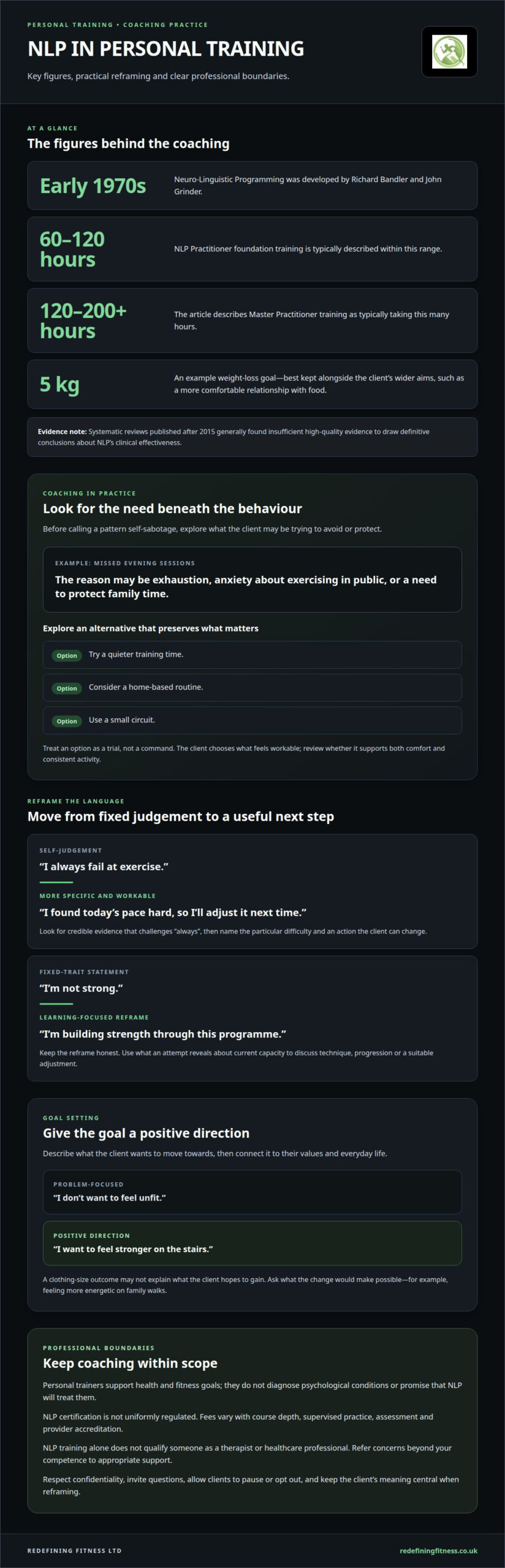
Before you label a client’s behaviour as self-sabotage, find out what it does for them. Neuro-Linguistic Programming (NLP), developed by Richard Bandler and John Grinder in the early 1970s, offers techniques for exploring how language, thought and behaviour connect. If a client repeatedly misses evening sessions, ask what happens before they cancel. The reason might be exhaustion, anxiety about exercising in public, or a need to protect family time. The behaviour has a consequence they want to avoid, even if it blocks their fitness goal.
That distinction can change the conversation. Ask what the client gets from the current pattern, then explore another way to meet that need. Someone who avoids a crowded gym might value privacy, not lack discipline. A quieter training time, home-based routine or small circuit could preserve that benefit while supporting regular movement. Treat each option as a trial, not a command. The client chooses what feels workable, and you review whether it supports both comfort and consistent activity.
Habit change takes more than intention. Distinguish a learned behaviour from the skills needed to change it. A client who snacks after a stressful shift may have learnt to use food for comfort and may lack a practical way to unwind. Explore skills they already have, such as preparing a meal or taking a short walk, then connect one to the moment the pattern begins. Practice can make the new response easier to use. Fitness can also become part of identity: “I make time to move” describes an action the client can practise, not a demand for perfection.
NLP coaching differs from motivational interviewing and cognitive behavioural approaches in its emphasis on language, internal representations and reframing; all can use questions to explore change, but they aren’t interchangeable. In the UK, NLP Practitioner foundation training is typically described as 60 to 120 hours, while Master Practitioner training is 120 to 200 plus hours; NLP certification isn’t uniformly regulated, and fees vary with course depth, supervised practice, assessment and provider accreditation. NLP training alone doesn’t qualify someone as a therapist or healthcare professional.
Keep the boundary firm. Personal trainers support health and fitness goals; they don’t diagnose psychological conditions or promise that NLP will treat them. Systematic reviews published after 2015 generally found insufficient high-quality evidence to draw definitive conclusions about NLP’s clinical effectiveness. Invite questions, respect confidentiality, allow clients to pause or opt out, and refer concerns beyond your competence to appropriate support. The UK Government recommends open questions and questions that challenge limiting assumptions, a useful discipline for keeping coaching curious rather than coercive.
Reframing weight-loss goals positively
A goal framed only around weight or clothing size can leave progress feeling narrow. NLP coaching reframes the target around positive outcomes the client values, such as losing 5kg whilst building a more comfortable relationship with food.
Reframing negative self-statements
Reframing means turning a negative self-judgement into a more useful, realistic description of what the client can do next. If someone says, “I always fail at exercise,” avoid empty praise. Ask for an example that challenges “always”. Perhaps they completed a walk last week or returned after missing a session. That evidence gives them a credible, positive statement to draw on during a demanding workout.
Language matters because a sweeping judgement can make one difficult session feel like proof of permanent failure. Help the client name the specific challenge instead: “I found today’s pace hard, so I’ll adjust it next time.” This shift keeps attention on an action they can change. They can review the session, choose a manageable adjustment and continue without pretending the setback did not happen.
Growth mindset through reframing
A growth mindset treats skills as abilities that can develop through learning and practice, rather than fixed traits. In a fitness setting, reframe “I’m not strong” as “I’m building strength through this programme.” This does not promise a particular result; it points to the client’s next effort. It also gives you a clearer basis for discussing technique, progression and what they have learnt.
Use this approach when a client sees a missed target as a verdict on their ability. If they complete fewer repetitions than planned, ask what the attempt revealed about their current capacity. Their answer may help guide a more suitable load or rest period. Progress comes from using that information, not demanding positivity or dismissing frustration.
Now bring the goal itself into focus. “Get into a smaller clothing size” describes an external outcome, but it doesn’t explain what the client hopes to gain. Ask what that change would make possible. If they want to feel more energetic on family walks, frame the goal around building stamina for those walks. If their aim is to lose 5kg and improve their relationship with food, preserve both parts instead of reducing success to the number on the scales.
In NLP, a goal is framed positively: describe what the client wants to move towards, not only what they want to avoid. “I want to feel stronger on the stairs” gives coaching a direction. “I don’t want to feel unfit” names a problem without defining the desired change. Make the target specific enough to guide choices, then connect it to the client’s values and daily life.
Reframing is a technique, not a quick verbal fix. A problematic thought pattern may take more than one or two sessions to identify and work through. Some NLP approaches use dissociation, stepping back from an experience to view it differently, alongside reframing. Keep the client’s meaning central: check whether a new perspective feels credible, and adjust it if it does not. A positive statement helps only when it supports an honest next step.
Using pattern interruption to challenge limiting beliefs
A limiting belief can sound like a fact: “I’m too old to get lean” or “I always quit.” Pattern interruption helps the client pause that familiar response and examine its assumptions. Do not argue or demand confidence. Ask what evidence supports the belief, what complicates it and what useful action could follow in this situation. The aim is to open up a choice, not replace one rigid rule with another.
For someone who believes age makes progress impossible, ask: “What are you accomplishing now that you couldn’t achieve two months earlier?” This directs attention to change already happening. Follow with an open question, such as “What does that tell you about what you can do next?” The UK Government recommends open questions and questions that challenge limiting assumptions. Used thoughtfully, these prompts help clients examine their own language instead of simply accepting your verdict.
The NLP swish pattern is one technique for interrupting a repeated mental response. The client identifies a trigger image linked to an unwanted habit, then imagines replacing it with an image of themselves responding differently. For example, someone who pictures abandoning a workout when tired might rehearse seeing themselves begin a manageable warm-up instead. The page recommends repeating the NLP swish reversal three to five times. Treat this as a rehearsal technique, not a guaranteed reset or a substitute for practical planning.
Make the new response specific. If the trigger is arriving home after work, the client could picture changing into training clothes and starting a short session. Ask what might get in the way, then adapt the plan around the answer. The programme needs to fit the person’s actual routine. A technique loses value if it ignores childcare, fatigue, access or why the old pattern developed.
The Milton Model describes language patterns associated with Milton Erickson, including broad or permissive phrasing that leaves room for personal interpretation. In coaching, an invitation such as “You might notice which kind of movement feels possible today” gives the client space to decide. But vague language can also obscure your meaning. Be clear about the exercise, choices and expected effort. Never use suggestive language to pressure someone into agreement.
Pattern interruption works best as a prompt for awareness and deliberate action. If a client says, “I can’t stick to exercise,” explore when that thought appears and what tends to happen next. Then ask which small behaviour could challenge the belief in a real session. The client might complete a warm-up, practise one movement or attend a planned class. These examples give them evidence for a more flexible belief and build confidence through action, not persuasive language alone.
Keep the boundary clear: personal trainers can coach behaviour towards fitness goals, but should not present NLP techniques as treatment for psychological distress. If a belief points to an issue beyond your competence, pause the exercise and respond within your professional role. Question the assumption, not the client’s dignity.
Anchoring and state management
A client’s mental state can shape how they approach exercise, especially when a session feels demanding. In Neuro-Linguistic Programming, anchoring means linking a cue with a particular emotional state or experience. The cue might be a word, gesture or breathing pattern chosen by the client. For example, they could use the word “steady” before starting a challenging set. The aim is to bring attention back to a useful state, not switch off discomfort or force confidence.
Build an anchor from a real positive experience, not a motivational slogan. Ask the client to recall a moment when they felt capable during training. Perhaps they completed a controlled kettlebell movement or kept a consistent pace through a circuit. Invite them to describe what they noticed, such as their breathing, posture or focus. They can then choose a simple cue to associate with that memory. The experience belongs to the client; your role is to guide reflection, not prescribe an emotion.
Use the cue in a relevant situation. Before a difficult exercise, the client might pause, recall a successful movement and repeat their chosen word. Afterwards, ask what they noticed and whether the cue helped them focus on the next action. If “steady” supports controlled technique, it has practical value. If it feels distracting, change the cue or leave it out. This is focused state management: observe the response, adapt the approach and keep the exercise appropriate.
Anchoring can also help a client revisit progress after a setback. Suppose they missed a planned session and feel discouraged. Rather than insisting they feel positive, return to a concrete experience: they completed a session last week despite feeling tired. Ask what made that possible and which part might apply today. Reframing the setback as information can help them identify a manageable next step, such as rescheduling or choosing a shorter session.
Keep consent and choice at the centre of every technique. A cue should never become a test of commitment or a way to push someone past their limits. If a client associates a movement with pain, fear or distress, do not use an anchor to override that response. Pause, listen and adjust the exercise within your role. For health-related needs, appropriate exercise referral or lower back pain management may offer a more relevant framework than mental techniques alone.
The practical benefit is that clients learn to notice what supports their focus and apply it deliberately. That might mean using a familiar breathing rhythm before a set, a word that helps them settle or recalling a specific success before trying again. “NLP” stands for neuro-linguistic programming, but the label matters less than the quality of the coaching. Keep the cue simple, connect it to the client’s experience and review whether it supports safe, purposeful exercise.
Building rapport through communication
Rapport is not a performance. It is the working trust that lets a client speak honestly, ask questions and engage with a session. A qualified trainer builds it by listening closely, noticing how the client responds and adapting communication without imitation. If someone gives short answers and avoids eye contact, do not assume they lack interest. Pause, use a calm tone and ask whether they would prefer to talk through the plan or begin moving.
Start with questions that reveal the goal and the barrier: “What would you like to feel more able to do?” and “What tends to get in the way?” Then ask what usually motivates them, what inspires them and what gets them out of bed in the morning. A client may want to keep up with their children, feel stronger at work or return to a favourite activity. Their answers give coaching a direction based on personal values.
Tailor your language to the individual, not to a fixed NLP label. One client may respond to a clear target, such as completing a steady circuit; another may value a choice between two exercises. Check understanding with a specific question: “Does that plan feel realistic for your week?” If the client hesitates, explore what feels difficult before changing the programme. This keeps motivation collaborative instead of making coaching a speech the client has to endure.
Communication includes words, tone and body language, but no single cue proves what someone thinks. A client looking away might be concentrating, uncomfortable or simply listening. Check your interpretation with a respectful question, then allow time for the answer. Match the client’s pace when it helps conversation, but do not mimic their gestures or assume shared posture creates trust. Genuine rapport comes from attention, clarity and consistent respect.
Connect a client’s future vision to the values behind it. If they want to feel confident walking up a hill with friends, ask what that would mean to them. Then link the next session to a practical step towards the goal, such as practising a suitable incline or building leg strength. Review the connection as their goals change. A compelling reason can help focus effort, but it must remain the client’s reason, not one you impose.
How personal trainers can use NLP with their clients starts with questions that clarify the result they want, their current situation and likely barriers. Ask, “What would be different if you reached this goal?” and “What has stopped you so far?” Understanding how personal trainers can use NLP with their clients also means asking, “What support or change would make the next step easier?” These questions uncover beliefs and practical obstacles without treating assumptions as facts. Revisit the answers and adapt the plan together.
Redefining Fitness: Level 2 & 3 Personal Training Course
Redefining Fitness offers a Level 2 & 3 Personal Training Course for people ready to build strong foundations in the fitness profession. If you want to use communication techniques thoughtfully, professional training can help you develop the wider skills needed to support clients’ health and fitness goals. The course is delivered online and in person, with learning that connects theory to practical application.
Specialist options include kettlebells, circuits and indoor cycling, which can broaden your exercise knowledge alongside a personal training qualification. NLP is one coaching approach, not a substitute for sound training practice, clear boundaries or listening to each client. Develop your professional skills with care, curiosity and purpose.
Are you the fitness industry’s next best secret? Contact Redefining Fitness to discuss the Level 2 & 3 Personal Training Course.
Make Your Coaching Count
Your next step is to turn insight into professional practice. NLP can give you another way to listen and communicate, but your judgement determines when a technique helps, when it distracts and when a client needs support beyond your role. Keep learning, stay curious and let each person’s needs shape your approach.
Mastering how personal trainers can use NLP with their clients is not about finding a script that works for everyone. It is about learning to ask better questions, notice what matters and adapt while keeping safe, purposeful coaching in view. That takes practice, reflection and a commitment to keep developing.
Explore the Redefining Fitness prospectus and take your next step in fitness training. Are you the fitness industry’s next best secret? Keep building the knowledge and confidence to prove it.
Frequently Asked Questions
How Coaches Can Use NLP in Their Practice?
Coaches can use NLP-inspired questions to help clients define what they want from exercise and identify practical obstacles. For a busy client with limited time, ask which part of their week offers a realistic opportunity to move. Keep the discussion focused on activity and personal goals. The UK’s Chief Medical Officers’ physical activity guidelines offer a useful reference for discussing activity levels.
How Does NLP Work?
NLP uses ideas about the relationship between language, thought and behaviour to shape coaching conversations. A trainer might ask a client to describe what “a successful session” means to them, then use that answer to clarify the aim. It’s a coaching framework, not a guaranteed mechanism for change. For wider context on physical activity and wellbeing, the NHS exercise information explains the role of movement in everyday health.
What Is Neuro-Linguistic Programming?
Neuro-Linguistic Programming, usually shortened to NLP, is an approach that explores how people interpret experiences and communicate. In a fitness conversation, a trainer could ask what a client means by “getting fitter” before suggesting a programme. That keeps the discussion personal rather than relying on assumptions. The British Psychological Society provides broader information about psychology, which is distinct from a personal trainer’s fitness role.
Can NLP Coaching Help Clients with Anxiety?
NLP coaching shouldn’t be presented as treatment for anxiety. A trainer can explain the session structure, offer choices and let the client decide what feels manageable. If anxiety is affecting wellbeing or everyday life, encourage appropriate support rather than attempting therapy. The NHS overview of anxiety disorders and NICE guidance on generalised anxiety disorder provide health information beyond a fitness coach’s remit.
How Can Personal Training Clients Benefit From NLP?
Clients may use NLP-style reflection to clarify what they want from training and describe progress in personally meaningful terms. Someone returning to activity might value being able to walk comfortably to work, rather than comparing themselves with a past fitness level. A trainer can use that goal to shape relevant sessions. Sport England shares information about participation in sport and physical activity across England.
What Is NLP?
In coaching, NLP means Neuro-Linguistic Programming; in computing, the same initials can mean natural language processing. Context makes the distinction clear. A conversation about motivation, exercise habits or communication usually refers to the coaching approach. Neither meaning makes a personal trainer a therapist. For information about counselling as a separate professional activity, see the British Association for Counselling and Psychotherapy’s explanation.
What Does NLP Mean in Personal Training and Coaching?
In personal training, NLP refers to using language and reflection to explore how a client understands exercise and their goals. Ask what “feeling stronger” would enable them to do in daily life, then use their answer to inform the fitness conversation. It doesn’t replace exercise knowledge or clinical support. Mind’s information about anxiety can help readers understand the topic outside a trainer’s role.
How Can Personal Trainers Use NLP Techniques to Build Rapport With Clients?
Build rapport by listening, explaining exercises clearly and asking permission before exploring personal barriers. If a client seems uncertain about a movement, offer to demonstrate it or explain another option. Then ask what would help them feel ready to begin. Respectful, clear communication supports a more collaborative session. ukactive provides wider information about the UK physical activity sector and its work to encourage active lives.
Ready to develop your knowledge and skills for a fitness career? Contact Redefining Fitness Ltd. Are you the fitness industry’s next best secret? Take your next step with confidence.

How Personal Trainers Can Use NLP for Client Success
Personal trainers can use NLP with clients to explore behaviour, reframe goals, question limiting beliefs, manage emotional states and build rapport….

Nutrition Myths for Personal Trainers Debunked
The 70% diet, 30% exercise claim isn’t a universal rule. For most people focused on weight loss, diet accounts for around 80% or more of results, but…
