Level 2 Gym Instructor Course UK for New Instructors A level 2 gym instructor course uk prepares you to plan and deliver safe, effective exercise programmes in a gym or health club. It’s the starting qualification for gym-instructor work; progression into personal training requires Level 3 Personal Training. The route builds practical competence, not just a certificate to frame.
You’re right to look beyond the qualification itself. What you learn, how you’re assessed and where the course can take you all matter. It’s also important to understand the instructor’s role and the boundaries of the qualification.
This guide covers entry expectations, course content, assessment methods and progression routes. You’ll learn what the role involves, how learners demonstrate their skills and which further qualifications support specialist teaching. No shortcuts or inflated promises, just a clear view of the work ahead and the choices that can shape your next step with Redefining Fitness Ltd.
Table of Contents
- Assessment methods
- What are the progression routes available once I’m qualified as a Level 2 Fitness Instructor?
- What will I learn on the Level 2 Certificate in Gym Instructing course?
- Entry requirements
- Course content and learning outcomes
- Redefining Fitness: Level 2 & 3 Personal Training Course
Assessment methods
Assessment tests whether you can apply fitness knowledge, not just recall terminology. For the Active IQ Level 2 Certificate in Fitness Instructing (Gym), assessment includes coursework or a project, a multiple-choice examination, a portfolio of evidence and a practical demonstration or assignment.
Written assessments and programme cards
Written work checks how you turn course knowledge into decisions for real gym settings. According to HFE, its online workbook assessment has a 70% pass mark. Active IQ’s assessment also includes coursework or a project, alongside a multiple-choice examination. Prepare by answering each task directly, using clear explanations and examples rather than memorised phrases.
Programme cards turn planning into something you can use and explain. Set out exercise choices, sequence and instructions clearly, then connect each choice to the participant and session goal. Your card should make the plan understandable to another fitness professional, not just to you. Check that its details match the programme you deliver in practice.
Health screening and fitness assessments
Health screening helps identify information that could affect someone’s participation in exercise. Level 2 gym instructors can use standardised questionnaires such as PAR-Q to identify potential contraindications. Read each response carefully and follow the course’s taught process; screening is not a box-ticking exercise. It informs decisions about safe programme planning.
Basic fitness assessments help you gather relevant information before planning programmes. A Level 2 instructor may measure blood pressure as part of a basic fitness assessment if trained to do so. Treat each assessment as a practical skill: explain the step, carry it out correctly and record the result accurately. Your evidence should show both competent technique and sound judgement.
Online study and practical assessment
Online study can provide learning materials and support written assessment, but practical competence still needs practical evidence. Active IQ assessment includes a portfolio and a practical demonstration or assignment, alongside written elements. This mix tests both what you know and what you can do. A qualification matters most when you can demonstrate sound practice in a gym environment.
If your practical assessment uses video submissions, treat the recording as evidence, not a performance. Show the exercise instruction clearly, keep your explanation audible and make each part of the demonstration easy to follow. Review the footage before submitting it. If an action or instruction is hard to see, record it again rather than relying on the portfolio to fill the gap.
Keep the practical task aligned with your programme card and written explanation. If your card sets out an exercise sequence, demonstrate it and explain your coaching choices. Online learners should plan study around assessment tasks, practical preparation and submission deadlines. Payment arrangements are separate from the standard of evidence you need to build for the fitness industry.
What are the progression routes available once I’m qualified as a Level 2 Fitness Instructor?
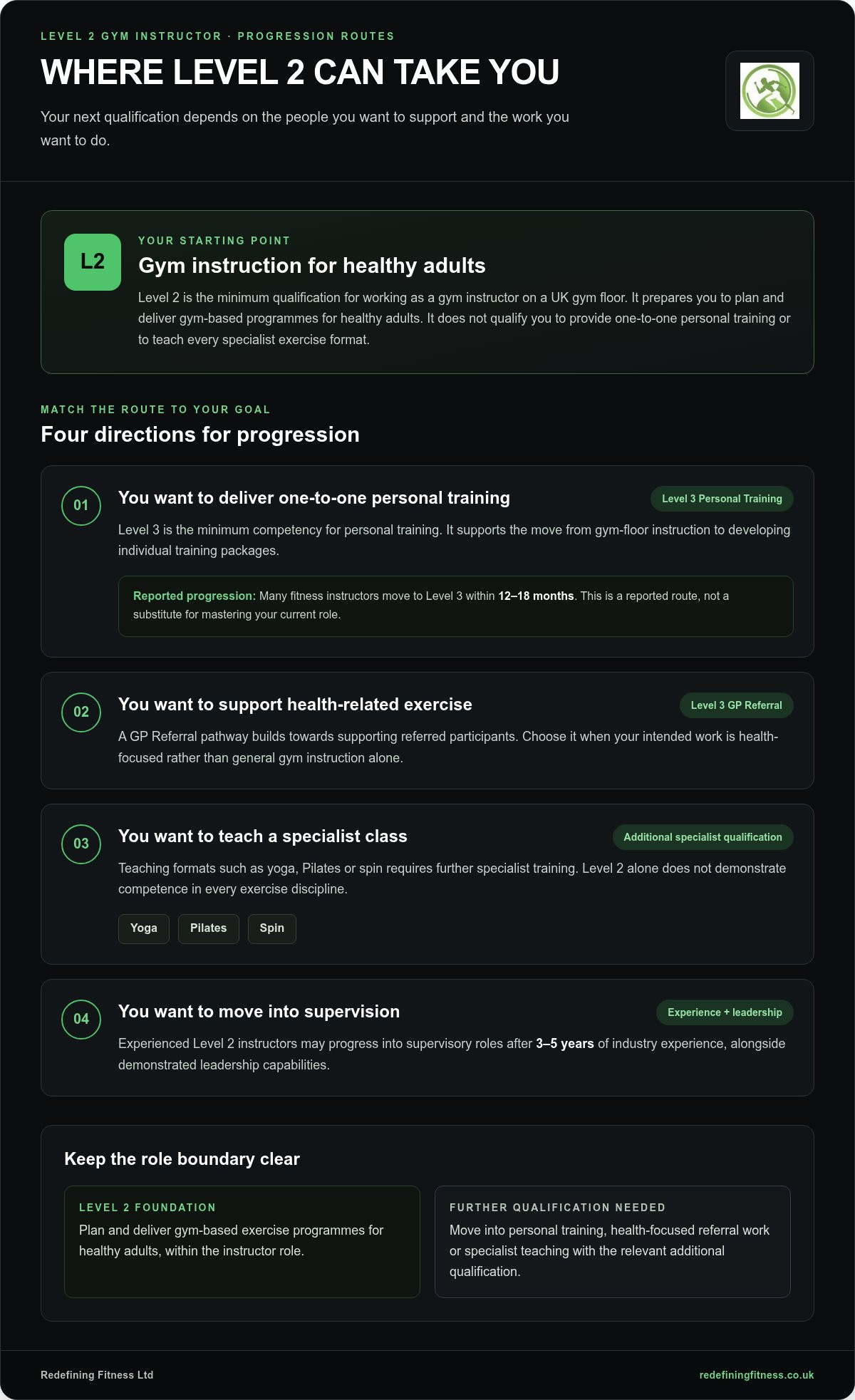
Yes, Level 2 is the minimum qualification for working as a gym instructor on a UK gym floor. Level 3 Personal Training is the next qualification if you want to move into personal training.
Progression to personal training
Level 2 gives you a foundation in gym instruction, but it doesn’t qualify you to provide one-to-one personal training. That requires a Level 3 Personal Training qualification as the minimum competency. The distinction matters: a gym instructor supports exercise in a gym setting, whilst a personal trainer can develop individual training packages. Industry standards also describe Level 3 as the logical step after Level 2 for delivering personal training packages.
Plan the progression deliberately. The Active IQ Level 2 Certificate in Fitness Instructing (Gym) provides progression to the Active IQ Level 3 Certificate in Personal Training. Many fitness instructors move to Level 3 within 12-18 months, seeking greater earning potential and career flexibility. Treat that timeframe as a reported route, not a substitute for mastering your current role.
Further fitness qualifications
Level 3 personal training isn’t the only route. Learners can progress from Level 2 to Level 3 Personal Training and Level 3 GP Referral courses. Choose according to the people and physical activity settings you want to support. A health-focused pathway, for example, builds towards work with referred participants rather than simply extending general gym instruction.
Specialist classes have their own requirements. Level 2 instructors need additional specialist qualifications to teach formats such as yoga, Pilates or spin. Identify the format first, then pursue the qualification that prepares you to teach it. A Level 2 certificate alone doesn’t demonstrate competence in every exercise discipline.
Gym-Based Programme Planning
Your Level 2 foundation includes planning and delivering gym-based exercise programmes for healthy adults. Build each programme around the participant, their aims and the equipment available. Then make the plan clear enough to guide the session: exercise selection, order and instructions should connect to the intended outcome.
This planning skill also helps you recognise the scope of your qualification. A gym programme for a healthy adult is different from individual personal training or specialist provision. Use your Level 2 training to deliver within its intended role, and identify when a further qualification, such as Level 3 Personal Training or GP Referral, fits your next step.
Career Progression
Progression can mean deeper coaching skills, specialist teaching or leadership, not just a new job title. Experienced Level 2 gym instructors may move into supervisory roles after 3-5 years of industry experience, alongside demonstrated leadership capabilities. That route depends on building practical judgement as well as showing you can support the work of a team.
Choose your next qualification by matching it to the work you want to do. If your goal is one-to-one personal training, prioritise Level 3. If you want to teach spin, yoga or Pilates, pursue the relevant specialist qualification. If you’re drawn to health-related exercise, consider the Level 3 GP Referral progression.
What will I learn on the Level 2 Certificate in Gym Instructing course?
A Level 2 gym instructor qualification prepares you to prescribe, plan and deliver safe, effective exercise programmes in a gym or health club. The Active IQ Certificate comprises 6 mandatory units worth 24 credits, giving you a structured foundation for instructor work.
Course learning connects knowledge to the work you’ll do on a gym floor. You develop skills to support healthy adults with exercise, use gym equipment appropriately and lead group fitness classes. The qualification builds practical capability, but it is not a shortcut into every role in the fitness industry.
Expect a mix of theory and applied learning. Topics include programme planning, communicating exercise instructions and using health-screening information to guide decisions. For example, a screening response can affect how you plan a participant’s session. The course can help build skills relevant to leading group classes for healthy adults.
Course length depends on the study format and how you organise learning alongside practical sessions. An intensive face-to-face course is offered as four lessons. That format concentrates in-person learning into a defined sequence, whilst online study gives you a different way to work through learning materials. Redefining Fitness delivers Level 2 and Level 3 qualifications online and in person, so learners can consider both study formats.
Course price depends on the format, delivery and assessment arrangements, and is given after a quote request. Payment arrangements should be considered alongside course sessions, assessment deadlines and the time you can commit to study. Treat the payment schedule as part of your planning, not as a substitute for understanding what the course teaches.
Both online and in-person study require active participation. Online learning means organising your study time and completing course tasks; practical skills still need to be developed and assessed. Face-to-face workshops provide structured practical learning. Whichever format you choose, connect each topic to an instructor task, such as explaining an exercise or planning a safe programme.
A successful course choice supports your next career step as well as your immediate learning. Compare the qualification title, awarding organisation, unit structure, delivery format and assessment approach. Active IQ’s Level 2 Certificate in Fitness Instructing (Gym) is one named qualification, with 6 mandatory units and 24 credits. Read those details against your goal: entering gym instruction, building practical confidence or creating a foundation for further study.
Entry requirements
You don’t need prior qualifications or experience to start Level 2 gym instructor training. A Level 2 gym instructor course in the UK still involves physical participation, communication and practical learning, so preparation matters.
Minimum entry age
Age eligibility is separate from previous qualifications or gym experience. Before enrolling, understand the age criteria for the qualification you’re considering. Beginner entry does not necessarily mean every applicant has identical requirements. Age, learning needs and the practical demands of assessment are distinct factors when deciding whether a course suits you.
The Active IQ Level 2 Certificate in Fitness Instructing (Gym) involves physical exertion and individual participation, so learners need a degree of physical fitness. That means being prepared to take part in practical learning, not meeting an athletic standard. You’ll practise gym-based movements and demonstrate what you learn in an exercise environment.
Suitability for beginners
Beginners can start Level 2 gym instructor training without prior experience or qualifications. A Level 2 gym instructor course in the UK develops your understanding through course learning and practical tasks. You don’t need an existing fitness career; you do need to engage with the material, practise skills and work towards the assessment requirements.
Active IQ says learners should have basic communication skills pitched at level 2. Those skills help you understand instructions, explain exercise clearly and communicate with participants. Effective coaching doesn’t depend on complicated language. It depends on clear directions, careful listening and adapting an explanation when someone needs a different approach.
Experience of gym-based exercise, including free weights, is highly recommended for learners taking the Active IQ qualification, but it is not a requirement. Familiarity with equipment and movement can make practical learning easier to follow. If free weights are new to you, build familiarity with common equipment and basic exercise technique before training begins.
Consider the physical and communication demands of the course together. You may understand written material but need practice demonstrating an exercise; or you may feel at home in the gym but need to strengthen your written explanations. Use the assessment tasks to identify where preparation will help. Practical confidence grows with practice, attention to technique and clear explanations.
Responsible learning matters in a gym environment. Leading an exercise session means paying attention to instructions and participants’ needs. Learn the movements, practise explaining them clearly, then use feedback to improve your technique. Previous experience isn’t compulsory, but active preparation helps you engage with the course and its practical demands.
Course content and learning outcomes
The course covers planning and delivering gym-based exercise, alongside health screening and instruction. Assessment combines written work, a multiple-choice examination, a portfolio and practical evidence.
Course topics
The Active IQ Level 2 Certificate in Fitness Instructing (Gym) comprises 6 mandatory units worth 24 credits. Its learning prepares you to prescribe, plan and deliver safe, effective exercise programmes in a gym or health club. Focus on how each topic informs a real instructor decision, not simply how to repeat course language.
Health screening is one practical part of the work. You learn to use standardised questionnaires such as PAR-Q to identify potential contraindications to exercise. This information helps guide programme planning. For example, a response indicating a potential concern affects how you approach the participant and their planned activity.
The course also prepares you to lead group fitness classes for healthy adult populations. You’ll practise communicating exercises clearly and structuring activity so participants can follow the session. A useful test is whether you can turn a learning point into an instruction someone can understand and act on.
Learning outcomes and assessments
By the end of the qualification, you should be able to plan and deliver gym-based programmes safely and effectively within the Level 2 Fitness Instructor role. Apply that outcome to a practical example: select suitable exercises, organise them into a coherent programme and explain your instructions to participants.
Assessment checks knowledge and practical ability through coursework or a project, a multiple-choice examination, a portfolio of evidence and a practical demonstration or assignment. Your portfolio should support the skills you demonstrate, while written tasks show how you understand and apply what you’ve learned. Treat each assessment as evidence of a specific capability.
The course may also support your continuing professional development. A certificate and its credit value record achievement, but the important outcome is what you can demonstrate: sound programme planning, clear instruction and appropriate use of health-screening information. Keep those outcomes in view as you assess whether the course matches your interest in gym instruction.
Use the learning outcomes to compare course options: check the qualification title, unit structure, assessment methods and intended role. A course should prepare you for the work named in its certificate, rather than blur Level 2 instruction with advanced responsibilities. If you’re ready to develop those skills, explore Level 2 and Level 3 course options and consider which qualification fits your next step.
Redefining Fitness: Level 2 & 3 Personal Training Course
Redefining Fitness offers a Level 2 & 3 Personal Training Course for learners building gym-instruction skills and aiming to progress towards personal training. Its qualifications are delivered online and in person, combining blended learning with face-to-face workshops.
Choose this route when you want a qualification to support a clear next step, rather than a certificate without direction. Alongside core learning, workshops cover specialist areas including kettlebells, circuits and indoor cycling. Consider which delivery format suits your learning preferences and how the qualification aligns with the role you want to pursue.
Ready to build your next stage in the fitness industry? Visit redefiningfitness.co.uk to explore the course and take your next step.
Turn Your Qualification Into Your Next Step
Your first qualification is a starting point, not a ceiling. The standards you build now will shape how you learn, communicate and contribute in a gym environment. Choose development that helps you grow into the instructor you want to become, rather than collecting qualifications without direction.
If you’re considering a Level 2 gym instructor course in the UK, think beyond passing assessment. Focus on the professional habits you’ll bring to every session: preparation, clear instruction and a willingness to keep improving. Those habits make your learning count long after the course ends.
Are you the fitness industry’s next best secret? Take a considered step towards your next stage by viewing the prospectus. Bring your ambition, then build the skill and purpose to make it count.
Frequently Asked Questions
How do I choose the best course for me?
Choose a course that matches your intended role, learning style and practical schedule. Compare the qualification title and assessment approach, using the GOV.UK regulated qualifications search to look up a qualification. You can also review the Active IQ qualification information when considering its course. Then assess whether online learning, workshops or blended study fits your routine and support needs.
What is CIMSPA and why are CIMSPA points important?
CIMSPA is the Chartered Institute for the Management of Sport and Physical Activity, a professional body for the UK sport and physical activity sector. Its CIMSPA website explains its work across the sector. CPD points can help you record professional development beyond your initial qualification. Treat them as a record of learning, not a replacement for practical competence. Note the course or workshop completed and how it relates to your role.
Can I begin personal training without prior fitness industry experience in the UK?
Yes, you can start studying towards a personal training qualification without previous fitness industry experience. Starting a course is different from working as a personal trainer; the route described here requires Level 3 Personal Training for that role. The National Careers Service personal trainer profile offers another view of the role. Use course learning to build knowledge and practical skills before taking on work requiring a higher qualification.
How do I book?
To discuss enrolment with Redefining Fitness, explain which qualification interests you, your preferred study format and your learning goals. The courses combine online videos, PowerPoints and quizzes with face-to-face practical workshops, and include one-to-one tutoring. Course content is designed to be accessible for neurodivergent learners and non-native English speakers. Explore the course and take the next step towards your fitness career.
What can I do with this qualification?
A Level 2 qualification can prepare you for gym-instructor work, including planning gym-based exercise for healthy adults and leading group fitness classes. For example, you could plan a suitable session, explain exercises clearly and support participants as they follow the programme. It doesn’t qualify you for every fitness role, so match duties to your training. The GOV.UK course search can help you explore further learning options.
What career opportunities will the Level 2 Gym Instructor Qualification lead to?
It can support a starting role as a gym instructor, where you help members use gym facilities and take part in exercise. You can build experience in instruction and group sessions, then choose development that fits your direction. The National Careers Service fitness instructor profile outlines the role. For a longer-term path, Level 3 Personal Training supports progression towards personal training.
What funding support can I get to help pay for my Gym Instructor course?
Possible support depends on your circumstances and course, so first identify schemes that may apply. GOV.UK explains Advanced Learner Loans and apprenticeships; these routes have their own eligibility conditions. You could also ask your employer about support for job-related training. Establish what funding covers, what costs remain yours and whether the course meets the scheme’s rules before making a commitment.
What’s the minimum qualification I need to start working and earning in a UK gym?
Level 2 is the minimum qualification identified for working as a gym instructor on a UK gym floor. It provides a route into instructor work, rather than personal training. For qualification details, consult the Ofqual organisation information and its regulated qualification search. Keep the role distinction clear: one-to-one personal training requires Level 3 Personal Training.