Personal Trainer Qualifications: Complete UK Guide Level 3 is the qualification that allows you to work as a personal trainer in the UK, but it doesn’t have to be the end of your development. The common route starts with a Level 2 Gym Instructor qualification, then moves to Level 3 Personal Trainer; Level 4 is optional and gives you a route into specialist practice. Those are the key stages to understand when comparing personal trainer qualifications.
It’s sensible to want a clear route into the profession. But earning the entry qualification and building the judgement to work confidently with different clients aren’t the same thing. This guide explains the entry requirements, why trainers study beyond Level 3, and how specialisms can shape your next step. You’ll also learn what to expect from online, blended and in-person study, including the practical training that turns course knowledge into usable coaching skills. Choose your route with ambition, but keep it grounded: the right qualification should match the work you want to do and the people you want to support.
Table of Contents
Why do many personal trainers choose to continue beyond Level 3?
Level 3 is the qualification that allows you to work as a personal trainer in the UK. Continuing beyond it can develop specialist knowledge for different clients and career goals.
Further qualification levels in the UK
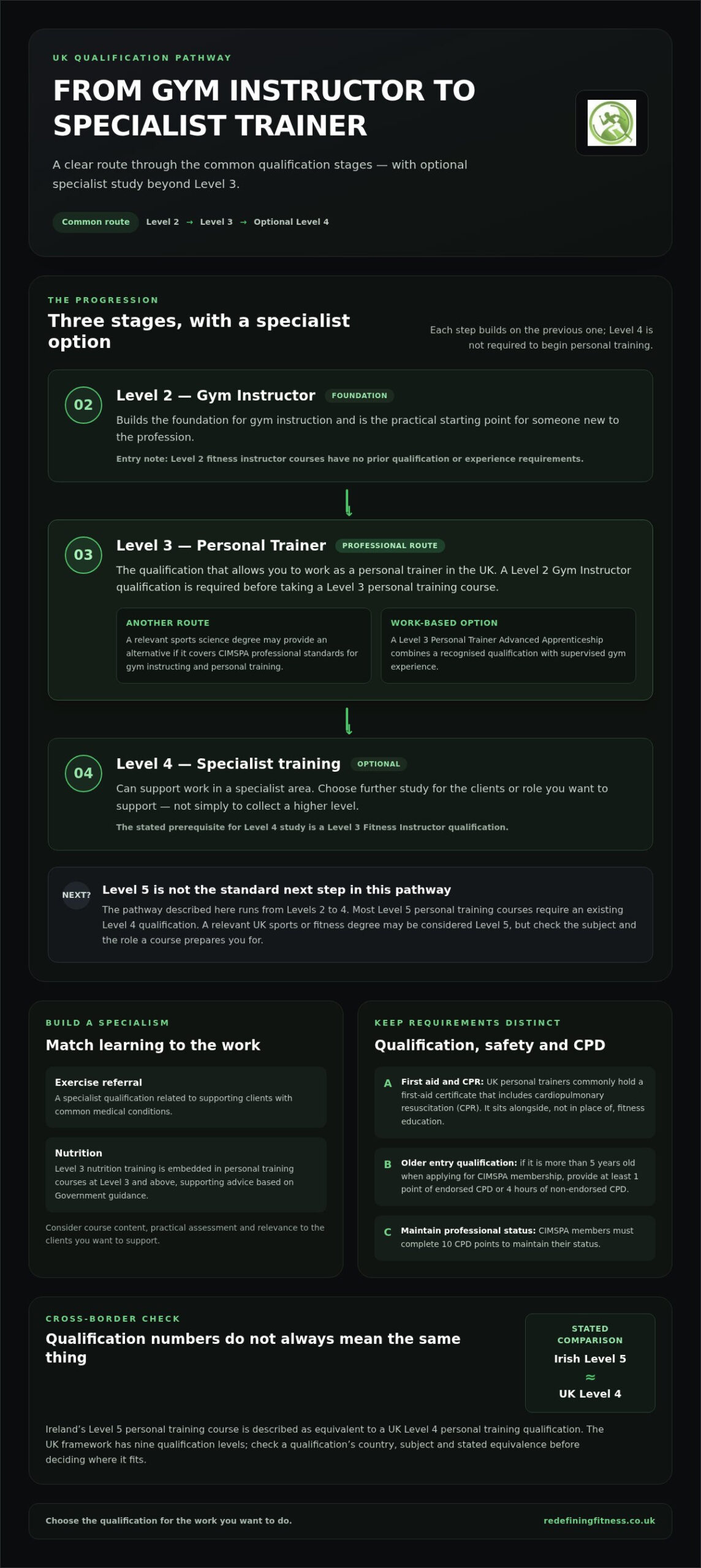
The common pathway has three stages: Level 2 fitness or gym instructor, Level 3 personal trainer, then optional Level 4 specialist training. Level 2 builds the foundation for gym instruction; Level 3 prepares you to work as a personal trainer. Level 4 is not a requirement to begin personal training, but it can support work in a specialist area.
Level 5 exists within the UK’s qualification levels, and a relevant sports or fitness degree may be considered a Level 5 qualification. That doesn’t make Level 5 the next standard step in the personal training pathway described here, which runs from Level 2 through Level 4. When comparing a course, look at its actual subject and the client group it prepares you to support.
Going beyond Level 3 is about depth, not collecting levels for appearance. For example, a trainer interested in supporting clients with specific health needs may pursue relevant specialist study. Choose based on the work you want to do, not simply the highest number printed on a certificate.
Career options after Level 3
With Level 3, you can work as a personal trainer. That qualification can support a move into personal training after the Level 2 gym instructor stage, or progression from gym instruction into a role focused on individual clients’ fitness goals. A Level 3 Personal Trainer Advanced Apprenticeship is another route, combining a recognised qualification with supervised gym experience.
Your next step depends on the clients and settings you want to work with. A general personal trainer course establishes a broad foundation; later study can build expertise in a particular area. Nutrition is another subject to understand: Level 3 nutrition training is embedded in personal training courses at Level 3 and above, and supports advice based on Government guidance.
Further study can help you develop a clearer professional focus. Exercise referral, for example, is a specialist qualification related to supporting clients with common medical conditions. A qualification alone does not define your full capabilities, so consider its content, practical assessment and relevance to the role you want.
UK and Irish qualification levels
Don’t compare qualification numbers across borders as if they mean the same thing. Ireland’s Level 5 personal training course is described as equivalent to a UK Level 4 personal training qualification. The number is different, but the stated comparison places those qualifications at equivalent levels.
The UK framework has nine qualification levels, while the personal training pathway discussed here uses Levels 2, 3 and 4. A relevant UK sports or fitness degree may be considered Level 5, but that doesn’t make it identical to an Irish Level 5 personal training course. Check the qualification’s country, subject and stated equivalence before deciding how it fits your career plan.
What are the entry requirements?
No degree is required on the standard route: you need Level 2 Gym Instructing before Level 3 Personal Training. A relevant sports science degree can provide another route if it covers CIMSPA professional standards.
Course entry requirements
Start with the qualification you already hold. Level 2 fitness instructor courses have no prior qualification or experience requirements, while a Level 2 gym instructor qualification is required before taking a Level 3 personal training course. That makes Level 2 the practical starting point for someone new to the profession.
Choose a course approved by CIMSPA, and compare its prerequisites with your existing education. A sports science degree that includes CIMSPA professional standards for gym instructing and personal training can allow graduates to join CIMSPA and work as personal trainers without a separate qualification. For Level 4 study, the stated prerequisite is a Level 3 Fitness Instructor qualification.
Planning further ahead? Most Level 5 personal training courses require an existing Level 4 qualification. The highest level isn’t automatically the right next step; match the prerequisite and subject to the role you want. A clear sequence prevents you enrolling on a course before you meet its entry conditions.
Evidence for older qualifications
An older certificate can still matter, but its date affects the evidence CIMSPA requires for membership. If your recognised entry qualification is more than 5 years old when you apply, CIMSPA requires additional CPD evidence: at least 1 point of endorsed CPD or 4 hours of non-endorsed CPD.
Keep your certificate and records of relevant learning together. For example, a trainer with an older entry qualification can use qualifying CPD evidence to support a membership application. CIMSPA professional status also requires members to complete 10 CPD points to maintain their status, so ongoing development isn’t a one-off administrative task.
Separate entry evidence from ongoing membership requirements. The older-qualification rule concerns evidence for an application; the 10-point requirement applies to maintaining professional status. Track both against your own qualification date and membership position.
First Aid and CPR Certification
Personal trainers in the UK commonly hold a first-aid certificate that includes cardiopulmonary resuscitation (CPR). Treat this as a practical part of your preparation, not a substitute for fitness education or a personal training qualification.
Look at whether a course includes first aid and CPR, and understand what its certificate covers. The qualification pathway described here sets out Level 2, Level 3 and further study; first-aid certification sits alongside that progression. Keeping these requirements distinct helps you plan your training without confusing a safety certificate with a personal training qualification.
Career opportunities and progression
A Level 3 qualification opens the route into personal training, while specialisms can shape your next move. As a self-employed trainer, assess public liability and professional indemnity cover against your activities, venue terms and client work.
Career options and earning potential
Career options include working as a personal trainer in a gym or building a self-employed practice. You can also pursue specialist work by studying subjects relevant to the clients you want to support. Each route has different practical demands: employed roles take place within a gym’s working environment, while self-employment involves organising your own business.
Those figures provide context, not a personal forecast: your role, client base and working arrangements affect your earnings. Treat business development as part of your career, not an optional extra. Build a clear programme, communicate its value and organise the practical work needed to deliver it.
If you plan to work for yourself, consider whether your insurance covers the sessions you deliver, where you coach and the advice you provide. Public liability and professional indemnity are types of cover to assess against your activities. The appropriate scope depends on your work and venue.
Assessment and career paths
Assessment gives you evidence of what you can apply, not just what you can recall. Level 4 personal trainer courses are typically assessed through online exams and practical assessments. The exam tests your understanding; practical assessment examines how you put that knowledge into action. Look for a programme whose assessment methods reflect the specialist direction you’re considering.
Use assessment feedback to identify your next development step. If you need to improve your practical coaching, look for opportunities to practise and refine your delivery. If you’re aiming for specialist work, choose further study that builds relevant knowledge. A qualification marks one stage in your career; applying what you learn helps shape your progress.
Tutor support and career guidance are also worth considering when comparing programmes. Find out how feedback is delivered, how you can get help with course content and whether career guidance covers practical decisions such as employed or self-employed work. These features can help you move from assessment into a working role with confidence.
Online, blended and in-person study options
The study format affects how you learn, but you still need to meet the required standard. Compare online, blended and in-person study by considering how each covers course content, practical coaching and assessment.
Online study lets you work through learning materials around your existing commitments. It can suit learners who manage their own study time and can revisit course content independently. But convenience alone does not build competence. When choosing personal trainer qualifications, consider how you’ll practise coaching skills and get feedback, especially if you study away from a training space.
In-person learning brings tutors, learners and practical activities together. You can practise demonstrations, observe movement and receive immediate feedback. For example, rehearse explaining an exercise, then adjust your instructions based on a tutor’s feedback. This format offers structure and direct interaction, but requires you to attend scheduled sessions in person.
Blended learning combines online study with face-to-face learning. You might complete theory remotely, then practise practical skills in workshops. This can make study more flexible without treating hands-on learning as an afterthought. Check how the course connects each part: online lessons should prepare you for practical sessions, where you can apply and refine what you’ve studied.
Assessment matters as much as delivery. Level 4 personal trainer courses are typically assessed using online exams and practical assessments. That example shows why a course can include digital learning without being purely online. Before choosing a format, map its learning activities against its assessments: identify what you’ll study remotely, what you’ll practise in person and how your practical ability will be assessed.
Use these questions to compare formats:
- How does the course develop practical coaching, not just subject knowledge?
- Where do you receive feedback on your instruction and exercise demonstrations?
- Which parts require in-person attendance, and how do they fit your schedule?
- How does the assessment reflect the work you want to do in the fitness sector?
No single format suits every learner. If you prefer fixed sessions and direct tutor contact, in-person study may suit you. If you work independently, online learning may offer more flexibility. If you want both, blended study combines remote theory with face-to-face practice. Judge the course structure, not just the label: choose a format that helps you engage with the material, practise your skills and demonstrate what you’ve learned.
Do personal trainers need first aid and CPR certification?
In the UK, personal trainers commonly hold a first-aid certificate that includes cardiopulmonary resuscitation (CPR). This is separate from a personal training qualification: one develops fitness instruction skills, while the other covers first-aid knowledge and CPR. Treat them as distinct parts of your professional preparation, rather than assuming one certificate covers both.
Plan for first aid and CPR alongside your fitness education. A CPR component covers cardiopulmonary resuscitation, not exercise programming or coaching technique. For example, personal training qualifications and first-aid certificates serve different purposes, even if you complete both during the same stage of your development.
Read the certificate description before choosing a course. Check that it explicitly includes first aid and CPR instead of relying on a broad course title. Then consider how the learning content relates to the environment where you expect to work. A trainer coaching in a gym, for example, should understand what their certificate covers in that setting. Focus on the stated learning outcomes, not assumptions based on the words “first aid”.
Keep your qualification records organised and distinct. Your personal training certificate demonstrates your fitness education; your first-aid certificate records relevant safety training. Clear records make it easier to show which training you’ve completed when applying for a role. Don’t describe a CPR certificate as a personal training qualification or treat a general fitness award as evidence of first-aid training.
Use this simple comparison when reviewing your training:
- Personal training qualification: develops knowledge and skills for fitness instruction and coaching.
- First-aid certificate: records first-aid learning, and commonly includes CPR for UK personal trainers.
- Course description: tells you whether first aid and CPR form part of the learning or require separate study.
Keep the distinction clear: a course in exercise technique does not automatically demonstrate first-aid competence, just as a first-aid certificate does not qualify you to design fitness programmes. When comparing course options, look for explicit wording about first aid and CPR, then plan your study around the qualifications your intended work requires. This gives you a more accurate picture of your preparation than relying on a course title alone.
Redefining Fitness: Level 2 & 3 Personal Training Course
Redefining Fitness offers Level 2 and Level 3 personal trainer qualifications through online and in-person study. If you’re ready to build the foundation for a fitness career, or progress from gym instruction into personal training, its course provides a relevant next step. Blended learning combines online study with face-to-face workshops, giving you practical opportunities alongside course content.
You can also develop skills in areas such as kettlebells, circuits and indoor cycling. Choose a pathway that matches the skills you want to build, rather than collecting qualifications without a clear purpose. Inclusive teaching and support for neurodivergent learners can make the learning experience more accessible.
Explore the course and visit Redefining Fitness to take your next step.
Make Your Next Move Count
Your next step can help shape the professional you want to become. Look beyond the certificate: consider the standards you want to bring to your work, the people you hope to support and the skills you want to keep building. Then take a considered step towards that goal.
Are you the fitness industry’s next best secret? Put your ambition into action and explore the Redefining Fitness prospectus. Find out whether its approach fits your goals, then choose your next step with purpose. Your career won’t be built by waiting for the perfect moment. Start with a clear decision, stay curious and keep raising your own standard.
Frequently Asked Questions
What’s the standard qualification path to become a Personal Trainer in the UK?
The standard pathway is gym-instruction study followed by personal training study. To plan your route, write down the qualification title, level and awarding organisation for each stage, then compare those details with the CIMSPA professional standards. Qualification levels have defined meanings, and the UK Government’s qualification-level guide helps explain how levels compare across different types of learning.
Can I begin personal training without prior fitness industry experience in the UK?
Yes, you can start without previous fitness-industry employment. Prior work experience and course entry requirements are different things, so identify what the course expects before applying. If you prefer learning alongside workplace experience, an apprenticeship is another route to explore. The UK Government apprenticeship guide explains how apprenticeships work, while the Skills England apprenticeship information covers occupational standards in England.
What Does CIMSPA Enhancing Status Mean for Your Qualification?
CIMSPA status is not the same as a qualification level. Read the exact status wording alongside your certificate title, awarding organisation and course content, rather than treating “Enhancing Status” as a substitute qualification. CIMSPA’s professional framework can help you understand how training relates to industry standards. If a course description uses this phrase, focus on what it says about the course and your professional recognition.
What qualifications do personal trainers need in the UK?
For a typical route, personal trainers hold qualifications in gym instruction and personal training. A relevant sports science degree may provide an alternative when it includes the required professional standards. Consider first aid separately: UK trainers commonly hold a certificate that includes CPR. For nutrition, the Association for Nutrition distinguishes general guidance from writing meal plans, which requires a degree in nutrition or dietetics.
What is a Level 2 fitness instructor qualification?
It is a vocational qualification at Level 2 focused on fitness or gym instruction. To understand what a particular certificate covers, compare its title and level with the regulated qualification record. The Ofqual register provides a way to search regulated qualifications in England. Scotland, Wales and Northern Ireland have their own qualification organisations, including Qualifications Scotland, Qualifications Wales and CCEA.
What is a Level 3 personal training qualification?
It is the qualification level associated with preparing to work as a personal trainer in the UK. Check the course syllabus for how it teaches exercise programming, client communication and safe practice, then see how nutrition is addressed. For wider context on healthy eating, the Government’s Eatwell Guide sets out public guidance. The NHS exercise information offers further public-facing context on physical activity.
Which UK awarding bodies offer recognised personal trainer qualifications?
No single awarding body name applies to every course. Check the exact qualification title and awarding organisation on the certificate, then search the relevant official register. In England, Ofqual regulates qualifications and publishes its register; CIMSPA is a professional body, not an awarding organisation. For courses elsewhere in the UK, check the relevant national qualifications framework and regulator before comparing awards.
What entry requirements are needed for personal training courses?
Entry requirements depend on the course level. Before applying, check the stated prerequisite, the evidence needed to show you meet it and whether your existing award matches the required qualification title. A sports science degree may offer an alternative route if it includes relevant CIMSPA professional standards. If you’re studying in London, include practical workshop attendance and travel in your course plan.