
Personal trainer exercise programming isn’t about copying a template or cramming in more exercises. It’s about making clear decisions that fit the person in front of you. A well-formatted plan is only useful if it still works when a client’s week changes.
If you’re unsure where assessment ends and programme design begins, or how to adjust a plan when a client’s goals, schedule or circumstances shift, start by looking at the decisions behind the plan. A programme should reflect your client’s needs and real life, not just what looks impressive on paper. Every exercise and progression choice should have a reason you can explain.
This guide sets out a repeatable, client-centred process, from turning assessment information into a practical plan to reviewing progress and adapting when things change. You’ll learn how to make programming a skill you develop through learning, practice and reflection, rather than a template you follow blindly. The result is more confidence in what you prescribe, why you prescribe it and what to change next.
What Personal Trainer Exercise Programming Actually Means
Programming organises training decisions around a client’s goals, needs and circumstances. It gives each choice a purpose, from selecting exercises to fitting sessions into the week. That’s the difference between coaching and handing someone a list of movements. An exercise plan also sits within a wider conversation about activity: guidance from the World Health Organization, the UK Chief Medical Officers and the NHS provides useful general context.
Good personal trainer exercise programming connects what a client wants to work towards with what they can realistically do. The plan should make sense to the client, fit their available time and resources, and remain open to review. A template can help organise ideas, but it can’t make decisions on the client’s behalf. Your reasoning must do that.
How Is a Training Programme Different from a Workout?
A workout is one training session. A programme is the wider plan that gives sessions a shared direction. Each workout has its own exercises and structure, but it also fits into an approach shaped by the client’s aims, experience and routine.
For example, a client might complete a session focused on strength, then follow it with another session that gives attention to a different training priority. The aim is to make the sessions coherent and relevant to that person, rather than to promise a particular result. A useful overview of exercise prescription introduces variables such as exercise type, duration, frequency and intensity. Further general guidance is available from NICE and the US Centers for Disease Control and Prevention. These resources provide context, not a ready-made client programme.
Exercise programming is the process of selecting and organising training choices into a purposeful, adaptable plan that reflects a client’s goals and circumstances.
Why Client Context Comes Before Exercise Choice
Don’t begin with your favourite exercises. Begin with the person. Their goals matter, but so do their training experience, preferences, access to equipment and weekly availability. These details shape what a plan can reasonably ask of them and whether it’s practical to follow.
A demanding plan may look impressive on paper and still be the wrong fit. A client with limited time or equipment may struggle to complete it. Someone who dislikes particular activities may find it harder to stay engaged. That doesn’t mean abandoning the goal. It means making considered choices that respect the client’s reality.
Templates fall short when coaches treat them as finished answers. Use a structure if it helps, then adapt it to the individual. Resources such as the American College of Sports Medicine’s physical activity guidance can support your wider understanding, whilst professional resources from CIMSPA and UK Coaching offer context for developing coaching practice. An effective plan remains understandable, deliverable and open to review. If it can’t work in the client’s real life, it needs more thought.
How to Turn Client Goals into a Programme Brief
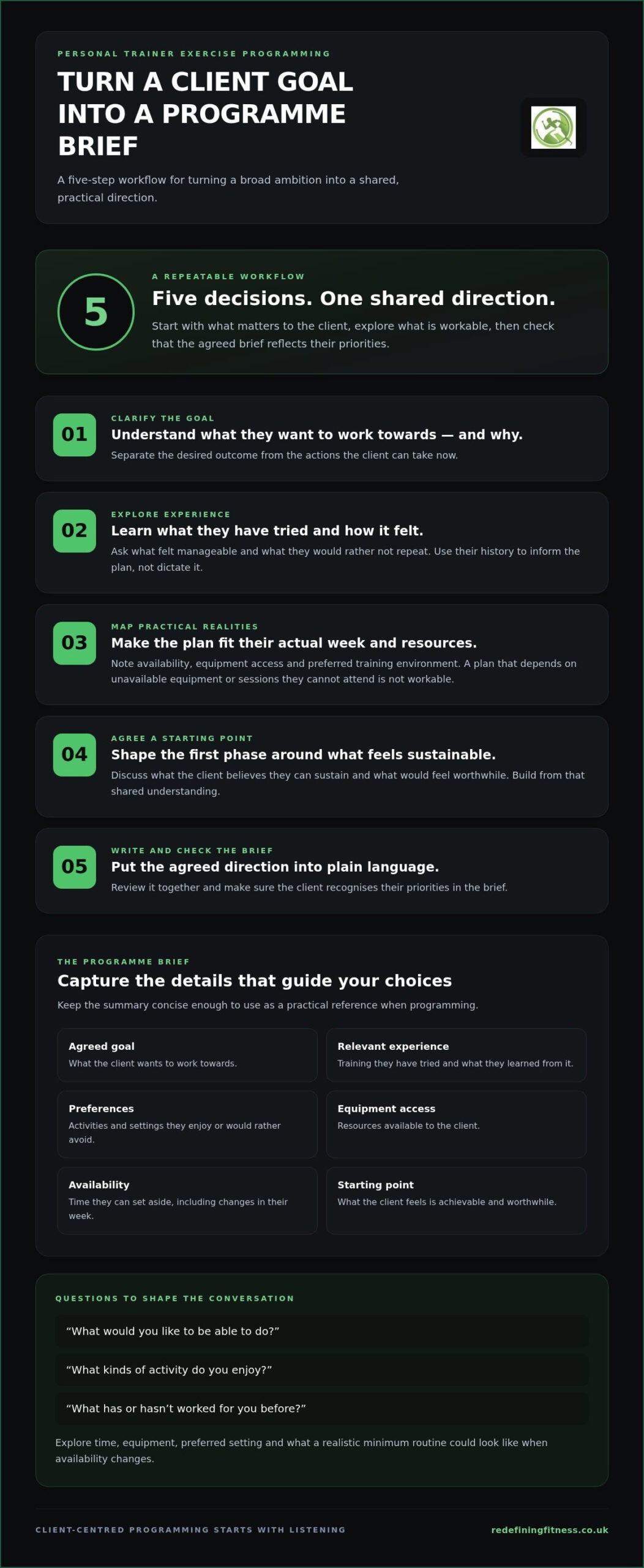
A goal is a starting point, not a programme. Your job is to translate what the client wants into a plan that respects their routine, preferences and resources. That takes conversation and judgement, not a screening form treated as a box-ticking exercise. A clear brief gives you a practical reference for the decisions that follow.
Use this workflow to turn a broad ambition into a shared, usable direction:
- Clarify the goal. Ask what the client wants to work towards and why it matters to them. Separate their desired outcome from the actions they can take now.
- Explore their experience. Find out what training they’ve tried, what felt manageable and what they’d rather not repeat. Their history can reveal useful preferences, but it shouldn’t dictate the whole plan.
- Map practical realities. Note their weekly availability, access to equipment and preferred training environment. A plan built around equipment they can’t use or sessions they can’t attend isn’t workable.
- Agree a realistic starting point. Discuss what the client believes they can sustain and what would feel worthwhile. Shape the first phase around that shared understanding.
- Write the brief and check it together. Record the agreed direction in plain language, then make sure the client recognises their priorities in it.
What Should a Personal Trainer Ask Before Programming?
Ask open questions that invite a real answer: “What would you like to be able to do?”, “What kinds of activity do you enjoy?” and “What has or hasn’t worked for you before?” Then explore practical barriers without judgement. How much time can they set aside? What equipment can they use? Would they rather train at home, outdoors or in another setting?
Record the client’s own view of what feels achievable and worthwhile. If their availability changes from week to week, ask what a realistic minimum routine looks like and what they could do when more time is available. That conversation creates a stronger starting point than assuming their priorities or preferences for them.
How to Write a Clear Programme Brief
Keep the brief concise enough to guide decisions. Summarise the agreed goal, relevant experience, preferences, access to equipment, availability and starting point. For example: “Build a consistent strength-training routine using available home equipment, with sessions that fit around a changing work week.” That’s more useful than a vague instruction to “get fitter”.
Be clear about what sits within your competence. The brief should guide appropriate exercise programming, not make claims beyond your role. Seek relevant support when a client’s needs call for expertise outside your scope. The Physical Activity Guidelines for Americans can offer a reference point for general activity guidance, though it’s a US publication rather than UK-specific guidance.
Building this skill takes sound foundations and practice. The Level 2 and 3 personal training diploma guide outlines a qualification pathway for developing core coaching knowledge. Explore personal training qualifications as a next step in building your professional foundations.
How to Choose Exercises and Structure a Client Programme
The programme brief now has to become a set of practical decisions: which exercises serve the goal, how sessions fit together and how much work the client can reasonably take on. Strong programming doesn’t reward complexity for its own sake. It rewards choices you can explain and adapt.
Compare possible exercises against the client’s purpose and circumstances before settling on one. A useful comparison might look like this:
| Choice | Goal relevance | Experience and access | Client preference |
|---|---|---|---|
| Body-weight sit-to-stand | Can practise a lower-body movement pattern | Needs little equipment and can be adjusted | May feel familiar and approachable |
| Loaded squat variation | Can train a similar broad movement pattern | Depends on suitable equipment and familiarity | May suit a client who enjoys using weights |
How Do You Select Exercises for a Client?
Choose for purpose, not performance theatre. Consider whether an exercise supports the agreed goal, matches the client’s experience, works with their available equipment and feels acceptable to them. A coach’s ability to perform a demanding variation is irrelevant if that movement doesn’t suit the client.
Keep alternatives ready. If equipment or the training environment changes, select another movement that preserves the intended purpose as closely as possible. For example, if a client’s usual equipment isn’t available, consider a suitable variation that still lets them practise the movement pattern the session is built around.
Use FITT-VP to organise the main programme variables: frequency is how often training happens; intensity is how demanding it is; time is its duration; and type is the activity or exercise. Volume describes the total amount of work, whilst progression describes how the training develops over time. It’s a framework for clearer decisions, not a formula that makes them for you.
How Should You Organise a Training Session?
Give the session a clear flow, but don’t force every client into the same sequence. You might prepare for the main work, prioritise the exercises most relevant to the brief, add supporting movements, then finish in a way that fits the session’s purpose. Available time and client priorities determine how much fits. If time is tight, protect the key work rather than rushing through a long exercise list.
Illustrative example, not a universal prescription: A client who wants to build confidence with basic strength training and has access to a few pieces of home equipment might practise familiar movements first, then add a manageable supporting exercise. If the equipment isn’t available that day, choose a suitable alternative and keep the session’s intent intact.
Accessibility matters in how you coach, explain and adapt, not just in the exercises you select. An inclusive personal training course guide offers context for individualised learning, a useful reminder that clear communication and flexible support strengthen coaching practice.
How to Progress and Adapt Personal Training Programmes
A programme isn’t finished when you write it. Its quality shows in how you respond to what happens next. Progression doesn’t mean adding weight or work every session, and adaptation isn’t an admission that your original plan failed. Both depend on observing the client and making a reasoned decision.
Use a repeatable review cycle:
- Deliver: Coach the plan as intended, making appropriate adjustments in the session when needed.
- Observe: Notice attendance, exercise performance, confidence and the client’s response to the work.
- Review: Compare what happened with the plan, then invite the client’s perspective.
- Decide: Maintain, progress or adapt a training demand in light of the evidence.
- Document: Record what changed and why, so the next decision has a clear rationale.
How Do Personal Trainers Progress a Client’s Programme?
Progressive overload means gradually changing a suitable training demand as the client becomes ready. You might adjust resistance, repetitions, duration, exercise complexity or another relevant variable, but only when that choice fits the goal and the client’s current capacity. There’s no rule that demands an increase every session. Performance can vary, and steady practice may be the right call.
Progression is a reasoned adjustment to training in response to a client’s performance, readiness and current circumstances.
When Should a Personal Trainer Change a Programme?
Review the plan when the client’s goals, availability or preferences shift, or when their observed performance suggests the current approach needs reconsidering. A missed target is information, not a verdict. Explore what affected the session: did the client have less time, find the task unfamiliar, or feel that the work didn’t suit them? Adapt without blame or punishment.
Change exercises for a reason, not simply to make the programme look fresh. Familiar movements can remain useful; novelty is not the same as progress. If concerns arise that sit beyond your competence, stay within your professional scope and refer the client to an appropriate source of support. For signs that a coach may be crossing boundaries or compromising client wellbeing, see these personal trainer red flags.
Keep review practical. Ask the client what felt manageable, what challenged them and what they’d change. Consider that feedback alongside attendance and performance rather than relying on one session or one measure alone. If they missed a planned session, find out whether the barrier was a temporary disruption or a sign that the weekly plan needs to fit their routine better. Then record the decision. A short note on why you kept, changed or reduced a demand makes your next review more purposeful.
That’s the craft: not forcing a client through a fixed script, but making the next decision clearer than the last. Develop that judgement through structured learning and reflective practice with personal training qualifications.
Build Your Exercise Programming Skills as a Personal Trainer
A template can give you a starting point, but it can’t replace professional judgement. Strong programming grows through study, coached practice and reflective review. Learn the principles, apply them and examine the decisions you make. That’s how personal trainer exercise programming becomes a skill, not a formula you follow without thinking.
What Skills Should an Aspiring Personal Trainer Develop?
Build the ability to explain your choices in plain language. A client should understand why you’ve selected an exercise, how it relates to their priorities and what might lead you to adapt it. Clear explanations help clients take an active role in training. They also challenge you to make choices you can justify. Practise adapting your plans rather than clinging to a session because it’s written down. Listen to feedback, consider what happened and reflect on what you’d change next time. That’s how knowledge becomes sound coaching judgement.
What Is the Next Step Towards Becoming a Personal Trainer?
If you’re building towards a career in fitness, Level 2 and Level 3 personal trainer qualifications offer a relevant learning pathway. Structured study helps you develop foundational knowledge, whilst coached practice gives you the chance to apply and review what you learn. Redefining Fitness Ltd delivers learning online and in person, with face-to-face workshops and learner support. Its inclusive teaching includes support for neurodivergent learners. Different people bring different strengths and learning needs. The aim isn’t to hand you a script for every client, but to help you build the knowledge and confidence to make thoughtful choices and keep learning from practice.
Explore the Level 2 and Level 3 pathway through the course prospectus, and take the next step towards developing your coaching skills.
Are you the fitness industry’s next best secret? Find your next step in the personal training course prospectus.
Take Your Coaching Craft Further
Your next step isn’t to chase a perfect programme. It’s to become the coach who can make sound decisions when a client’s needs, confidence or circumstances change. That judgement grows through learning, practice and the willingness to question your own choices. Exercise programming is a professional craft, and you can keep sharpening it throughout your career.
If you’re ready to build that foundation, explore training with a multi-award-winning organisation that supports aspiring fitness professionals through online and in-person learning, face-to-face workshops and learner support. Inclusive teaching matters, including support for neurodivergent learners, because capable coaches come from different backgrounds and learn in different ways.
Choose a pathway that helps you develop knowledge you can put into practice, not just a set of answers to memorise. Take a closer look at the personal training course options and decide what your next move could be.
Are you the fitness industry’s next best secret? Explore the personal training course prospectus and take your first step towards becoming a thoughtful, adaptable coach.
Frequently Asked Questions
How Do Personal Trainers Create an Exercise Programme?
Personal trainers create a programme by understanding what the client wants to achieve and the circumstances shaping their training. They then choose relevant exercises, arrange them into sessions and review how the client responds. Effective personal trainer exercise programming doesn’t mean copying a plan and hoping it fits. For example, a client with limited home equipment needs exercise choices that work with what they can actually access and use.
What Should a Personal Trainer Consider When Designing a Programme?
Consider the client’s goals, experience, preferences, available time, equipment access and response to training. These details inform the plan; they don’t act as a generic checklist that dictates one answer. A client whose week includes a long London commute may have different practical options from someone with predictable free evenings. Use context to guide exercise choice and session structure, then pay attention to how the client experiences the plan.
How Often Should a Personal Trainer Change a Client’s Programme?
There’s no universal calendar rule for changing a programme. Review the client’s progress, circumstances and feedback, then decide whether a change has a clear purpose. If their routine shifts or an exercise no longer fits, adapt the plan. Don’t swap movements just to make training look new: a familiar exercise can remain useful when it still serves the client’s needs and suits their current situation.
What Is Progressive Overload in Personal Training?
Progressive overload is a gradual, considered increase or adjustment in training demand over time when appropriate. The change might involve more than adding weight; the coach should consider the demands that suit the exercise and client. Readiness matters. If a client is struggling to regain confidence with a movement or hasn’t yet adapted to the current workload, automatically increasing the load each session isn’t thoughtful progression.
Can a Personal Trainer Use the Same Programme for Every Client?
A shared template can help organise coaching, but it shouldn’t dictate every client’s plan. Two people with a similar goal may differ in training experience, preferred activities, equipment and weekly availability. A copied programme can therefore demand movements or a routine that doesn’t suit one of them. Keep useful structure where it helps, then tailor relevant choices rather than assuming every client needs an entirely different system.
What Is the Difference Between a Workout and a Training Programme?
A workout is one training session; a programme is the wider plan connecting sessions to a client’s goal and context. For example, a client might have one session centred on practising strength exercises and another with a different emphasis, both serving a shared direction. The programme gives each workout a place in the broader plan, rather than treating every session as an unrelated list of activities.
Do Personal Trainers Need to Use Periodisation for Every Client?
No. Periodisation is one way to organise training over time, not a requirement to make every programme elaborate. The appropriate level of structure depends on the client and their goal. A straightforward plan with clear priorities may be more useful than a complex model that adds detail without helping the coach make better decisions. Choose structure because it serves the plan, not because sophistication looks impressive.
Are you the fitness industry’s next best secret? Explore the personal training course prospectus and build the knowledge to programme with confidence.