Five Uncommon Exercises That Give You Great Bang For Your Buck
Exercise selection is all about return on investment and in this article we have given you 5 uncommon exercises that give you great bang for your buck. For most people, time is one of the biggest constraints when it comes to training, so the goal should be to use that limited time as effectively as possible. Choosing exercises that train multiple muscles, joints and physical qualities at the same time can make a programme considerably more efficient.
This does not mean every exercise needs to be a complicated compound movement. Isolation exercises absolutely have their place, particularly when you need to target a specific muscle, address a weakness or add training volume without creating unnecessary fatigue. The point is that your programme should be built around exercises that actually contribute towards the outcome you are trying to achieve.
Compound exercises are particularly useful because they involve movement at more than one joint. A lunge, for example, involves movement at the ankle, knee and hip, whereas a biceps curl primarily involves movement at the elbow. The curl is not a bad exercise, but if you have only 45 minutes to train, the lunge gives you considerably more to work with.
There are hundreds of exercises that could make a case for inclusion, but some offer a particularly interesting combination of strength, mobility, stability, coordination and muscular development. Here are five uncommon exercises that can give you serious bang for your buck.
https://www.zing.coach/fitness-library/the-front-squat-hand-position-basics-optimize-form
Whilst there are many exercises that give you fantastic value, we have narrowed it down to these five so here are our 5 exercises that give you great bang for your buck:
1. Front Squat
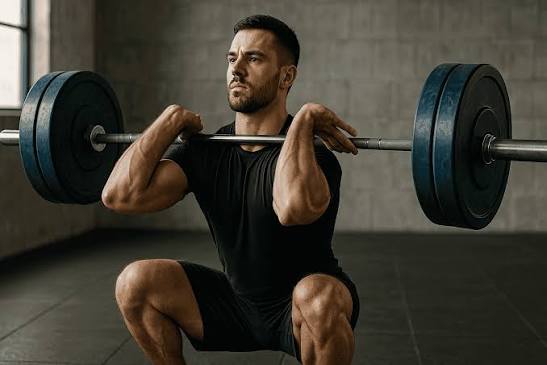
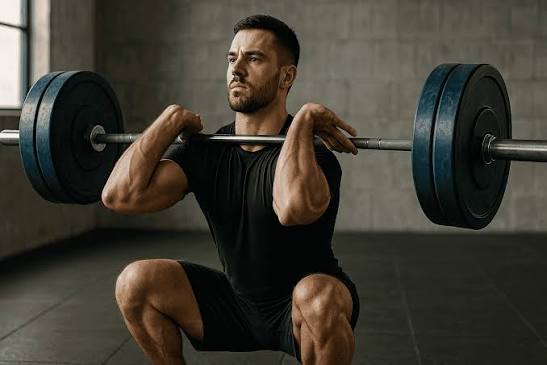
The traditional back squat is an excellent staple for many training programmes, but the front squat is often overlooked despite offering a number of advantages. With the bar positioned across the front of the shoulders, the lifter has to maintain a more upright torso throughout the movement while producing substantial force through the legs.
The front-loaded position places considerable demand on the quadriceps while also requiring the trunk to remain stable as the body moves through the squat. CrossFit’s foundational movement guidance also highlights the demands placed on the front-rack position, including the wrist and shoulder mobility required to maintain it.
The front squat is therefore more than simply another way of squatting. It combines lower-body strength with trunk stability and an upper-body positioning challenge, meaning one exercise can address several useful qualities at once.
Why Is The Front Squat Such A Good Exercise?
One of the biggest advantages of the front squat is the amount of information it gives you as a coach. If someone cannot maintain their position, the bar will usually tell you immediately. Dropping the elbows, losing the torso position or allowing the bar to move forwards can all indicate that the athlete needs to reduce the load or address a limitation before progressing.
The exercise can also be useful for people who struggle to maintain an upright position during a back squat. It does not magically correct their mechanics, but the front-loaded position encourages a different movement strategy and can be an excellent teaching tool.
It is also worth remembering that a front squat is not automatically superior to a back squat. The best exercise depends on the individual, their goals and what you are trying to achieve within the programme.
How To Perform A Front Squat
Place the bar across the front of the shoulders in a stable front-rack position, keeping the elbows high. Brace the trunk before beginning the descent and maintain control as you squat between the hips. The objective is not simply to reach the deepest position possible. You should descend to the greatest range you can control while maintaining the desired technique and then drive through the floor to return to standing.
2. Pendlay Row
The Pendlay row is a variation of the bent-over row that deserves more attention than it generally receives. The biggest difference is that the bar returns to the floor between every repetition, meaning each repetition starts from a dead stop rather than with the bar hanging continuously beneath you.
That changes the exercise considerably. Instead of gradually losing your position as fatigue builds, the floor provides a natural reset point. You can establish your hip hinge, brace your trunk and produce the next repetition from a consistent starting position.
The movement develops the upper back, lats, shoulders and arms while also demanding considerable control from the trunk and posterior chain. Catalyst Athletics describes the Pendlay row as a back-strength exercise that can also contribute to postural strength and shoulder stability.
Watch A Pendlay Row Technique Demonstration
Why Use A Pendlay Row Instead Of A Standard Row?
One of the problems with ordinary bent-over rows is that technique can deteriorate as the set progresses. The torso begins to rise, the range of motion gets shorter and momentum starts doing more of the work.
The Pendlay row does not eliminate those problems automatically, but the dead stop gives you an opportunity to reset every repetition. That makes it particularly useful for someone who needs to improve their ability to produce force from a stable hip-hinge position.
It also makes the exercise relatively easy to coach. If the athlete cannot maintain the required torso position, the solution is usually straightforward: reduce the weight, improve the setup and rebuild the movement.
How To Perform A Pendlay Row
Start with the bar on the floor and establish a strong hip-hinge position with the torso approximately parallel to the ground. Brace your trunk, pull the bar towards the lower chest or upper abdomen and then return it to the floor. Allow the bar to settle before beginning the next repetition. The reset is an important part of the exercise rather than wasted time.
3. Split Stance Romanian Deadlift
The Romanian deadlift is already an excellent exercise for developing the posterior chain. The split stance variation adds a unilateral element without requiring the same balance demands as a completely unsupported single-leg Romanian deadlift.
The movement places considerable emphasis on the hamstrings and glutes while requiring the athlete to control the pelvis and maintain a strong hip-hinge position. Because one leg is positioned in front of the other, it also gives you an opportunity to observe how effectively each side contributes to the movement.
This can make the exercise particularly useful in programmes where you want to develop posterior-chain strength while also introducing more unilateral work. The Collegiate Strength and Conditioning Coaches Association identifies the hamstrings, glutes and erector spinae among the primary muscles involved in the Romanian deadlift.
CSCCa Romanian Deadlift Exercise Guide
Why Use A Split Stance Romanian Deadlift?
The split stance changes the balance of the exercise without completely removing the stability provided by the second foot. That makes it a useful progression between bilateral and single-leg movements.
It can also expose differences between the two sides. If one leg consistently contributes more, if the pelvis rotates or if the athlete loses control on one side, those differences become easier to identify.
This does not mean that unilateral training automatically fixes every imbalance. Exercise selection should still be based on the individual and the outcome you are trying to achieve.
How To Perform A Split Stance Romanian Deadlift
Place one foot slightly in front of the other and establish a stable position before beginning the hip hinge. Keep the majority of your pressure through the front leg while maintaining enough contact through the rear foot to help with balance. Push the hips backwards while keeping the weight close to the body. Lower only as far as you can maintain control of the pelvis and spine, then drive the hips forwards to return to the starting position.
4. Towel Grip Pull-Ups
Pull-ups are already one of the most effective upper-body compound exercises available, but changing the grip can completely alter the challenge. The towel grip pull-up is a simple variation that requires you to grip a towel rather than a conventional pull-up bar.
The result is a much greater demand on the hands and forearms while you still have to perform the fundamental pulling action of a pull-up. T Nation’s exercise guide describes the towel pull-up as a variation that places substantial demands on grip and forearm strength.
Why Are Towel Grip Pull-Ups Worth Doing?
Grip strength can become a limiting factor across a surprisingly large number of exercises. Rows, deadlifts, carries and other pulling movements all require the hands to maintain control of an external load.
Someone can therefore have sufficient strength in their back and legs to perform an exercise but still be limited by their ability to hold onto the equipment. Training the grip directly can provide a useful return because it addresses a quality that contributes to several other movements.
The towel pull-up also demonstrates an important principle in exercise selection: you do not always need a completely new exercise to create a different training effect. Changing the grip, stability, range of motion or loading can make a familiar movement considerably more demanding.
How To Perform A Towel Grip Pull-Up
Place a strong towel over the pull-up bar and grip both ends securely. Before attempting a full repetition, make sure the towel and bar are stable and that you can safely support your bodyweight.
From the hanging position, pull your body upwards while maintaining control and avoiding excessive swinging. Because grip fatigue can arrive quickly, lower repetitions and controlled technique are often more useful than trying to accumulate large numbers of repetitions. Isometric holds and controlled eccentric repetitions can also be used if someone is not yet strong enough to perform full towel pull-ups.
5. Overhead Squat
The overhead squat is arguably the most demanding exercise on this list. It combines a deep squat with an overhead position, requiring the lifter to coordinate movement across the ankles, knees, hips, spine and shoulders while maintaining control of the bar.
The exercise requires mobility, stability, strength and coordination simultaneously. The lifter must maintain an active overhead position while descending and ascending through the squat, making it considerably more technically demanding than a conventional squat.
CrossFit includes the overhead squat within its foundational movement series and describes it as a progression from the air squat and front squat.
CrossFit’s Overhead Squat Guide
Why Does The Overhead Squat Give You So Much Bang For Your Buck?
Very few resistance exercises require so many parts of the body to work together under load. The legs have to produce force, the trunk has to remain stable and the shoulders have to maintain the bar in a strong overhead position while the athlete moves through a large range of motion.
That makes the overhead squat particularly valuable as a movement assessment and coaching exercise. It can reveal limitations that may not be obvious during a simpler squat pattern.
However, this is also why the overhead squat should not simply be thrown into every training programme. If someone lacks the mobility or control required to perform it correctly, adding more weight is not going to solve the problem.
The movement should be appropriately scaled. A dowel, PVC pipe or empty bar can be used to establish the movement before meaningful external loading is introduced.
How To Perform An Overhead Squat
Begin with the bar securely overhead and establish an active shoulder position. Brace the trunk, keep the bar balanced over the middle of the foot and descend into the squat while maintaining control. If the bar moves forwards, the torso collapses or the required position cannot be maintained, reduce the load or regress the movement. The objective is to develop the movement rather than simply complete the repetition.
How Do You Choose Exercises That Give You The Best Return?
The concept of bang for your buck should not be interpreted as meaning that every exercise needs to train as many muscles as possible. The best exercise is the one that gives you the appropriate training stimulus for the person, the goal and the circumstances.
A competitive powerlifter, a recreational runner and a new gym member may have completely different requirements despite all having the same amount of time available to train. Their programmes should therefore look different.
This is where good programming becomes more important than simply having a large exercise library. A trainer needs to understand what the client is trying to achieve, identify the qualities that need to be developed and then select movements that provide an appropriate stimulus without creating unnecessary fatigue or technical complexity.
The American College of Sports Medicine’s current resistance-training guidance similarly emphasises individualisation and matching training variables to the desired outcome rather than relying on a single universal prescription.
ACSM: Resistance Training Position Stand
Does More Complicated Mean More Effective?
Not necessarily. One of the biggest mistakes in exercise selection is assuming that an unusual or technically difficult exercise must provide a better training effect.
The overhead squat is considerably more complicated than a goblet squat, but that does not mean it is the better choice for every client. A towel pull-up is more difficult than a conventional pull-up, but if someone’s primary goal is simply to build their lats and they cannot maintain a safe grip, the additional complexity may not provide any meaningful benefit.
Good programming is about selecting the simplest exercise that produces the desired result and then progressing it when the client has earned that progression.
That is why the five exercises in this article should be viewed as tools rather than mandatory inclusions. Their value comes from what they can contribute to a programme, not from how impressive they look on Instagram.
How Can Personal Trainers Use These Exercises With Clients?
A personal trainer should never select an exercise simply because it is interesting. The first question should always be what the client actually needs.
A client who needs more quadriceps development and struggles to maintain an upright squat might benefit from front-squat work. Someone who needs stronger horizontal pulling and can establish a good hip hinge could use the Pendlay row. A client who needs more unilateral posterior-chain work may benefit from a split stance Romanian deadlift, while someone whose grip is limiting their pulling performance could use towel-grip work.
The overhead squat is different because its technical demands make it more appropriate for clients who have already developed sufficient movement capacity. It can be an excellent exercise for developing coordination and control, but there is little value in forcing it on somebody who cannot yet perform the underlying movement patterns.
This is ultimately what makes exercise selection a professional skill. The exercise itself is only one part of the equation. The trainer needs to understand the client, the objective, the movement and the appropriate progression.
Final Thoughts: 5 Uncommon Exercises That Give You Great Bang For Your Buck
Good exercise selection is about getting more from the time you have available. That does not mean choosing the hardest exercises or attempting to cram as many movements as possible into a single workout. It means selecting exercises that contribute meaningfully towards the goal and using them intelligently.
The front squat, Pendlay row, split stance Romanian deadlift, towel grip pull-up and overhead squat are five excellent examples. Each provides a combination of physical qualities that makes it more interesting than simply adding another isolation exercise to a programme.
More importantly, they demonstrate why understanding exercise selection matters. A good personal trainer does not simply know what exercises exist. They understand why an exercise has been selected, who it is appropriate for, how to coach it and when another option would produce a better result.
That knowledge is what turns a collection of exercises into a properly designed training programme.
Go From Zero To Hero And Become The Industry’s Next Best Kept Secret
The fitness industry does not need another personal trainer who can copy a workout from Instagram. It needs coaches who understand exercise, know how to programme intelligently and can deliver results that make clients want to tell everyone about them.
That starts with the right education. At Redefining Fitness, we want to take aspiring trainers from zero to hero by giving them the knowledge, practical skills and confidence to become genuinely exceptional fitness professionals. You will learn far more than a list of exercises. You will learn how to think like a coach, make better decisions and build the foundations of a successful career.
Your first qualification is only the beginning. The trainers who continue developing their knowledge, broaden their qualifications and become genuinely great at what they do are the ones who stand out in an increasingly crowded industry.
Go from zero to hero. Become the industry’s next best kept secret.